Ice Thickness Calculator
Estimate gravel or stone depth volume for RV pads, campsites, fire rings, and drainage zones with fast imperial and metric outputs.
📌Use a Real Campsite Preset
⚙Project Inputs
📊Calculated Results
🧱Material Weight Spec Grid
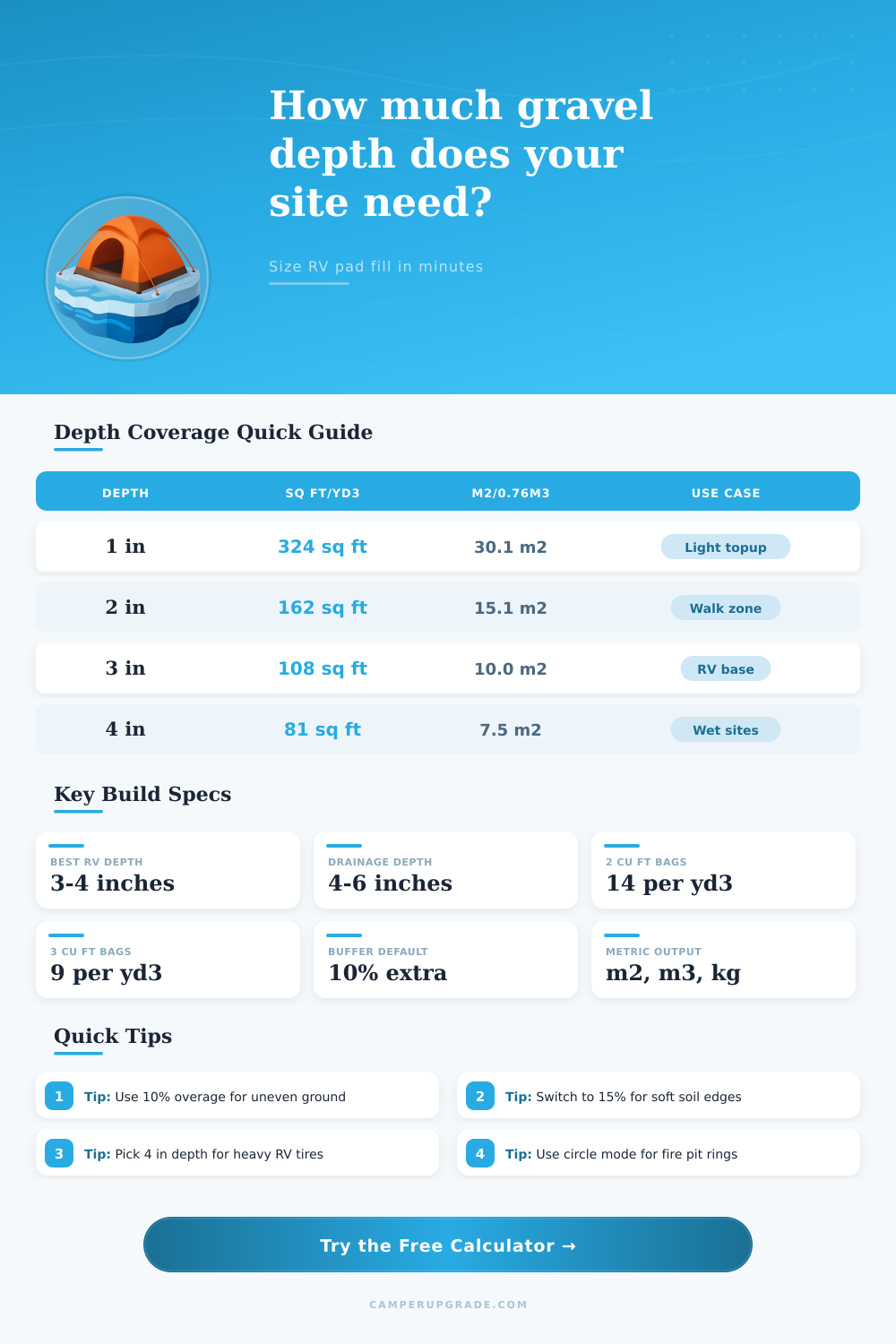
📋Coverage by Depth (per 1 yd³)
| Depth | Coverage (sq ft) | Coverage (m² per 0.76 m³) | Typical RV Use |
|---|---|---|---|
| 1 in | 324 | 30.1 | Leveling top-up |
| 2 in | 162 | 15.1 | Walkways and tent edge |
| 3 in | 108 | 10.0 | Standard campsite base |
| 4 in | 81 | 7.5 | Heavy RV parking pad |
| 6 in | 54 | 5.0 | Wet or soft subgrade |
📦Bags vs Bulk Conversion
| Supply Type | Volume Each | Units per yd³ | Coverage at 3 in |
|---|---|---|---|
| Bulk delivery | 1 yd³ | 1.0 | 108 sq ft |
| Large bag | 3 cu ft | 9 bags | 12 sq ft per bag |
| Standard bag | 2 cu ft | 14 bags | 8 sq ft per bag |
| Small bag | 1.5 cu ft | 18 bags | 6 sq ft per bag |
⛺Common RV Project Sizes at 3 in Depth
| Project | Area (sq ft) | Volume (yd³) | 2 cu ft Bags |
|---|---|---|---|
| Travel trailer pad 12×35 | 420 | 3.89 | 53 |
| Class A pad 14×45 | 630 | 5.83 | 79 |
| Awning zone 8×20 | 160 | 1.48 | 20 |
| Fire ring circle 14 ft | 154 | 1.43 | 20 |
| Picnic area 15×15 | 225 | 2.08 | 29 |
📏Compaction and Buffer Guide
| Ground Condition | Suggested Buffer | Depth Adjustment | Use This When |
|---|---|---|---|
| Firm gravel base | 5% | None | Top-up only |
| Average mixed soil | 10% | None | Most RV pads |
| Soft shoulder edges | 15% | +1 in | Sites with rut risk |
| Wet clay or low spot | 20% | +2 in | Drainage build-up |
Reference conversions used: 1 m = 3.28084 ft, 1 in = 2.54 cm, 1 yd³ = 0.764555 m³, 1 lb = 0.453592 kg.
The thickness of ice is important when you do winter activities, like fishing on ice or camping on it. Flows, snow cover, temperature, springs and even sharp fish affect the safety of the ice. Because no authority controls every lake, the safety stays your own task
To check the main thing, that is the thickness of ice, you can make holes with an ice drill. Observe whether it is clear (sometimes called black ice) or white because of air bubbles (called snow ice), and measure both. Note also the frequency of cracks.
How to Check Ice Thickness and Stay Safe
Tape measure works for precise reading: put it in the hole, hook the bottom edge of the ice, and later read. Also ice skimmer with marks on the handle works well. Do not find the thickness of breach by means of chisel or drill.
Thick ice sounds like solid thunk, while hollow bonk shows thin. Then check with drill, spud or ice chisel, and do not assume same through the whole surface. Some clear ice commonly shows its thickness before you walk on it.
Four inches of clear ice suffice for walking, skating and fishing on ice. For snow vehicles or ATVs minimum is seven inches, ideal is eight. Average passenger car requires eight inches on lake, but twelve are safer.
For van or alike heavy car minimum is twelve inches, better fifteen.
Fishing RV on ice weigh around 2500 to 5500 pounds, so it requires 8 to 15 inches of ice. When you put vehicle on frozen water for fishing, the thickness stays the most critical safety element.
On lake or pond suffices four to six inches. On river or brook better six to eight. Because flow does uneven thickness, contact outfitter for safe way.
Also springs create danger. Lake fed by spring can have from ten to only three inches of ice above active spring.
It can be one degree under zero or thirty, and that causes big diffrence in thickness. Snow covering also alters lot. Ice does not change dramatically day to day, so info of today help for tomorrow, if temperatures did not surpass zero a lot.
Heavy camping gear with heater on ice requires more attention than simply fishing. For winter camping best install when ice already forms but before snowcovers it well.