Ice Skate Blade Hollow Calculator
Estimate a practical radius of hollow using skater weight, skate type, blade width, ice condition, and desired grip-to-glide feel.
Blade Hollow Results
| Radius of hollow | Depth on 0.115 in blade | Grip feel | Typical use |
|---|---|---|---|
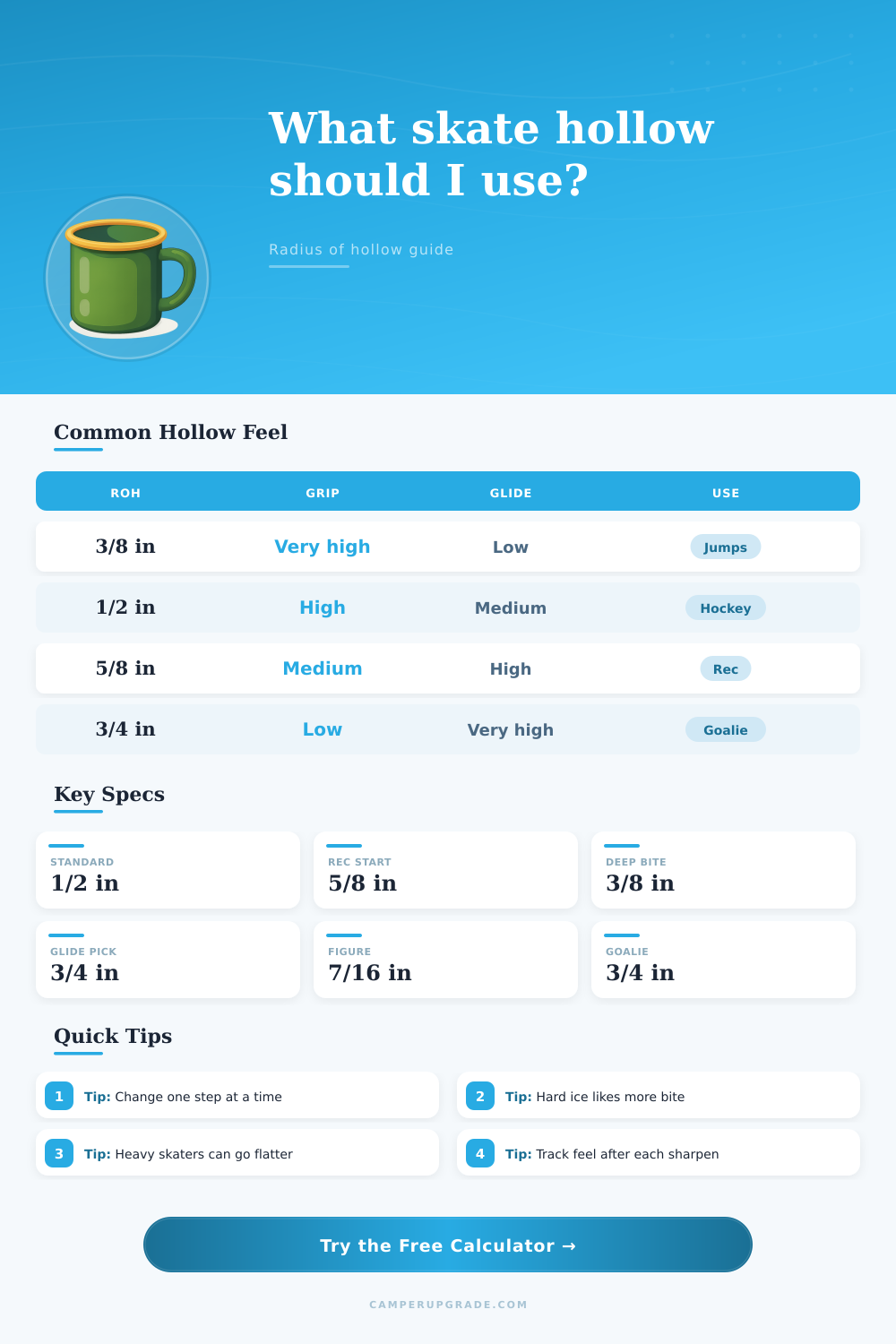
| 3/8 in | 0.00443 in / 113 microns | Very high bite, lower glide | Light hockey players, hard ice, figure jump bite |
| 7/16 in | 0.00380 in / 97 microns | High bite | Figure freestyle, aggressive hockey edges |
| 1/2 in | 0.00332 in / 84 microns | Standard bite and glide | Common hockey and all-around sharpening |
| 5/8 in | 0.00265 in / 67 microns | Moderate bite, better glide | Adult rec hockey, heavier skaters, soft ice |
| 3/4 in | 0.00221 in / 56 microns | Light bite, high glide | Goalies, speed-focused hockey, soft ice |
| Skater type | Common starting hollow | Move deeper when | Move flatter when |
|---|---|---|---|
| Youth hockey | 3/8 to 1/2 in | Edges slide out on stops | Skate feels stuck in ice |
| Adult hockey | 1/2 to 5/8 in | Hard ice or tight turns feel weak | Legs tire from too much bite |
| Figure freestyle | 7/16 to 1/2 in | Jump takeoff needs more hold | Spins or turns feel grabby |
| Goalie | 5/8 to 1 in | Pushes slip during butterfly recoveries | Shuffles drag or edges catch |
| Recreational | 1/2 to 5/8 in | Confidence is low on turns | Forward glide feels choppy |
| Ice surface | Usual hollow adjustment | Reason | Example change |
|---|---|---|---|
| Cold hard indoor ice | One step deeper | Hard ice gives less natural bite | 5/8 in to 1/2 in |
| Normal indoor ice | No adjustment | Balanced friction and edge hold | Stay at current hollow |
| Warm soft ice | One step flatter | Soft ice already grabs edges | 1/2 in to 5/8 in |
| Outdoor uneven ice | Usually one step deeper | Ruts and snow reduce clean edge hold | 5/8 in to 1/2 in |
| Blade width | 1/2 in depth | 5/8 in depth | What changes |
|---|---|---|---|
| 0.110 in hockey | 0.00303 in | 0.00242 in | Narrow steel feels less aggressive |
| 0.115 in hockey | 0.00332 in | 0.00265 in | Common player runner reference |
| 0.125 in figure | 0.00392 in | 0.00313 in | Wider blade increases edge height |
| 0.150 in goalie | 0.00566 in | 0.00451 in | Goalie steel often needs flatter ROH |
The radius of hollow is an curve that is ground into the bottom of a skate blade. The radius of hollow will determine the way that the skate blade interact with the ice. When a person sharpens their skate blade, metal is ground away from the blade to create two sharp edge.
The removal of the metal from the center of the skate blade create a groove in the blade. The radius of hollow is the depth of that groove. A deep radius of hollow will create a skate blade that provide the skater with more grip and responsiveness with the blade, but will reduce the skate blades ability to glide smooth over the ice.
Choose the Right Hollow for Your Skate Blades
A shallow radius of hollow will allow for a skate blade to glide more easy across the ice, but the edge of the blade may feel slippery when the skater perform turns on the ice. A person must consider their body weight when setting the radius of hollow of their skate blade. A person that weigh more will push more deeply into the ice with their skate blade than a person that weighs less.
Thus, a person that weighs more will require a flatter radius of hollow compared to a person that weighs less. This calculator account for body weight when setting the radius of hollow. The width of the blade is another variable that will alter the way in which a person experience the radius of hollow of their skate blade.
The user must measure the width of the blade to determine the proper radius of hollow for each type of blade. Goalie blades is wider than blades used by hockey runners. Thus, a 1/2 inch radius of hollow on a goalie blade will feel different than a 1/2 inch radius of hollow on a hockey runner skate blade.
This calculator takes into consideration the width of the blade and calculate the depth of the radius of hollow. Another factor that will impact the performance of a skate blade is the temperature and hardness of the ice. Cold ice will be harder and provide less natural grip for the skate blade.
Warm ice will be softer and provide the skate blade with more natural grip. A deep radius of hollow will create drag for the skate blade on warm ice, but will allow blades to grip for better turns on cold ice. The reference tables can help a skater understand how to adjust the radius of hollow to compensate for the temperature of the ice.
The role of a skater on the ice will impact the radius of hollow that they prefer. Defensemen requires more grip than wingers due to skating demands. Thus, a defenseman will prefer a deeper radius of hollow than a winger.
The tool will ask a skater what their primary demand on the ice is as the ideal radius of hollow for jumping is not the same than gliding. Many skaters change the radius of hollow of their skate blade drasticly. A drastic change in radius of hollow can cause a skater to lose there balance.
A skater who changes from a deep radius of hollow to a very shallow radius of hollow all at once will feel as if their skate blades is different from before. Thus, a skater should of make changes to the radius of hollow in small increments. If the edges of the blade feel slippery, the skater should move to a deeper radius of hollow.
If the blade feel slow, the skater should move to a shallower radius of hollow. A skater should keep track of how their skate blade feel after each sharpening. A skater may find that after sharpening their blade, they feel better with a deeper radius of hollow in the winter months compared to the summer months when the ice is warmer.
Thus, after understanding the role of each of the variable described in this tool, a skater will understand what radius of hollow they require. By understanding each of these factor, a skater can let the skate shop know exactly what radius of hollow each skater require for their blade.