Ice Fishing Line Test Calculator
Estimate practical ice fishing line test from fish species, expected weight, water depth, drag target, temperature, presentation style, cover, and line material.
🎣Ice Fishing Presets
⚙Fish, Depth, Drag, and Cold Inputs
This calculator gives planning estimates from common ice-fishing line classes, drag rules, cold-weather derating, and species fight factors. Check your spool rating, knots, leader, regulations, and local ice conditions before fishing.
🧵Line Material and Spec Grid
Ice mono
2-12 lbForgiving stretch, easy knots, good shallow-to-mid depth handling.
Fluorocarbon
3-15 lbLow visibility and abrasion resistance, stiffer in extreme cold.
Braid plus leader
6-20 lbLow stretch for deep water; use a leader for stealth and ice abrasion.
Copolymer
3-12 lbBalanced stretch and memory, useful for walleye, perch, and trout.
Tip-up Dacron
15-50 lbHand-friendly main line for traps, usually paired with a clear leader.
Wire leader
20-40 lbFor pike and muskie teeth; match it to bait size and hook rig.
Fluoro leader
4-20 lbOften heavier than main line when abrasion and clear water matter.
Fresh knot
70-95%Real usable strength depends on knot choice, moisture, and trimming.
📊Calculated Spec Snapshot
📘Ice Fishing Line Test Reference Tables
| Species | Usual Weight | Line Test | Notes |
|---|---|---|---|
| Bluegill | 0.3-1 lb | 2-4 lb | tiny jigs |
| Crappie | 0.5-2 lb | 3-5 lb | soft mouth |
| Perch | 0.5-2 lb | 3-6 lb | school fish |
| Walleye | 2-8 lb | 6-10 lb | spoons |
| Trout | 2-10 lb | 6-12 lb | fast runs |
| Pike | 5-20 lb | 15-30 lb | leader needed |
| Technique | Main Line | Leader | Drag |
|---|---|---|---|
| finesse jig | 2-4 lb | same | light |
| spoon | 5-8 lb | 6-10 lb | medium |
| deadstick | 4-8 lb | 4-8 lb | soft |
| deep tube | 8-15 lb | 10-15 lb | firm |
| tip-up bait | 15-30 lb | 8-30 lb | hand set |
| quick-strike | 25-50 lb | wire | controlled |
| Depth | Mono | Braid | Add |
|---|---|---|---|
| under 10 ft | excellent | optional | 0% |
| 10-25 ft | good | good | 5% |
| 25-50 ft | stretchy | better | 10% |
| 50-90 ft | slow set | strong | 15% |
| 90 ft plus | limited | best | 20% |
| Line Test | 25% Drag | 30% Drag | Use |
|---|---|---|---|
| 2 lb | 0.5 lb | 0.6 lb | panfish |
| 4 lb | 1.0 lb | 1.2 lb | crappie |
| 6 lb | 1.5 lb | 1.8 lb | perch |
| 8 lb | 2.0 lb | 2.4 lb | walleye |
| 12 lb | 3.0 lb | 3.6 lb | trout |
| 20 lb | 5.0 lb | 6.0 lb | pike |
💡Line Test Calculation Tips
When choosing an ice fishing line, you need to ensure that the line can hold when a fish pull on the line. If the fishing line break, the fish will escape the angler’s line. Many people use the same kind of line each year or the one that is available in the store.
These two factor dont account for the various aspects of the ice fishing environment. Before you buy the line, you must consider the type of fish that you are likely to catch, the depth of the water where you will be ice fishing, and the temperature of the air in which you will be fishing. The weight of the fish that you are likely to catch will play a crucial role in your decision of what kind of ice fishing line to buy.
How to Choose the Right Ice Fishing Line
If the fish is significantly heavy, the line will have to be stronger to withstand the elements of the fish pulling on the line. For instance, a bluegill weighing less than a pound will not place as much strain on the fishing line as a walleye caught in deeper water. Pike and muskie has sharp teeth that can damage the ice fishing line.
The calculator will use the information on the species of the fish, the size of the fish, the depth of the water, and the air temperature to calculate the load that your line will have to bear. The depth of the water will have an impact on the fishing line you use. The more extended the length of the fishing line that the angler will place between the ice fishing hook and the angler, the more likely that the line will be subject to abrasion against the edge of the ice hole.
The thicker the ice and the colder the air, the more likely that the fishing line will experience abrasion against the edge of the ice hole. The temperature of the air will also impact the fishing line. If the fishing line has a knot in it, the knot will be less efficient in the cold air.
For instance, a knot may hold ninety percent of its strength when the air temperature is fifty degrees. However, the same knot may only hold seventy-five percent of its strength when the air is cold. The material from which the fishing line is made will impact how you use it when ice fishing.
For instance, monofilament lines have a stretch to them so that the fish’s strike is cushioned. However, because of this stretch, there is a delay in deep water hooksets. Braided lines with fluorocarbon fishing leaders will allow for a quicker hookset due to the less stretch in braided lines.
However, the knot will experience more shock when using these lines. Fluorocarbon lines are invisible in water and have a resistance to abrasion. However, fluorocarbon lines can become stiff in extreme cold water.
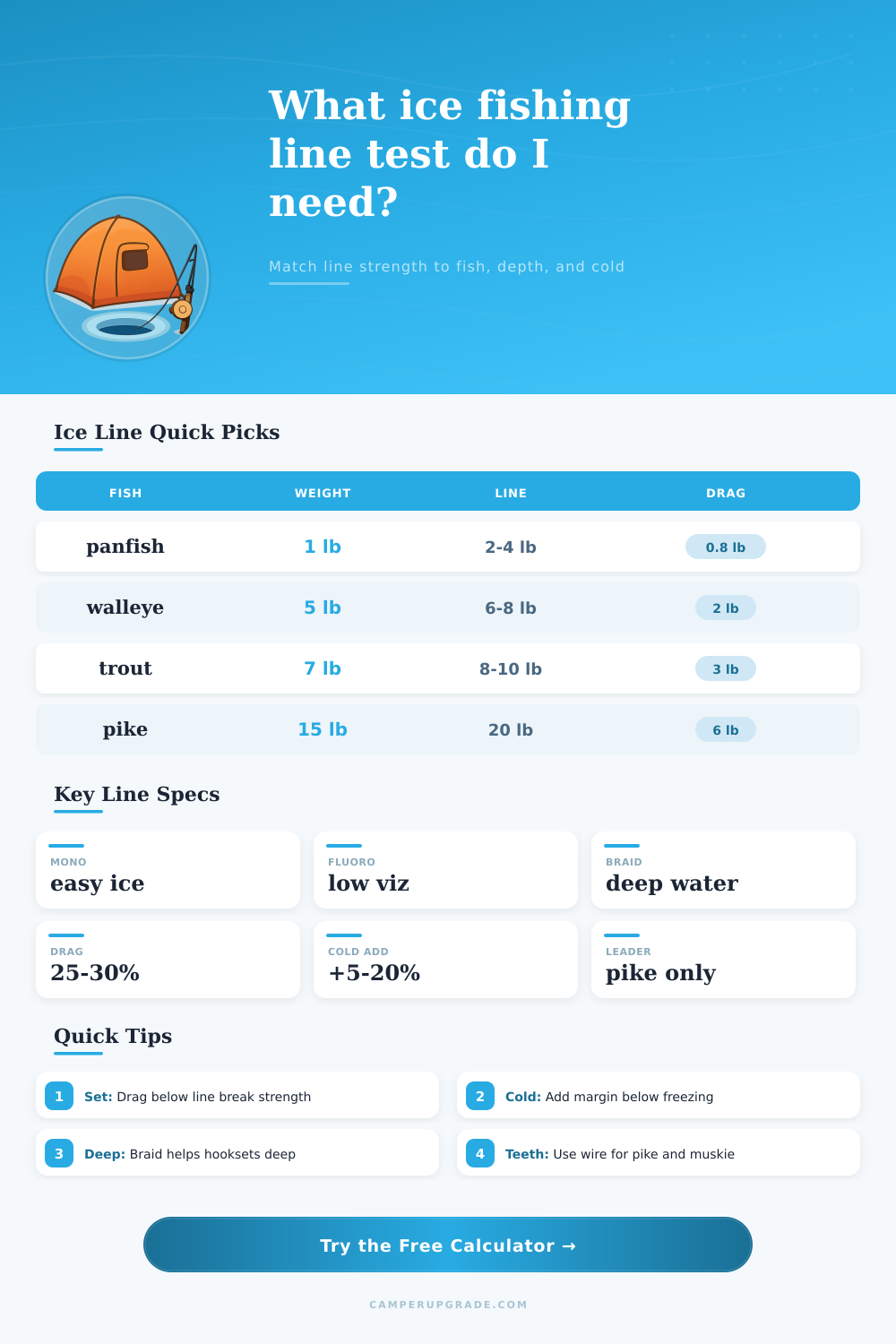
These variables is accounted for in the calculator by using material efficiency numbers. Another critical variable to consider when selecting an ice fishing line is the drag setting for the line. The angler should not set the drag for the line at the full strength of the fishing line.
If the angler sets the drag for the line too high, the line may snap when the fish suddenly pulls on the line. The drag should be set to between twenty-five and thirty percent of the test strength of the fishing line. This setting is provided for the test strength of the fishing line in the calculator.
However, anglers can set the drag to a lower percentage if they feel that the drag of the current line is inconsistent. Other factors to consider include the cover in which the fishing will occur and the power of the rod. If there is cover where the fishing will occur, the shock that will travel through the fishing line will be stronger.
For example, if the rod is medium-heavy and the fish takes a sharp turn over sharp rocks, the force will be stronger on the line. If the fishing spot includes weeds or sharp edges of the ice, the fishing line will be subject to abrasion. When selecting these parameters on the calculator, the recommendation for the strength of the ice fishing line will increase to account for the risk of the line being subjected to abrasion or snapping.
For example, a four-pound bass taking a sharp turn in the zebra mussels will damage the ice fishing line more than a ten-pound fish in open water. The strength of the knots tied in the fishing line is another variable for the angler to consider. A fresh knot will hold more weight than an old one.
A knot tied with warm hands will hold more weight than one tied with cold hands. The line strength accounted for in the calculator is to provide for the knots lesser strength so that the line will not snap due to the knot failing. Many fish are lost because of the failure of the knot to hold the fish.
Some of the mistakes that many ice anglers make when ice fishing include using the same test strength of the fishing line every year. They dont consider the depth of the fishing spot or the temperature of the air. Others use the same drag settings in deep water as in shallow water.
Some use old ice fishing lines that have been on the reel for many years. These mistakes can be avoided using the calculator. These reference tables will give you a general understanding of the different classes of ice fishing lines and the types of fish that use these lines.
These tables are not rules but starting points for the calculator to provide the best recommendation for your line. If you are not very familiar with the species of fish in your fishing area, these tables can help you not to buy the wrong type of fishing line. However, the calculator will provide the best adjustment to the lines in these reference tables to match the specifics of your environment.
When ice fishing, you have to think about the margin of the line strength and the drag that you use on your line. You will have to allow for the possibility of the line breaking due to the strength of the fish, the drag that you use on the line, and the length of the leader on the line. The calculator will provide you with the target line strength for your specific situation once you enter the information about your fishing spot.
Once you have the correct line for your fishing spot, you must also watch the line closely when you are ice fishing to ensure that it holds when the fish take the line. You should of checked the lines more carefuly. Actualy, it is alot more easier to just use the calculator.
This makes the process more comfortabley. Most people dont realize how much the temperature matters more then the depth. If you want to recieve a good catch, you should of used the right line.