Ice Cube Calculator
Estimate cube count, tray batches, freezer runs, drink service ice, cooler displacement, finished weight, and melt water from cube size and tray capacity.
🧊Named Ice Planning Presets
⚙Cube, Tray, Drink, Cooler, and Melt Inputs
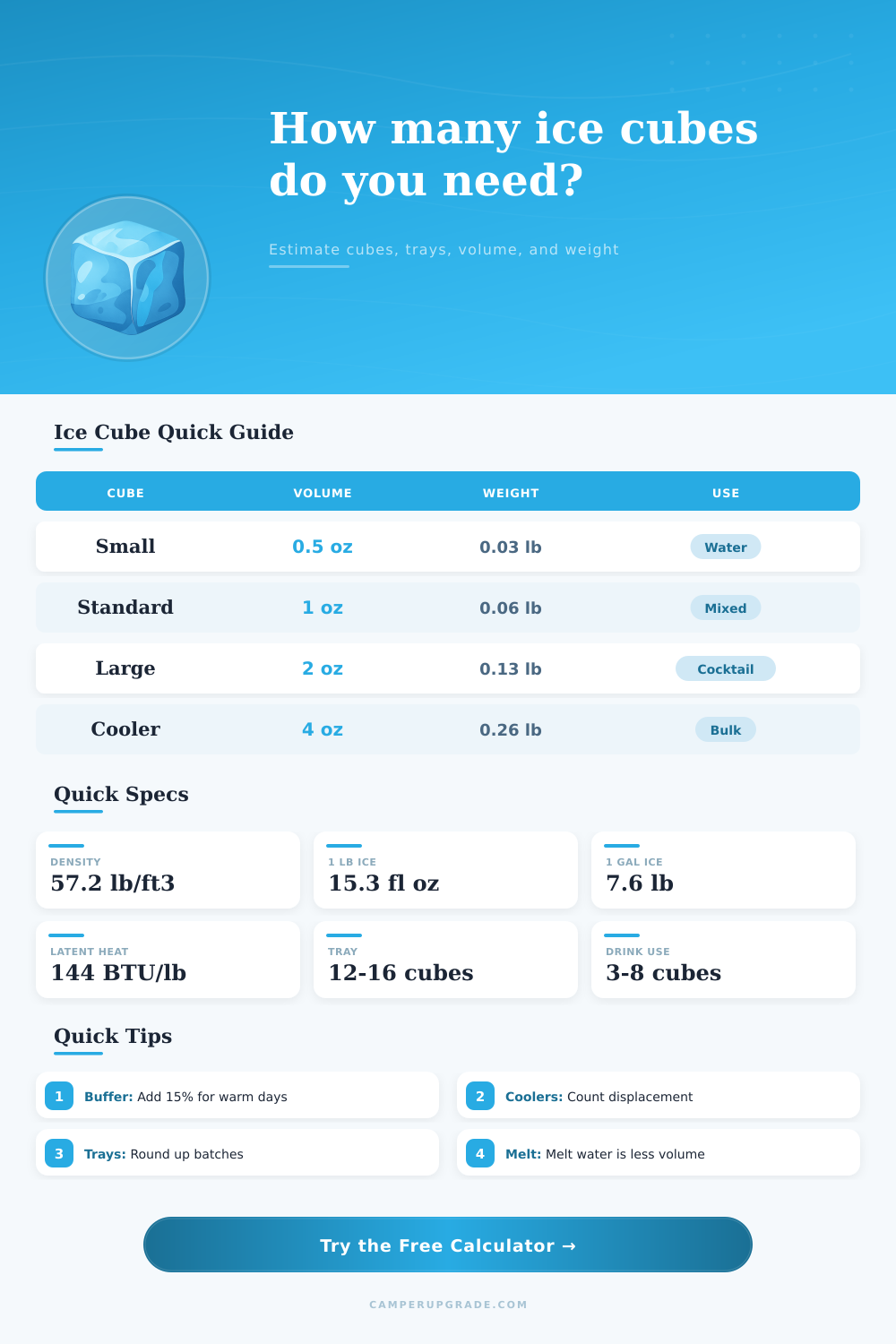
The calculator treats water ice density as 57.2 lb/ft³, 1 lb of ice as about 15.3 fl oz of solid ice, and 1 lb of ice as about 144 BTU of melt-cooling capacity.
🔢Four Formula Cards
Drink Cubes
drinks x cubesServing ice equals drink count multiplied by the cube count you want in each cup.
Cooler Fill
qt x 32 x packCooler ice volume equals reserved quarts converted to fl oz, then adjusted for air gaps.
Tray Batches
ceil(cubes / tray)Tray batches round up because partial freezer rounds still occupy a full waiting cycle.
Melt Water
lb x 0.12 galFinished ice weight converts to liquid water with 8.345 lb per gallon.
📊Cube and Tray Spec Grid
📋Ice Volume and Weight Tables
| Cube Type | Ice Volume | Weight Each | Best Use |
|---|---|---|---|
| Small crescent | 0.5 fl oz | 0.033 lb | Water bottles and quick chilling |
| Standard tray | 1.0 fl oz | 0.065 lb | Camp cups and mixed drinks |
| Large cube | 2.0 fl oz | 0.131 lb | Cocktails and slow melt service |
| Cooler block cube | 4.0 fl oz | 0.261 lb | Loose cooler fill with less surface area |
| Total Ice | Solid Volume | Liquid Melt | Cooling Reserve |
|---|---|---|---|
| 1 lb | 15.3 fl oz | 0.12 gal | 144 BTU |
| 5 lb | 2.39 qt | 0.60 gal | 720 BTU |
| 10 lb | 1.20 gal | 1.20 gal | 1,440 BTU |
| 20 lb | 2.39 gal | 2.40 gal | 2,880 BTU |
| Tray Setup | Cubes/Run | Standard Weight | Freeze Rhythm |
|---|---|---|---|
| 1 small tray | 12 cubes | 0.8 lb | One compact batch |
| 2 home trays | 28 cubes | 1.8 lb | Good for daily drinks |
| 4 home trays | 56 cubes | 3.7 lb | Useful before a day trip |
| 6 home trays | 84 cubes | 5.5 lb | Party or group service |
| Use Case | Typical Cubes | Ice Volume | Planning Note |
|---|---|---|---|
| 12 oz cup | 3-5 standard | 3-5 fl oz | Moderate chill without crowding |
| 20 oz tumbler | 5-8 standard | 5-8 fl oz | More headspace for hot weather |
| Pitcher service | 30-60 standard | 1-2 qt | Add near serving time |
| Cooler drink layer | 80-160 standard | 2.5-5 qt | Depends on air gaps and melt |
💡Ice Cube Planning Tips
Ice planning is an process of calculating how much ice a person need for an event. Ice planning becomes important for people who find themself in a situation where they has run out of ice for there drinks. If a person dont plan for how much ice they will need for there event, then the drink will not remain cold, and the ice will melt before there event have ended.
In order to plan for ice effective, a person must understand how ice behave in a cooler, how ice behaves in a cup, and how ice behaves in a freezer. A person must consider several specific factor when calculating the total amount of ice that will be needed for there event. These factors includes the size of the drinks that will be served, the temperature of the environment in which the ice will be served, and how often the person will open the cooler during the event.
How to Plan Ice for an Event
For instance, a large tumbler will require more ice than an small water bottle. Consequently, there will be a higher number of ice cubes required for the larger tumbler to help maintain its cold temperature. The way that the ice is packed into the cooler will affect the total amount of ice that a person is able to fit into there cooler.
Many people do not realize that loose ice cubes creates gaps in the cooler for air to exist between the ice cubes. These gaps take up space in the cooler in the same manner in which solid block of ice do. In fact, if an individual use loose ice cubes, they will require a higher volume of ice to fill that same cooler than a solid block of ice.
Ice has the potential to melt throughout the entire event. The sun, the warm drinks that must be served, and the opening of the coolers lid will melt the ice. If the melt rate of the ice is not account for when planning the ice for an event, the ice will melt to the point where there will not be enough ice left for the duration of the event.
In this situation, the person will need to calculate a buffer for the amount of ice that will melt throughout the event to ensure that there is enough ice to replace the melted ice. The size of the ice cubes will also play a major role in the melt rate of the ice. Large ice cubes has a larger melting rate than small ice cubes because of the increased amount of surface area that the ice has when place into the drink.
Large ice cubes are beneficial in that they will melt at a slower rate, allowing for the drink to remain cold for a longer period. However, large ice cubes take up more space within the freezer than small ice cubes. Another factor to consider when planning for ice is the capacity of the freezer.
A person must calculate how many batch of ice they can make within there freezer. Depending on the size of the individuals freezer, they may not have enough space to make all of the ice that they would like to have available for the event. In this situation, the best plan for an individual would of be to start making the ice as soon as possible to ensure that there is enough ice for the planned event.
Ice within a cooler can serve two purpose: it can be serving ice or bulk-fill ice. Serving ice is used to fill a persons drink, while bulk-fill ice is used to keep drinks cold within the cooler. The amount of serving ice and bulk-fill ice that is needed for an event must be calculated.
Using bulk-fill ice in large amounts will take up the space within the cooler for other product. Environmental conditions will have an impact upon the amount of ice that is require for a cooler. For instance, if the person places the cooler in the sun, it will melt at a faster rate than a cooler that is placed in the shade.
Additionally, if the cooler is opened more often, it will lose ice at a faster rate than a cooler that is left alone. These factors should be considered when planning for how much ice will be needed for the cooler. By accounting for these factor and considerations, an individual can ensure that they will have enough ice to keep all of there drinks cold from start to finish of the event.