Ice Block Weight Calculator
Estimate block ice weight from real mold dimensions, shape, density, air content, batch count, and trim loss for camping coolers, food bins, fishing chests, and drink tubs.
🧊Ice Block Presets
⚙Block Dimensions And Density
📊Density Reference Grid
▣Shape And Spec Comparison
Rectangular slab
Best for cooler bottoms and fish chests. Formula: length × width × thickness.
Cube block
Compact for volume. Formula: side × side × side, using the thickness input as side length.
Cylinder puck
Useful for buckets and drink tubs. Formula: pi × radius² × height.
Known volume
Use water-fill gallons or liters when the mold is irregular, tapered, or hard to measure.
📐Ice Density And Block References
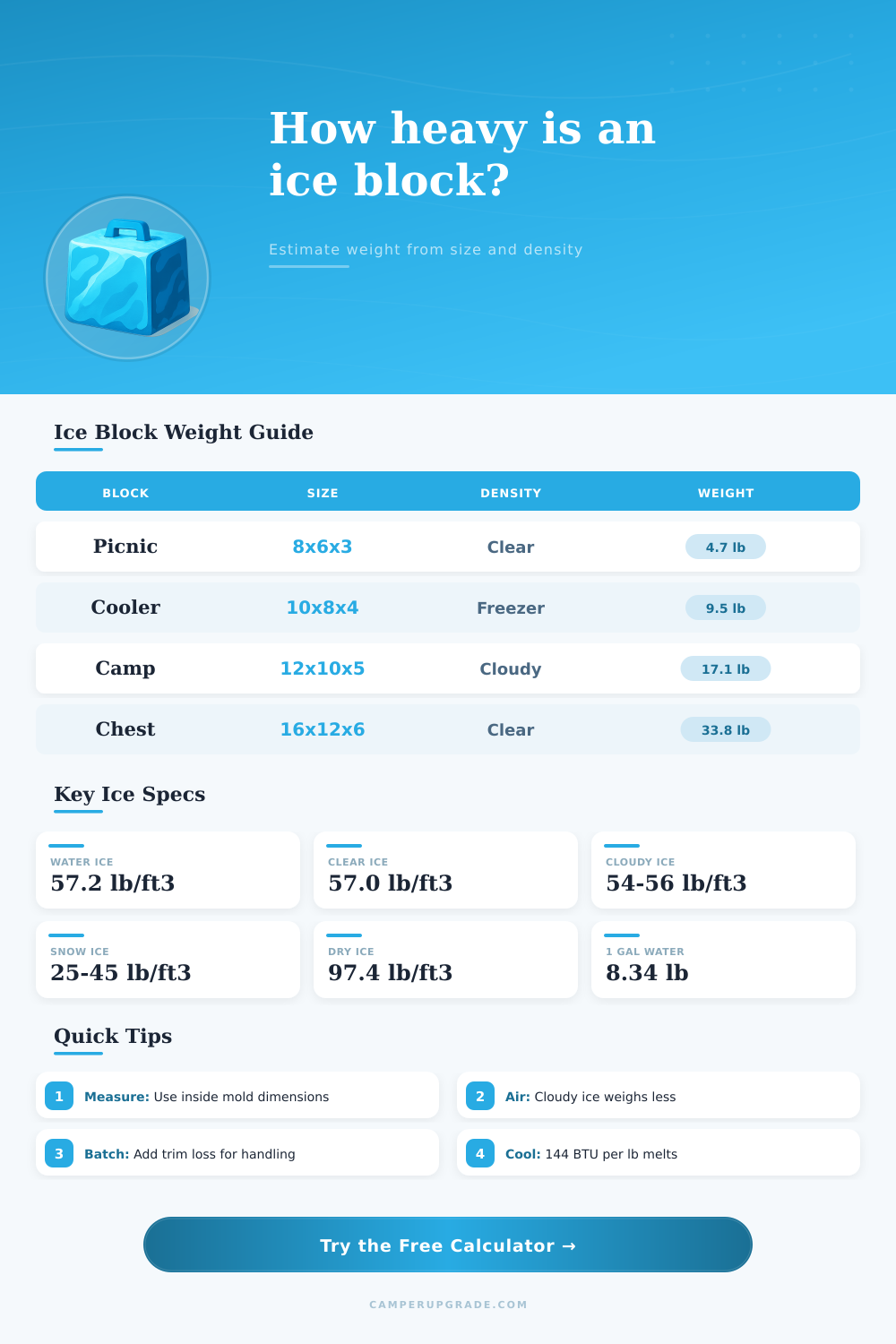
| Ice type | lb/ft³ | kg/m³ | Use |
|---|---|---|---|
| Pure water ice | 57.2 | 917 | Lab reference |
| Clear block ice | 57.0 | 913 | Commercial blocks |
| Home freezer ice | 56.2 | 900 | Cooler molds |
| Cloudy aerated ice | 54.5 | 873 | Camp freezers |
| Compacted snow ice | 38.0 | 609 | Loose voids |
| Dry ice slab | 97.4 | 1561 | Frozen shipping |
| Rectangular block | Volume | Freezer ice | Clear ice |
|---|---|---|---|
| 8 × 6 × 3 in | 0.083 ft³ | 4.7 lb | 4.8 lb |
| 10 × 8 × 4 in | 0.185 ft³ | 10.4 lb | 10.6 lb |
| 12 × 10 × 5 in | 0.347 ft³ | 19.5 lb | 19.8 lb |
| 16 × 12 × 6 in | 0.667 ft³ | 37.5 lb | 38.0 lb |
| 20 × 12 × 6 in | 0.833 ft³ | 46.8 lb | 47.5 lb |
| Mold volume | Water mass | Ice block | Meltwater |
|---|---|---|---|
| 1 gal | 8.34 lb | 8.1 lb | 1.0 gal |
| 2 gal | 16.7 lb | 16.2 lb | 1.9 gal |
| 3 gal | 25.0 lb | 24.3 lb | 2.9 gal |
| 5 gal | 41.7 lb | 40.5 lb | 4.9 gal |
| 10 gal | 83.4 lb | 81.0 lb | 9.7 gal |
| Cooling math | Per lb | 10 lb | 25 lb |
|---|---|---|---|
| Melt energy | 144 BTU | 1440 BTU | 3600 BTU |
| Meltwater | 0.12 gal | 1.20 gal | 2.99 gal |
| Metric mass | 0.454 kg | 4.54 kg | 11.34 kg |
| Metric water | 0.45 L | 4.54 L | 11.34 L |
Water ice expands as it freezes, so a full water container can split. This calculator estimates finished ice weight from frozen dimensions or known fill volume.
💡Block Weight Notes
When you are preparing for a camping trip, you must think about the weight of the ice that you will bring in your vehicle. Many people dont account for the weight of the ice that they plan to bring on their camping trips. The weight of the ice may be more than the weight of the food that they will bring on their trips.
Ice can be purchased in bags or can be frozen in plastic containers. The weight and density of the ice can differ based off the way in which the ice is frozen. If you freeze the ice in a home freezer, there will be air bubbles in the ice.
How to Plan Ice Weight for Your Camping Trip
These air bubbles make the ice less dense than the ice that is sold in stores. Because of the air bubbles, the ice will melt faster than if it were clear ice. In order to account for this, you should consider the density of the ice when planning for the camping trip.
When measuring the dimension of the molds in which the ice will be made, you must measure the dimensions of the frozen ice, not the outside of the plastic container in which the molds are contained. If you measured the outside of the container for the molds, you would find the measurements is too large for the actual molds. This is because the plastic containers for the molds have thickness.
If you are using a container with a tapered shape for the molds, you will need to find the average of the diameters of the top and bottom of the container. The calculator will use these dimensions to calculate how many pounds of ice will be produced in each batch of molds. Trim loss is another concept that you must account for when preparing the ice for your trip.
Trim loss is the amount of ice that you lose when you cut the edges of the ice blocks to make them fit into the cooler that will carry the ice. When you trim the ice blocks, you lose some of the total mass of the ice. Consequently, the total weight of the ice will be less than the weight of the initial ice blocks.
To find the total weight of the batch of ice blocks, you will use the batch count. You will need to know the total weight of all of the ice blocks so that you can calculate the total payload that your vehicle will carry. Four large blocks of ice can add up to a significant amount of weight that can be detrimental to your camping vehicle.
The cooling reserve of the ice is another concept that you must account for before setting off on your camping trip. The cooling reserve is the amount of heat that the ice will absorb while melting. The cooling reserve is measured in BTUs.
As the ice melts, the ice will absorb the heat from the food that is inside of the cooler. The amount of heat that will be absorbed is based on the mass of ice that you have in your cooler. A single large block of ice is better than a bag of ice cubes.
This is because a bag of ice cubes has a large amount of surface area. The ice in the bag will absorb the heat quick from the food and will melt at a rapid rate. A block of ice will melt at a slower rate than the ice cubes.
Another concept that you need to consider for your camping trip is the meltwater equivalent. The meltwater equivalent is the amount of liquid water that will result from the melting of the ice. If you have a large block of ice, it will melt into a large volume of liquid water.
This liquid water will fill your cooler. If your cooler doesnt have a good drain for the liquid water, your food will be in contact with liquid water. This can make your food soggy.
To avoid this problem, you can use smaller blocks of ice or use absorbent pads that will reduce the amount of liquid water in your cooler. If you are using dry ice instead of ice blocks, you will need to consider different variables. Dry ice is more dense than water ice.
A block of dry ice will weigh more than a block of water ice of the same size. When using dry ice, you must take care when handling the dry ice because the dry ice can cause frostbite. The sublimation of dry ice can also cause the pressure of the carbon dioxide gas to reach high levels within a container.
To account for this, the calculator will adjust for the density of the dry ice so that you can accurately calculate the weight of the dry ice that you will use for your camping trip. By calculating the weight of the ice for your trip, you are able to find a balance between the longevity of the cooling of the food and the portability of the ice. You want the ice to last long enough to ensure that your food remains safe, but you also dont want the ice to be too heavy for your camping vehicle to transport to the camping location.
Prior to packing the ice for your camping trip, you should of consider the density, the volume, and the heat absorption of the ice. By considering these variables in advance, you will be certain that you have the correct amount of ice to accommodate your camping trip and the food that you will bring with you.