Ice Block Melt Time Calculator
Estimate how long a solid ice block should last from block weight, shape, starting temperature, air or water contact, sun, wind, insulation, and cooler handling.
🧊Real Ice Block Presets
⚙Ice Block And Heat Inputs
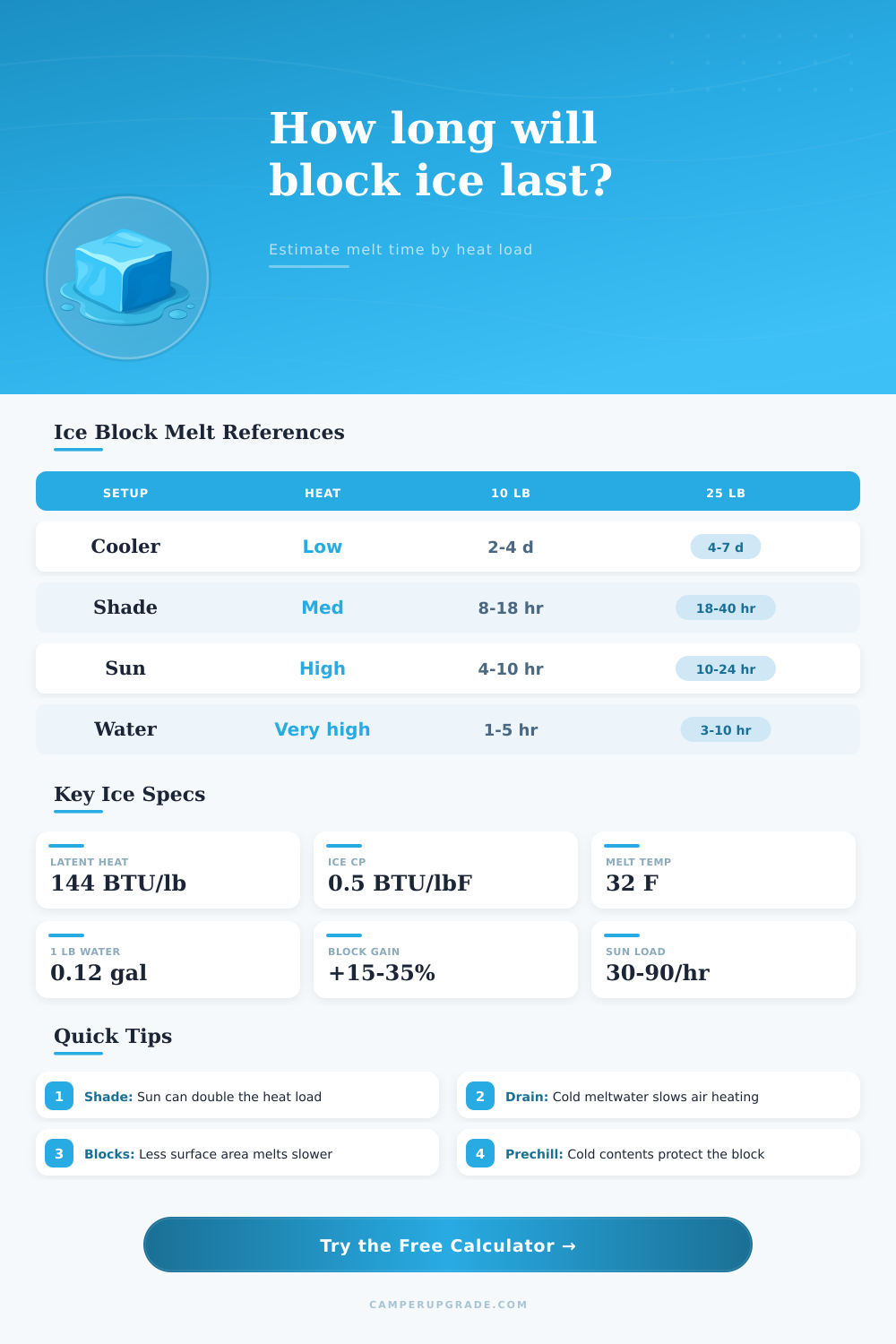
This calculator uses 144 BTU per pound for the latent heat of melting ice, about 0.5 BTU/lb°F to warm subfreezing ice to 32°F, and practical heat-transfer estimates for coolers, air, sun, and water contact.
📊Ice And Container Spec Grid
🌡Ice Melt Heat-Load Reference Tables
| Heat source | Typical range | Fast melt trigger | Calculator input |
|---|---|---|---|
| Latent melt energy | 144 BTU/lb | Always required | Ice weight |
| Subfreezing ice warming | 0.5 BTU/lb°F | Very cold freezer ice | Start temp |
| Still air convection | 1-2 BTU/hr ft²°F | Large exposed face | Air movement |
| Water contact | 15-80 BTU/hr ft²°F | Moving water | Contact mode |
| Direct sun | 30-90 BTU/hr ft² | Dark tray or full sun | Sun exposure |
| Block size | Approx block | Shade air | Closed cooler |
|---|---|---|---|
| 5 lb | 8x5x3 in | 4-9 hr | 18-36 hr |
| 10 lb | 10x6x4 in | 8-18 hr | 1.5-3 days |
| 20 lb | 14x8x5 in | 14-30 hr | 2.5-5 days |
| 40 lb | 18x10x7 in | 24-54 hr | 4-8 days |
| 50 lb | 20x11x8 in | 30-66 hr | 5-10 days |
| Container | Typical wall | Heat reduction | Best use |
|---|---|---|---|
| Open tray | None | 0% | Display ice |
| Towel cover | Thin fabric | 15-25% | Short shade use |
| Basic cooler | 1-1.5 in foam | 55-70% | Weekend block |
| Marine cooler | 1.5-2 in foam | 68-80% | Fishing chest |
| Rotomolded cooler | 2-3 in foam | 75-88% | Long camp use |
| Ice format | Surface area | Melt speed | Planning note |
|---|---|---|---|
| Compact block | Lowest | Slowest | Food cooler base |
| Rectangular block | Low | Slow | General camping |
| Wide slab | Medium | Moderate | Drink tub top |
| Bagged rough block | Higher | Faster | Easy store ice |
| Frozen bottles | Higher | Moderate | Dry cooler setup |
🧭Block Ice Calculation Tips
When you are packing for a trip, you have to make a choice between using cubed ice or an solid block of ice. Many people will choose cubed ice because it seem to fill the container more efficient. However, cubed ice melt much more quick than a solid block of ice.
A solid block of ice work more effectively to keep items cold for a long period of time. This is because a solid block of ice have less surface area relative to cubed ice. The cubed shape of ice allow the warm air to melt the ice at many different points at once.
Why a Block of Ice Lasts Longer Than Ice Cubes
A solid block of ice will melt more slow because the warm air cannot reach the solid block of ice as quick. The heat from the air must travel through the solid block of ice to reach the center of the solid block of ice. The shape of the solid block of ice will also impact how long the solid block of ice will remain solid.
If the solid block of ice take the form of a compact cube, that solid block of ice will melt more slow than a wide slab of ice of the same weight. This is because a compact cube has a lower ratio of surface area to the weight of the solid block of ice. More of the solid block of ice will be exposed to the air and the solid block of ice will melt at a faster rate.
The shape of the solid block of ice will determine the melt rate of the solid block of ice. Another factor that will impact the rate at which the solid block of ice melts is the temperature of the solid block of ice. If the solid block of ice remain in a deep freezer, it will have a subfreezing reserve.
This means that the solid block of ice will have to absorb more heat from the environment to reach the freezing point of water. A solid block of ice that remain subfreezing will last longer than a solid block of ice that dont contain as much subfreezing reserve. The environment surrounding the solid block of ice will also have an impact on the rate at which the solid block of ice melts.
Air is a poor conductor of heat. This means that if a solid block of ice is in a closed cooler, the solid block of ice will remain cold for longer period of time. However, water is a better conductor of heat than air.
This means that if you place the solid block of ice in a water bath, it will melt at a faster rate than if it were in air. Therefore, another consideration in packing for a trip is whether air or water will expose the solid block of ice. Sunlight can also have an impact on the solid block of ice.
Sunlight contain the radiant energy that will melt the solid block of ice. If you place the cooler in the shade, the solid block of ice will last longer. If sunlight exposes the cooler, the solid block of ice will melt at a faster rate.
Another consideration for how fast the solid block of ice will melt is the number of times the cooler is opened. If you open the cooler, warm air will enter the cooler and cold air will exit the cooler. If the cooler is opened frequent, the solid block of ice will melt at a faster rate than if the cooler is left alone with its lid close.
Finally, the type of cooler that is used can also impact the length of time that the solid block of ice remain frozen. If a cooler is made of plastic, the walls of the cooler are thin. However, if the manufacturer rotomolded the cooler, the cooler have thick and dense insulation.
The thicker the insulation on the cooler, the less amount of heat that will enter the cooler from the outside world. This will allow the solid block of ice to remain frozen for a longer period of time. For these reasons, when packing for a trip, it is best to always pack more ice than you think you will need.
This is because the weather may change or there could be extra guest arriving at your destination. By packing an extra solid block of ice, you ensure that the items you pack for your trip will remain cold and fresh. If you use a solid block of ice, keep the cooler in the shade, and leave the lid of the cooler alone, you will find that your solid block of ice will last for longer than it would of otherwise melted.