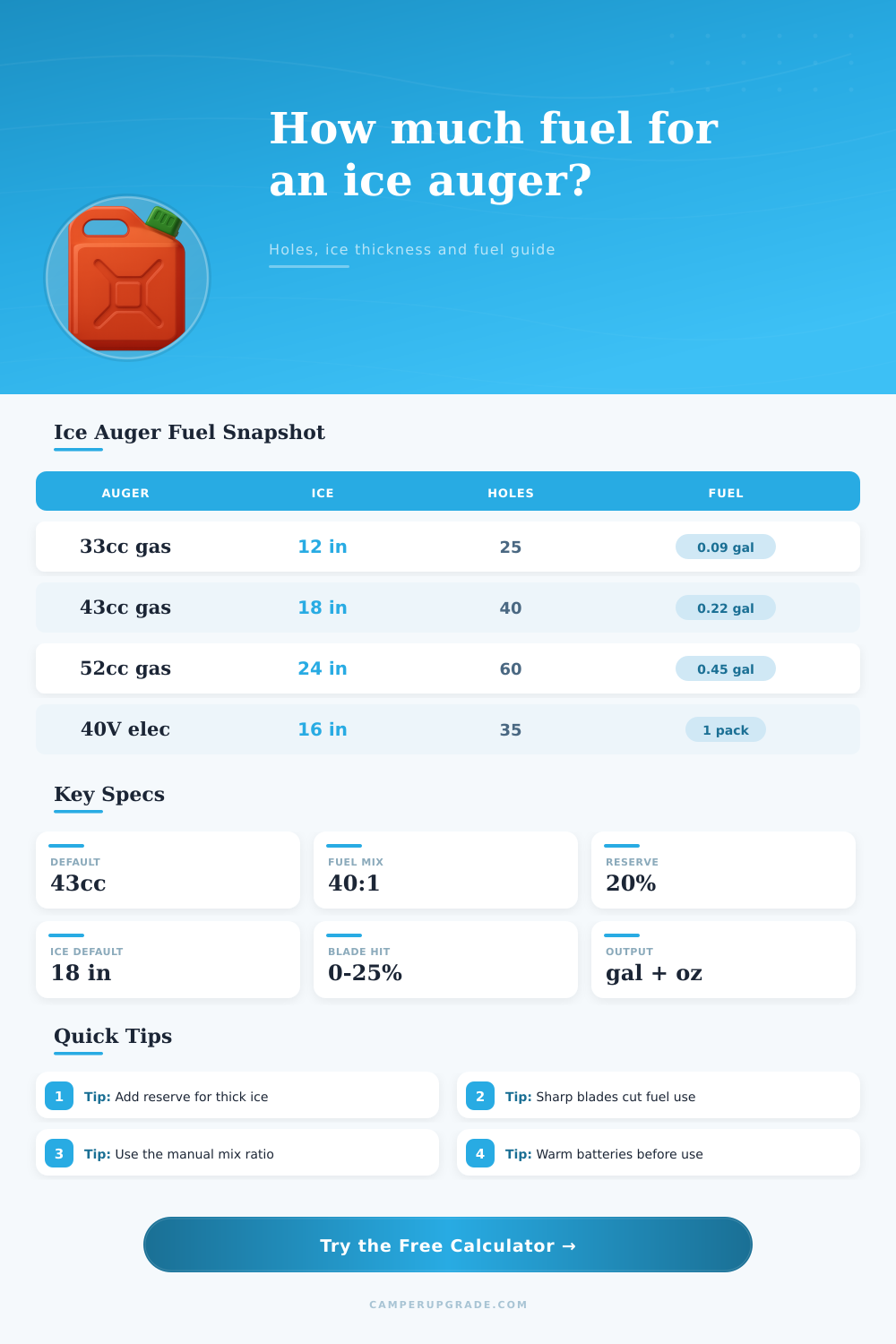
Ice Auger Fuel Calculator
Estimate gas, two-stroke oil, drill time, battery packs, and reserve fuel from planned holes, ice thickness, auger size, and cutting conditions.
Fuel Breakdown
| Power Head | Baseline Rate | Best Fit | Fuel Note |
|---|---|---|---|
| 33cc gas compact | 0.0045 gal per baseline hole | 6 inch to 8 inch bits, mobile scouting | Low carry weight, slower in thick ice |
| 43cc gas standard | 0.0060 gal per baseline hole | Most 8 inch ice fishing setups | Good default for mixed hole counts |
| 52cc gas high torque | 0.0075 gal per baseline hole | Thick ice or 10 inch bits | More burn but less bogging |
| 60cc gas heavy duty | 0.0090 gal per baseline hole | Guide, shack, or big-bit drilling | Plan more fuel for repeated starts |
| Propane equivalent | 0.0080 gal equivalent per baseline hole | Cold starts with propane bottles | Track bottle capacity separately |
| 40V electric | 0.020 pack per baseline hole | Quiet day trips and shelters | Battery warmth changes output |
| 56V electric | 0.015 pack per baseline hole | Higher capacity electric cutting | Carry spare packs in cold weather |
| Ice Thickness | 8 Inch Bit Load | 40 Holes at 43cc | With 20% Reserve |
|---|---|---|---|
| 8 inches | 0.67x baseline | 0.16 gal | 0.19 gal |
| 12 inches | 1.00x baseline | 0.24 gal | 0.29 gal |
| 18 inches | 1.50x baseline | 0.36 gal | 0.43 gal |
| 24 inches | 2.00x baseline | 0.48 gal | 0.58 gal |
| 30 inches | 2.50x baseline | 0.60 gal | 0.72 gal |
| 36 inches | 3.00x baseline | 0.72 gal | 0.86 gal |
| Bit Diameter | Area Factor | Use Case | Fuel Effect |
|---|---|---|---|
| 5 inch | 0.39x | Fast scouting, electronics hole | Much lower burn |
| 6 inch | 0.56x | Panfish, light travel, early ice | Lower burn and faster cuts |
| 8 inch | 1.00x | General ice fishing default | Baseline calculator size |
| 10 inch | 1.56x | Big fish, wheelhouse, shelter holes | Noticeably more fuel |
| 12 inch | 2.25x | Spearing or specialty holes | High load and slower drilling |
| Trip Pattern | Holes and Ice | Suggested Reserve | Planning Note |
|---|---|---|---|
| Quick evening | 10 to 20 holes, 8 to 14 inches | 10% | Small bottle or one warm battery may fit |
| Weekend grid | 30 to 60 holes, 14 to 22 inches | 20% | Good match for a half-gallon tank |
| Deep winter search | 50 to 90 holes, 24 to 36 inches | 30% | Carry fuel separately from shelter gear |
| Guide or derby | 80 to 150 holes, mixed thickness | 50% | Plan for restarts, blade changes, and delays |
Using an ice auger requires that a person plan for the fuel and battery that the auger will use. Planning for the fuel or battery life of the ice auger will prevent a person from running out of fuel or battery while they are on the ice. Most people will guess at how much fuel or battery the auger will use.
Guessing at the fuel or battery life will cause a person either to run out of fuel and battery too early, or to have to carry too much fuel and battery life by weight. By understanding the factors that influence the fuel and battery life of an ice auger, though, a person can avoid these two outcome. One of the factors that will influence the fuel and battery life of an auger is the thickness of the ice.
How to Plan Fuel and Battery for an Ice Auger
The thickness of the ice will determine how much ice the auger must remove. To remove twelve inches of ice will require the ice auger to remove more ice than eight inch of ice. To remove twenty-four inches of ice require the ice auger to remove roughly twice as much ice as to remove twelve inches of ice.
Thirty-six inches of ice will require the ice auger to remove three times as much ice as twelve inches of ice. Therefore, using ice that is twelve inches or more in thickness will require that the engine of an auger is working longer to remove the ice of such thickness. Another factor that will influence the amount of fuel that an auger will use is the diameter of the bit of the auger.
If the bit of the auger has a larger diameter, it will remove more ice than an auger that has an eight-inch bit when the depth of the ice is the same. For instance, an auger with a ten-inch bit will remove more ice than twice the amount of an auger with an eight-inch bit. Using an auger with a larger bit will cause a person to use more fuel with that auger.
The size of the engine of the auger will impact the fuel consumption of that auger. For instance, a thirty-three cc engine will use less fuel than a sixty cc engine, but the thirty-three cc engine will have more trouble cutting through thick or refrozen ice. A forty-three cc engine, which is in the middle range in terms of cc, is the most common engine size for ice augers.
Another calculation that a person must make for the fuel consumption of an auger is the two-stroke oil and gasoline ratio. Some augers require a thirty-two to one ratio of two stroke oil to gasoline, but others require a fifty to one ratio. If a person mixes the oil to gasoline ratio incorrect, the engine may create a smoky mess (if too much oil is used), or it may suffer engine damage (if too little oil is used).
For augers that are electric powered, the battery life must be planned for. Additionally, the life of the battery will decrease in cold weather. If the battery has been sitting in the cold it will contain less capacity than a battery that has been stored in a warm vehicle.
Each battery pack can be treated as a unit of energy; however, cold weather will impact the capacity of that unit. An additional consideration of fuel consumption is the inclusion of reserve fuel. A person can add a percentage of fuel to the total amount of fuel that is calculated for an auger.
For example, a ten percent reserve of fuel is recommended for a short fishing session, but thirty percent is recommended for remote fishing locations. For fishing tournaments, a fifty percent reserve is suggested so that the fisherman will have some extra time should something come up. The condition of the augers blade and the quality of the ice will influence the fuel consumption of the auger.
If the blades are sharp and the ice is clean, the auger will easily cut the ice. If the blades are dull or the ice is refrozen the engine will have to work harder to cut the ice. If an engine works harder it will use more fuel.
Calculating how much fuel and battery life an ice auger will use requires that a person calculate the factor that will influence that life. After calculating how much fuel and battery life an auger will need, a person will know for sure if their current fuel tank is going to be enough for the day, or if they will need to bring an extra quart of gasoline. Additionally, the person will also be able to determine if one battery pack is going to be enough for the ice fishing trip, or if they will need to bring two battery packs.
By calculating the fuel and battery life requirements for an ice auger, a person will be able to pack correctly and efficient move throughout the day.