Ice Auger Blade Size Calculator
Estimate practical auger blade diameter from target fish, hole clearance, ice thickness, auger drive type, blade condition, drilling count, and power margin.
🧊Ice Auger Blade Presets
⚙Hole Diameter, Ice, Species, and Auger Inputs
This calculator estimates blade diameter and drilling load for planning. Always confirm local ice safety, manufacturer limits, and blade compatibility before drilling.
📏Blade Diameter and Spec Grid
5 inch blade
19.6 in²Fast hand drilling for panfish, sight holes, and early ice mobility.
6 inch blade
28.3 in²Light all-around size for perch, crappie, and compact electric setups.
7 inch blade
38.5 in²Middle ground for walleye anglers who still drill many holes.
8 inch blade
50.3 in²Standard walleye and mixed-species size with transducer room.
9 inch blade
63.6 in²Large-fish comfort size when torque and battery margin are strong.
10 inch blade
78.5 in²Big pike, lake trout, wheelhouse, and low-hole-count applications.
Sharp edge
100%Clean bite reduces chatter, torque spikes, and battery draw per hole.
Dull edge
+25-45%Nicks and rolled edges make diameter feel larger than the label.
⚖Current Setup Snapshot
📘Ice Auger Blade Reference Tables
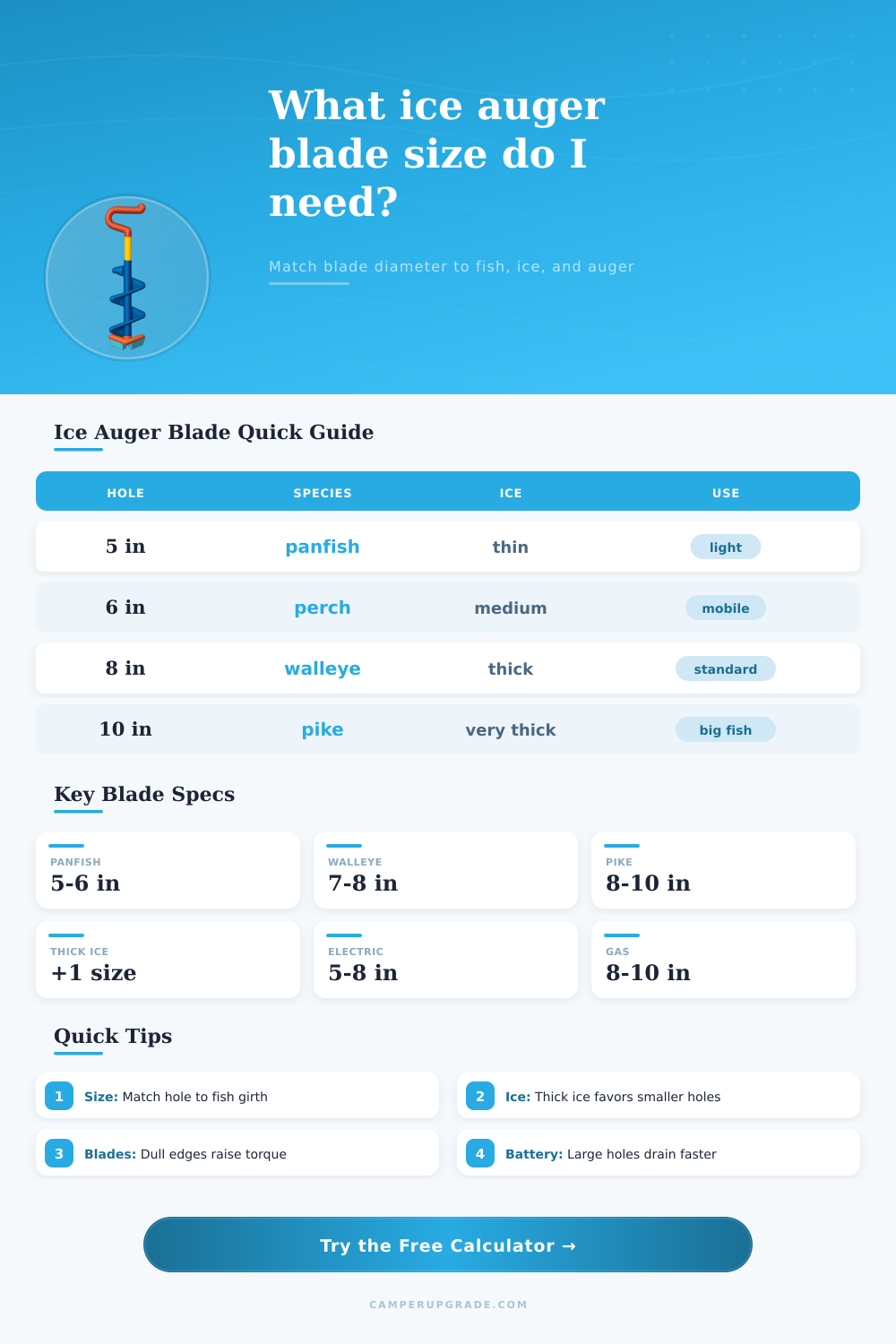
| Species | Fish Body | Blade Range | Best Fit |
|---|---|---|---|
| Bluegill | 2-3 in | 5-6 in | fast holes |
| Crappie | 3-4 in | 5-7 in | soft mouth |
| Perch | 3-4 in | 6-7 in | mobile |
| Walleye | 4-6 in | 7-8 in | standard |
| Trout | 5-8 in | 8-10 in | big fish |
| Pike | 6-10 in | 8-10 in | roomy |
| Blade | Area | Vs 6 in | Typical Auger |
|---|---|---|---|
| 5 in | 19.6 in² | 69% | hand/drill |
| 6 in | 28.3 in² | 100% | hand/drill |
| 7 in | 38.5 in² | 136% | drill/electric |
| 8 in | 50.3 in² | 178% | electric/gas |
| 9 in | 63.6 in² | 225% | gas/propane |
| 10 in | 78.5 in² | 278% | gas/strong electric |
| Ice | 5-6 in | 7-8 in | 9-10 in |
|---|---|---|---|
| 4-8 in | very easy | easy | manageable |
| 8-14 in | easy | standard | heavy |
| 14-24 in | efficient | moderate | high load |
| 24-36 in | best for many | power needed | low count |
| 36 in plus | least load | slow but useful | very heavy |
| Auger Type | Sweet Spot | Limit | Note |
|---|---|---|---|
| Hand | 5-6 in | 7 in | sharp only |
| Drill plate | 6-8 in | 8 in | battery heat |
| Electric | 7-8 in | 10 in | watch cycles |
| Propane | 8-10 in | 10 in | steady torque |
| Gas | 8-10 in | 10 in | best reserve |
💡Blade Size Calculation Tips
When selecting an ice auger blade size, several factor must be considered. The size of the blade determine how much ice the auger will remove and the amount of torque the ice auger will need. Using an ice auger blade that is too large waste teh energy required to turn the auger.
Using an ice auger blade that is too small makes it difficult to land the fish. The target species of fish will determine the blade size needed as some species requires more clearance than others. For example, bluegill fish require less clearance than northern pike, so the ice auger blade does not need to be as large for bluegill then for northern pike.
How to Choose the Right Ice Auger Blade Size
The calculator determines the size of the blade needed based off the depth of the fish species. Another factor to consider is the thickness of the ice. Ice augers with a 6-inch blade find it easy to drill through 10 inches of ice but will find it much harder drilling through 30 inches of ice.
The calculator accounts for the thickness of the ice in the calculation of the load the ice auger will experience. The condition of the ice also have an effect on the load the ice auger will experience. If the ice is dirty or contains slush, it will increase the friction of the blade and the load that the ice auger will experience.
The more friction on the ice auger, the less holes that can be drilled before the battery or the arms of the operator experience fatigue. The type of ice auger that the operator will use affects the load the auger will experience. For example, a hand auger or a cordless drill has less torque than a gas powered auger.
Using a hand or cordless auger with a large ice auger blade may not be able to handle the load of the blade. The calculator can compare the type of auger to the size of the ice auger blade and the thickness of the ice so that the operator understand if the load will be too heavy for the auger. Using a large ice auger blade with a small battery or hand auger will cause the battery to drain quick or the motor to labor while attempting to turn the auger.
Another factor that will affect the load the ice auger will experience is the condition of the ice auger blade. If the ice auger blade is sharp, it will require less torque to cut through the ice. A dull ice auger blade will require more torque and may create more difficulty for the operator.
The calculator allows the user to input the condition of the ice auger blade into the calculation of the load the auger will experience. Additionally, the calculator will provide a signal indicating if the condition of the ice auger blade is too dull to use effective. The number of holes that the angler is to be drilled will also affect the size of the ice auger blade.
The more holes that the operator will drill with a 9-inch ice auger blade, the more ice will be removed than if fewer holes are drilled. The calculator multiplies the amount of ice removed from each hole by the number of holes that will be drilled. This number will show the total amount of ice that the auger will remove during the day.
This number will help to decide whether a smaller ice auger blade should of been used or whether a backup battery should be brought to the ice. The last factor to consider when determining the size of the ice auger blade is the preference for the amount of clearance that the hole in the ice will create. Some anglers prefer that the hole be large enough to allow their fishing gloves to pass through the ice or for transducers to be lowered into the water.
Others prefer that the hole be the smallest in order to limit the load on the ice auger. The larger the hole in the ice, the greater the load on the ice auger. The calculator allows for the user to input the preference for the size of the hole in the ice so that the user can see the effect of this preference on the size of the ice auger blade.
There are other factor in the real world that will affect the load on the ice auger. Ice in the spring will likely be thin while the ice in the winter may contain slush. The number in the calculator can be run before the operator leaves the house.
The operator can enter the type of ice, the species of the fish, and the type of auger that will be used. The calculator will indicate if the ice auger blade is too large to create a light, moderate, or heavy load on the ice auger. If the load indicated by the calculator is too heavy, then the user can opt for a smaller ice auger blade to be use on the ice.