Hypothermia Calculator
Estimate field hypothermia risk, onset window, and rewarming urgency for cold-weather camping, hiking, paddling, and overnight exposure.
🧭 Scenario Presets
📋 Exposure Inputs
⚖ Field Spec Grid
📊 Wind and Wetness Risk Table
| Effective condition | Wind exposure | Likely onset band | Field action focus |
|---|---|---|---|
| 0 to 5 °C equivalent | Low wind | 2–5 hours | Layer and monitor trend |
| -5 to 0 °C equivalent | Moderate wind | 1–3 hours | Add shell and dry gloves |
| -10 to -5 °C equivalent | High wind | 30–120 minutes | Shelter and warm fluids |
| Below -10 °C equivalent | High wind + wet | 10–60 minutes | Immediate rewarming plan |
🧥 Clothing Insulation Benchmarks
| System | Approx clo | Best use case | Limit in wet conditions |
|---|---|---|---|
| Shell only + base | 0.5 | Active movement above freezing | Fast cooling when soaked |
| Fleece + shell | 1.0 | Mixed hiking and camp tasks | Needs dry layer backup |
| Synthetic puffy system | 1.5 | Cold static tasks and overnights | Better wet tolerance |
| Expedition insulated stack | 2.0 | Long stationary exposure | Bulk limits output pace |
🚶 Activity Heat Contribution Table
| Activity level | MET | Heat contribution | Operational caution |
|---|---|---|---|
| Resting / seated | 1.1 | Minimal internal heat | Prioritize insulation |
| Slow walking tasks | 2.0 | Moderate support | Avoid sweat buildup |
| Steady hiking pace | 3.5 | Strong heat generation | Vent layers on climbs |
| Hard uphill effort | 5.0 | High short-term warmth | Dry layers after stop |
🛟 Common Camping Exposure Scenarios
| Scenario | Typical inputs | Risk tendency | First priority |
|---|---|---|---|
| Cold dawn camp setup | 38 °F, 10 mph, damp | Guarded to high | Warm core and hands |
| Rain camp after sunset | 34 °F, 14 mph, soaked | High to severe | Dry layers immediately |
| Open boat crossing | 41 °F, 25 mph, spray | High to severe | Block wind and change |
| Unplanned overnight cold | 29 °F, 8 mph, static | Severe over time | Shelter and insulation |
This tool estimates field risk trends and does not replace emergency medical assessment.
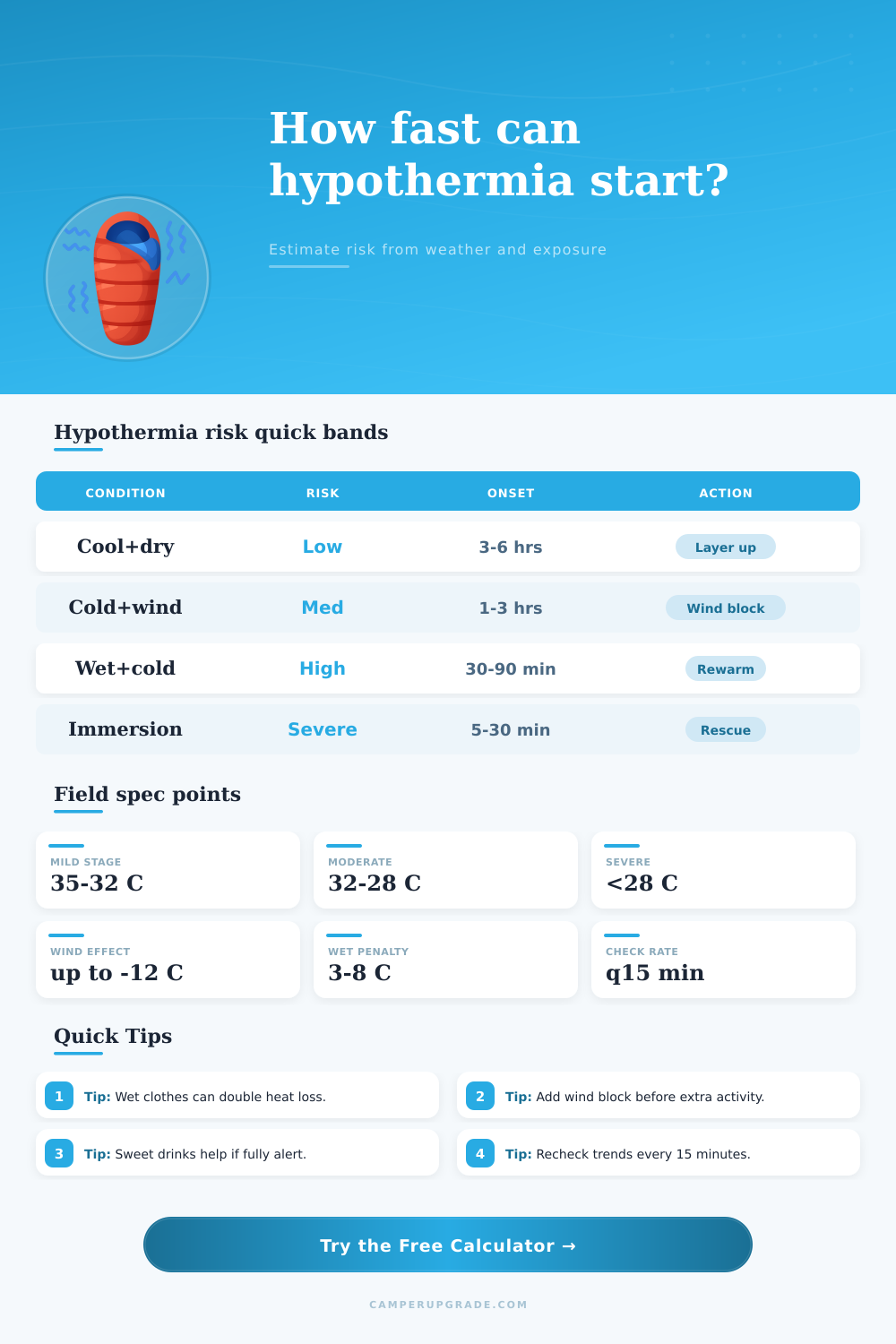
Hypothermia is a dangerous state that comes when the body loses heat more quickly than it can produce it. Average body temperature is around 37°C or 98.6°F. Hypothermia happens when the body temperature drops under 35°C or 95°F it most commonly happens in extremely cold weather, but also in cool environments, for instance above 40°F. Getting wet makes it happen even more soon.
In temperatures under 10°C hypothermia can develop, and in water it is possible under 20°C.
Hypothermia: What It Is, Signs and How to Stay Safe
The signs range according to how much the temperature drops. During mild hypothermia, shivering comes with mental confusion. Shivering helps the body keep heat by means of constant contract and loosening of muscles.
In moderate hypothermia, the shiverng stops and the confusion grows. The brain can wrongly believe that the body is warmed, hence it stops the shivering. In severe hypothermia, the person risks unconsciousness or needs urgent medical help.
During hypothermia progress, the person slowly loses skill to think clearly and move.
Long vulnerability to cold uses the energy stored in the body. Long exposures entirely exhaust the rest. Older adults and children easily cool, because they lack good heat regulation.
Poor clothes also contribute.
For campers and lovers of outdoor life, this is a soar problem. Even mild hypothermia can come in July, if a sudden rainstorm happens. Keep heat matters most for camping in cold.
A sleeping bag rated in 20 degrees will protect against hypothermia in sub-zero nights. Winter sleeping bags give the most reliable defense during RV trips in winter. When campground power fails, warm resources are needed to escape hypothermia or even death.
Drinking alcohol does not help against hypothermia. It boosts the rate of body heat loss, so you feel warm for a moment, but actually cool more quickly through the skin.
Helping a person with hypothermia, treat them carefully. Confine moves to strict requirements. Avoid massage or rub.
Rough or too active gestures can provoke heart stop. Remove the person from the cold. Heat them slowly, and only in a rush if the state is bad and the temperature too low.
With hypothermia, if you lack good clothes, fire-making skill or good shelter, it is not possible to stop it after being caught in a surprising situation.