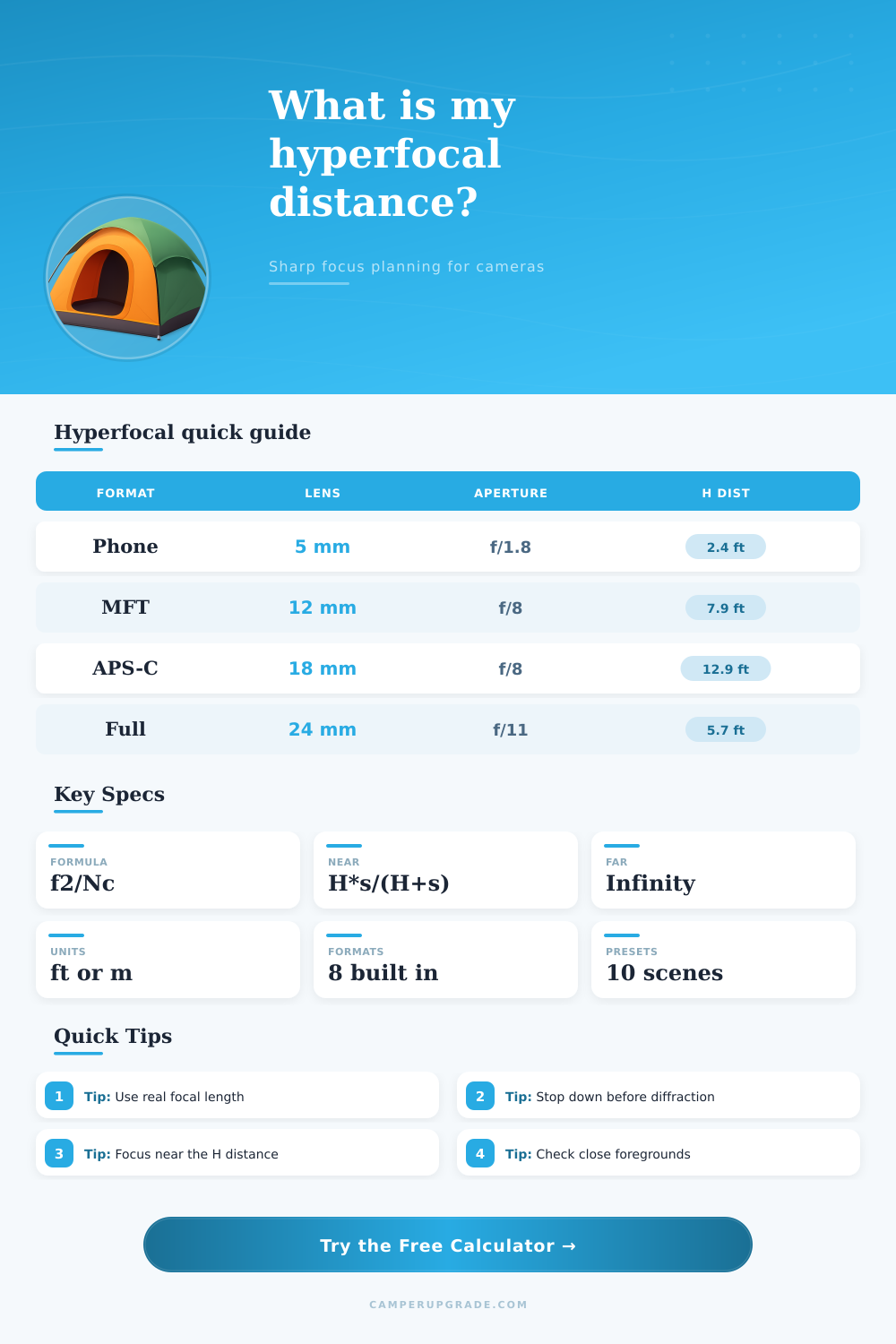
Hyperfocal Distance Calculator
Plan focus for landscapes, trail scenes, camp photography, travel work, and any shot where near-to-far sharpness matters.
Use the lens marking, not full-frame equivalent focal length.
Critical uses a smaller CoC; web allows a slightly larger CoC.
| Format | Typical CoC | Crop Factor | Field Use |
|---|---|---|---|
| Phone wide | 0.005 mm | 5.6x to 7x | Trail snapshots, camp scenes |
| 1 inch compact | 0.011 mm | 2.7x | Light travel cameras |
| Micro Four Thirds | 0.015 mm | 2.0x | Backpacking and wildlife kits |
| APS-C | 0.019 mm | 1.5x to 1.6x | General outdoor photography |
| Full frame | 0.030 mm | 1.0x | Landscape, night, travel |
| Medium format | 0.050 mm | 0.79x | High-detail scenic work |
| Aperture | Hyperfocal Effect | Tradeoff | Common Use |
|---|---|---|---|
| f/2.8 | Longer H distance | More blur, more light | Astro foreground checks |
| f/5.6 | Moderate H distance | Sharp lens zone | Handheld travel scenes |
| f/8 | Shorter H distance | Strong detail balance | Day hikes and overlooks |
| f/11 | Nearer H distance | Some diffraction risk | Close foreground landscapes |
| f/16 | Very short H distance | Diffraction more visible | Only when foreground is tight |
| Full Frame Lens | f/8 H Distance | f/11 H Distance | Near Limit At H |
|---|---|---|---|
| 14 mm | 2.7 ft | 2.0 ft | About half H |
| 20 mm | 5.5 ft | 4.0 ft | About half H |
| 24 mm | 7.9 ft | 5.7 ft | About half H |
| 35 mm | 16.8 ft | 12.2 ft | About half H |
| 50 mm | 34.2 ft | 24.9 ft | About half H |
| 100 mm | 136.8 ft | 99.5 ft | About half H |
| Scene | Format | Lens / Aperture | Planning Note |
|---|---|---|---|
| Tent with mountain | Full frame | 24 mm at f/11 | Check tent distance against near limit |
| Forest trail | APS-C | 18 mm at f/8 | Focus just beyond foreground rocks |
| Lake overlook | MFT | 12 mm at f/8 | Good for near-to-far day scenes |
| Milky Way camp | Full frame | 20 mm at f/2.8 | Foreground may need separate focus |
| Ridge wildlife | APS-C | 200 mm at f/8 | Hyperfocal is usually impractical |
CoC values are conventional planning values. For large prints, heavy crops, or high-resolution sensors, use the critical sharpness option or enter a custom smaller CoC.
The term hyperfocal distance sounds intimidating but it’s intuitive if you know what it does to your pictures. For example, when you’ve got mountain peak in the background and some rocks in the foreground, you want them all sharp. Enter: hyperfocal distance. Use the calculator above to run the numbers for you. That way as light fades, you don’t need to remember any complicated formulas.
This is why it is called hyperfocal distance: it is the focal distance that give maximum depth of field. Focusing at this distance will make everything beyond half that distance out to infinity look good enough. And here’s where people confuse things. They misunderstand it as meaning crisp sharpness everywhere, which just isn’t how photography works. It’s a dance of perception and physics.
What Is Hyperfocal Distance?
This tool does this by applying circle of confusion values, which is set for typical viewing distances and standard print sizes. So we’re not talking about theoretical perfection, we’re talking about something that works. Sensor size is important and it’s not as much about resolution as many think. A small sensor (APS-C or Micro Four Thirds) has less depth of field then a full frame given the same aperture and field-of-view due to difference in the circle of confusion. That’s explained in the chart above.
It also explains why so many landscape photographer like wide angles. If you use a 12mm lens, for example, on your Micro Four Thirds camera, you’ll be able to get very close up (hyperfocal distance) while maintaining sharpness out towards infinity. With a full frame, you’d have to back away more to achieve similar results.
There’s another important factor: aperture. Here’s the catch to that: When you stop down from f/2.8 to f/11 (for example), your hyperfocal distance becomes dramatically shorter. This means everything before and beyond are in focus. So what? Diffraction sets in at tiny apertures such as f/16 or f/22. And it softens all fine detail everywhere in the frame. That’s where the calculator comes in.
Generally speaking, f/8 is the sweet spot for most moddern sensors where depth of field balances well with lens sharpness. If you use even smaller aperture, you will gain more theoretical depth of field. But you’ll sacrifice micro-contrast in the texture of foliage or rocks, for instance.
In the real world, things don’t always cooperate like they do on paper. Maybe it’s windy, causing your tripod to wobble. Open up the aperture to get a faster shutter speed. Maybe you’re photographing in a forest with low light, requiring wider aperture. Here’s where knowing the near and far limits helps you make an educated compromise.
For example: let’s say the math works out that your near limit is 10 feet, yet the rock at the bottom of the frame, your key foreground element, sits just five feet from the camera. The math instantly tells you that you cannot use hyperfocal focus for this photo; perhaps a wider lens or even some focus stacking are necessary.
In the field, don’t get hung up on decimal places. The calculator will tell you accurate numbers. However, our eyeballs aren’t reliable enough to see a difference between focusing at 10.4 feet versus 10.5 feet. Often times rounding to the next convenient landmark will do just fine. Consider it a guideline of where to place your tap on the screen or turn focus ring. Don’t make it a hard-and-fast rule. You’re trying to achieve even sharpness across the entire image (not mathematical accuracy).
So, in the end, this whole business of learning hyperfocal distance comes down to… planning! Knowing exactly where your depth of field will begin and end means you can plan your compositions confidently. There is no more guesswork; just get it done. Next time you’re shooting a starry night sky above your tent, or a foggy mountain hike, pull out the numbers and use them. They’ll make the difference between wondering and knowing, uncertainty and control. You should of always have control. That is why you need to let the math handle the heavy lifting the next time you find yourself staring at a wide-open vista.