Hunting Arrow Weight Calculator
Estimate finished arrow weight from shaft GPI, carbon length, insert, collar, broadhead, nock, wrap, fletching, glue, draw weight, and balance point.
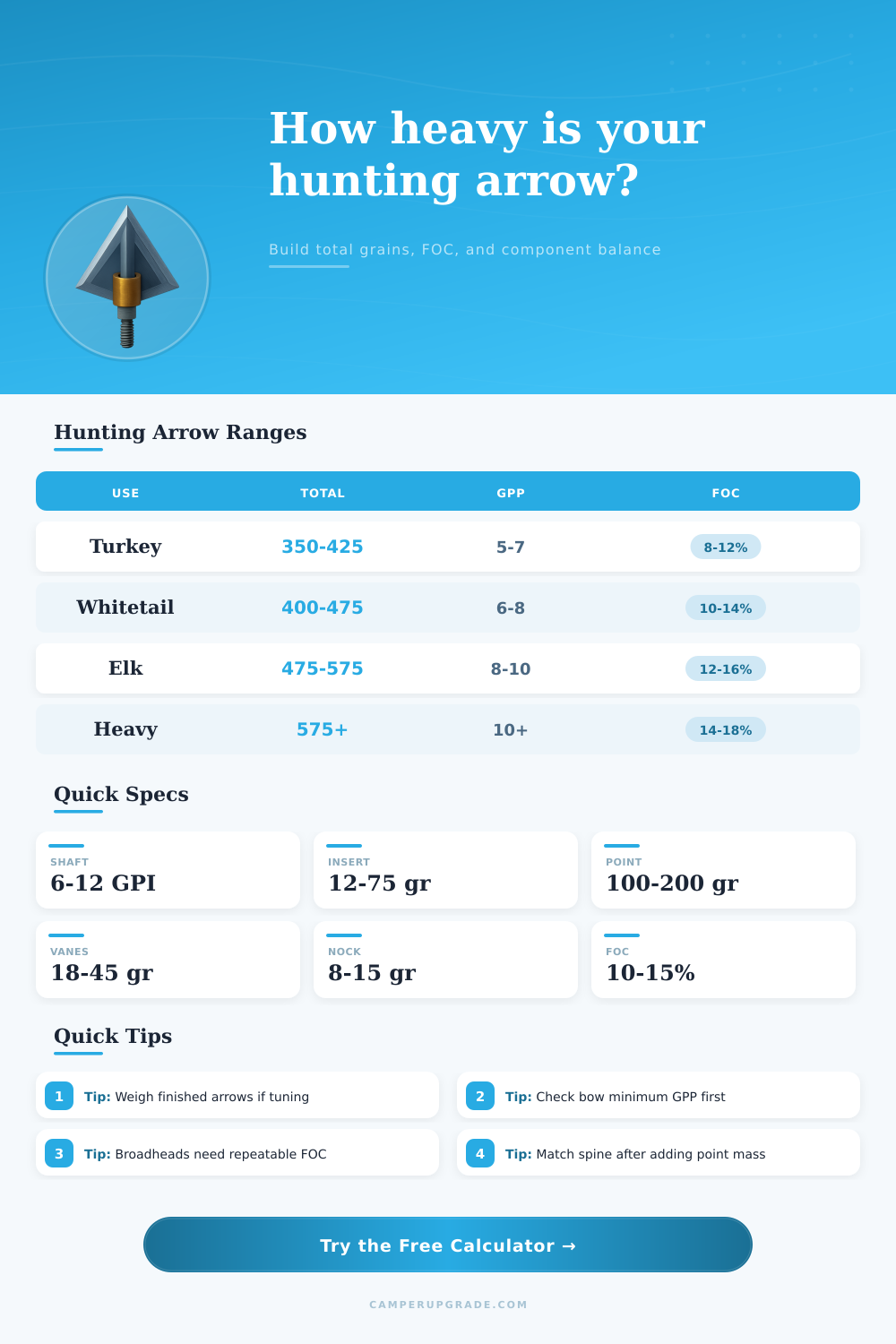
| Hunting use | Total grains | GPP range | Common note |
|---|---|---|---|
| Turkey / small game | 350 to 425 | 5 to 7 | Fast, controlled distance |
| Whitetail / mule deer | 400 to 475 | 6 to 8 | Balanced broadhead setup |
| Elk / black bear | 475 to 575 | 8 to 10 | Extra mass and stable flight |
| Moose / heavy bone | 575 plus | 10 plus | High-mass penetration build |
| Shaft class | Typical GPI | 28 in shaft | Build tendency |
|---|---|---|---|
| Speed carbon | 6.0 to 7.5 | 168 to 210 gr | Needs component mass |
| Standard hunting | 7.6 to 9.5 | 213 to 266 gr | Versatile deer and elk |
| Micro hunting | 9.0 to 11.0 | 252 to 308 gr | Small diameter wind drift help |
| Heavy wall | 11.0 plus | 308 gr plus | Durability and momentum bias |
| Component | Light | Common | Heavy |
|---|---|---|---|
| Insert / outsert | 12 gr | 16 to 50 gr | 75 gr plus |
| Broadhead / point | 85 gr | 100 to 125 gr | 150 to 200 gr |
| Nock | 7 gr | 9 to 12 gr | 20 gr lighted |
| Three vanes | 15 gr | 18 to 27 gr | 30 gr plus |
| FOC result | Meaning | Broadhead effect | Adjustment |
|---|---|---|---|
| Under 8% | Rear-biased | Can be less forgiving | Add front weight |
| 8% to 12% | Balanced | Works for many deer setups | Tune normally |
| 12% to 16% | Front-biased | Often stable with fixed heads | Check spine |
| Over 16% | Very front-heavy | Can need stiffer spine | Paper and broadhead tune |
Every bowhunter must determine how much an arrow should weigh when the arrow leaves the bow string. The weight of the arrow will have to change according to the size of the game, the weight of the broadhead, the draw weight of the bow, and the weather conditions. Beyond the arrow shaft and arrow point, there is a number of other components of the arrow that work together to ensure that the arrow travels as well as possible once it is released from the bow.
Thus, it is important that the total weight of the arrow is correct; the total weight of the arrow impacts the arrow flight and the energy of the arrow. Additionally, getting the total weight of the arrow correct will ensure that the bow remains within it’s safety limits. The grains per inch (GPI) of the arrow shaft is the starting point for calculating the weight of the arrow.
How to Choose the Right Arrow Weight
The carbon shaft portion of the arrow will be the largest portion of the arrow; therefore, the shaft can be lighter if shortened or be left as is if shorter shaft length are not used. A calculator can handle the mathematics of the arrow; you can plug the length of the shaft and the weights of the arrow components into the calculator. The weight of the arrow components will impact the dynamic spine of the shaft; any change to the weight of the arrow’s components will impact its flight.
The front-of-center balance of the arrow is another important component to consider; the use of fixed blade broadheads require a certain amount of front-of-center balance. Should the arrow have too much of a balance point towards the rear end of the arrow, the arrow will be more susceptible to wind; the arrow will be more difficult to tune to achieve an optimal flight. Should the balance point of the arrow be too far towards the front of the arrow, the arrow may require a stiffer shaft then the current arrow shaft.
You can determine the balance point of the arrow by finding the balance point of the arrow with its assembled components and comparing that measurement to the overall length of the arrow. This measurement will impact whether the arrow will steer from its front end or its rear end. Additionally, moving the balance point of the arrow forward by using a heavier insert will improve the arrow’s flight with the broadhead without changing the total weight of the arrow.
Another important measurement for the arrow is the grains per pound of draw weight; this is a measurement that is more important to bow manufacturer. The limbs and cams of the bow are engineered to provide for a minimum arrow mass; if the mass of the arrow is too light, some of the energy of the arrow will go back into the bow which could damage the bow. The arrow calculator can report the grains per pound of draw weight automatically; the measurement can be used to determine whether the arrow will be above the minimum grains per pound of draw weight or if it will be moved closer to that minimum.
This is another measurement that could have an impact on the arrow flight during long shot or during the hunting of game in the wind. Each of the components of the arrow will add to the weight of the arrow. For example, aluminum insert, steel collars, wraps and three vane will add fifty to sixty grains of weight to the arrow prior to the installation of the broadhead.
The total weight of the arrow must remain within the limits for the species of game that is to be hunted. For instance, turkey hunter may want to use arrows that are lighter in weight so that the arrow will travel faster. Elk hunter may prefer arrows that are of a heavier weight so that the arrow has more momentum to reach the vital area of the elk.
The arrow calculator can be used to determine the weight of each component of the arrow; the preset value can be changed to determine the weights of the arrow components. Another variable that must be considered when shooting arrows is the spine reaction to the weight of the arrow. An arrow that is heavier in its front end will react to the shaft in a way that it is weaker than it would otherwise act; the shaft is not changing its static spine rating.
Because the weight of the arrow will impact the arrow’s reaction, an experienced arrow hunter will often weigh one arrow before building the remainder of the arrows. The weight of the arrow can be measured on a scale that catches differences in weights of glue or manufacturing difference of the arrow components. Additionally, adding a new type of broadhead will change the balance point of the arrow; a changed balance point may require a change in shaft or arrow length.
External variable will also impact the arrow flight; cold weather will stiffen the limbs of the bow which will change the energy that is delivered to the arrow. The weight of the fletching of the arrow or the nock fit could also impact the arrow flight. These variable are not accounted for by the arrow calculator; however, these factors will impact why two arrows of the same weight may behave differently on the flight range.
Thus, the arrow calculator can be used as a starting point for weighing arrows; however, the arrows should be tuned to ensure that group of the arrow’s broadheads are consistent with each other prior to the hunting season. The most common mistake with arrows is to focus upon only one component of the arrow while ignoring the other component of the arrow. For instance, the arrow hunter may focus upon adding weight to the arrow to ensure that it reaches the necessary grains-per-pound of draw weight; the hunter may not consider how this will impact the front-of-center balance of the arrow and how the arrow will act with the fixed blade broadhead.
Additionally, the arrow hunter may adjust the length of the arrow for speed but may not consider that the altered length will impact the total weight of the arrow. The arrow calculator can prevent these common mistake by providing an indication of each of the components of the arrow prior to the hunter begins to cut or glue the components. In general, there will be a desire in an arrow hunter to have an arrow that both cleanly leaves the bow and has enough energy to kill the game.
Additionally, the arrow should group well with the broadhead that the hunter brings into the field with him or her. Each of these component can be achieved by understanding the impact of each component of the arrow upon the finished arrow. Thus, the arrow calculator provides the hunter with a map to create an arrow that meets each of these goal; however, additional adjustment will need to be made to fine tune the arrow based off the bow that is used, the arrow hunter and the weather conditions.