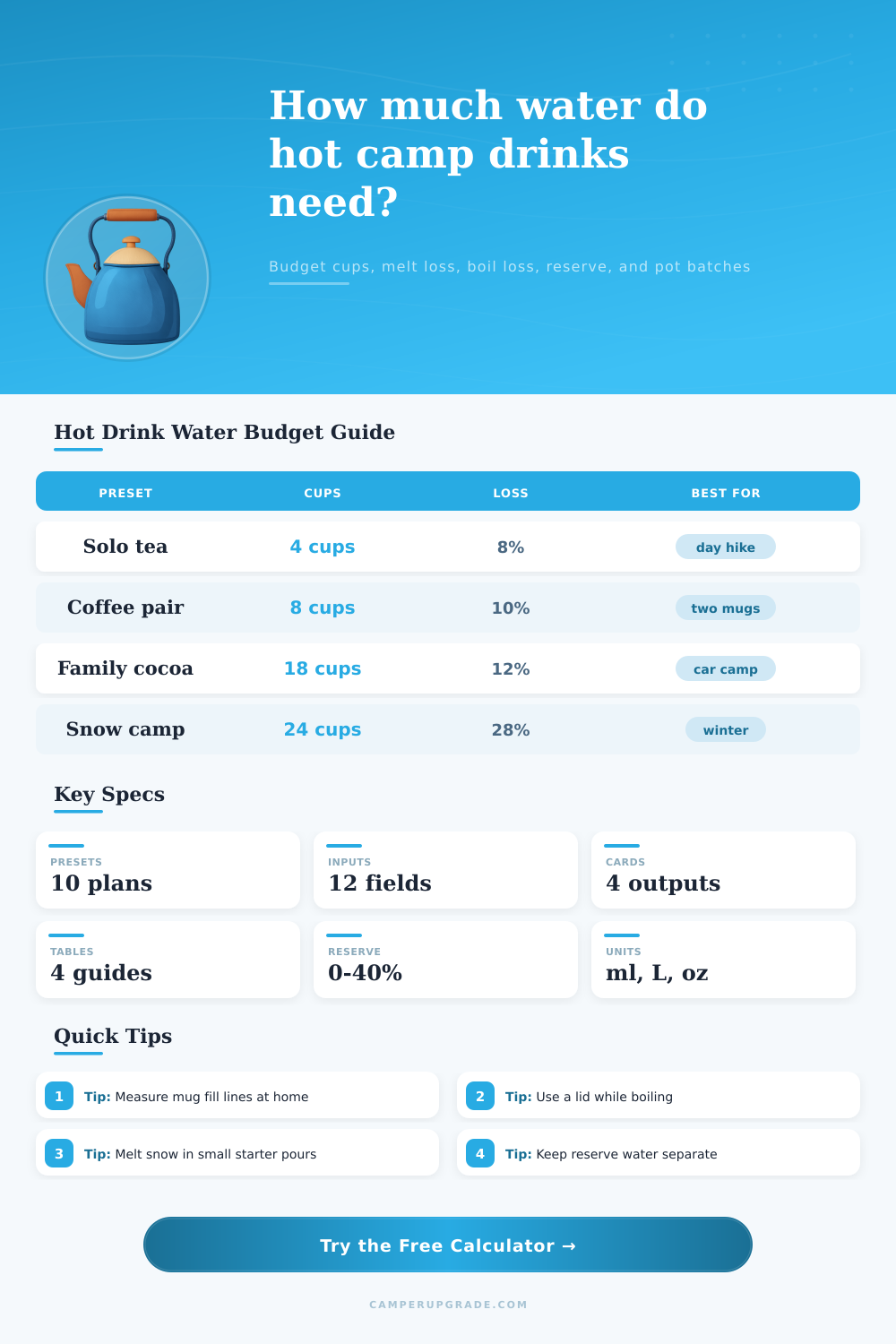
Hot Drink Water Budget Calculator
Plan hot water for camp coffee, tea, cocoa, cider, and thermos fills using people, drinks per day, cup volume, melt loss, boil loss, and reserve margin.
⛺Hot Drink Presets
⚙Inputs
🧮Water Budget Breakdown
📊Spec Grid
📘Reference Tables
| Preset | People | Cup | Use |
|---|---|---|---|
| Solo tea | 1 | 250 ml | Light brew stops |
| Coffee pair | 2 | 300 ml | Morning mugs |
| Family cocoa | 5 | 280 ml | Car camp evening |
| Snow camp | 4 | 320 ml | Winter melting |
| Crew kettle | 10 | 240 ml | Shared batch |
| Drink | Typical Cup | Water Note | Planning |
|---|---|---|---|
| Tea | 240-300 ml | Low residue | Small loss |
| Coffee | 280-350 ml | Rinse needed | Add reserve |
| Cocoa | 250-330 ml | Powder clings | Add 5% |
| Cider | 240-320 ml | Easy pour | Normal loss |
| Thermos | 500-1000 ml | Set aside | Count extra |
| Source | Yield | Loss Range | Field Note |
|---|---|---|---|
| Liquid water | 1.00 L/L | 0-6% | Fastest |
| Slush | 0.65 L/L | 8-15% | Wet snow |
| Packed snow | 0.35 L/L | 12-22% | Needs tamping |
| Powder snow | 0.12 L/L | 18-35% | Bulky |
| Ice chunks | 0.90 L/L | 6-14% | Slow melt |
| Pot Size | Safe Fill | 300 ml Cups | Best Use |
|---|---|---|---|
| 0.75 L | 0.60 L | 2 | Solo stove |
| 1.0 L | 0.80 L | 2-3 | Two mugs |
| 1.5 L | 1.20 L | 4 | Small group |
| 2.0 L | 1.60 L | 5 | Family pot |
| 4.0 L | 3.20 L | 10 | Crew kettle |
Snow yield varies by density. Treat the source volume as a field estimate and use the reserve margin when conditions are windy, cold, or gritty.
💡Tips
To determine how much water is needed for each person to drinking hot drinks on a trip, it is necessary to account for small loses of water. Each serving of a hot drink include the volume of water that is actualy observed in the cup. However, water is also lost due to the boiling of water to heat the liquid to the desired temperature, as well as the water that is lost in the form of snow melt to create the water for the hot drinks.
Additionally, water can be lost through splashes of hot water when you transfer it from a pot to the cup. Thus, if water is not accounted for in the plan for hot drinks, it is likely that the individual will run out of water for the hot drinks for the trip. However, if the individual accounts for the necessary losses of water, the individual will have enough water for each of the individuals hot drink serving.
How much water to bring for hot drinks on a trip
To calculate the total amount of water needed for the individuals going on the trip, the calculator requires that the individual enter a few inputs. For instance, the individual must enter the number of individuals going on the trip, the number of hot drinks each individual will consume during the trip each day, the size of the cups for each individual, and the losses of water for each individual into the calculator. The number of individuals and the number of drinks that each person will have will determine the total amount of finished water that will be required.
Cup size dont refer to the total potential capacity of the cup. Instead, the size of the cup is the amount of water that will be provided to each cup after water for tea or other flavorings is account for. Additionally, individuals may prefer different sizes of drinks, such as small espresso drinks or large drinks in insulated mug.
In addition to the size of the cups that will be used to provide the hot drinks to each individual, it is necessary to account for the way that water may be lost while boiling water for the drinks and while melting snow to provide water for the hot drinks. For instance, water may be lost both due to melt loss (snow and grit that is lost when straining snow) and due to boil loss (water that evaporates into steam while boiling, or water that adheres to the inside of the pot). These types of water losses is small for each individual category of loss, but they may accumulate to a volume that must be accounted for in the calculation of how much water must be provided.
For instance, if each individual has a 10% loss of melt loss and an 8% loss of boil loss, the source water that is provided must be more than the total volume of the hot drinks that is prepared. The source of the water that is provided for the individual’s hot drinks will impact the total amount of water that must be provided. For instance, if the water provided is in the form of liquid water from a filter, the yield of the water will be high, and the water that is lost due to melting snow will be small.
However, if the water provided is in the form of dry powder snow, more water will be lost due to the low yield of the dry powder snow. In these cases, it is helpful for the individual to provide a starter liquid to the pot prior to adding the dry powder snow. The reason for providing a starter liquid includes providing an amount of water that will prevent the snow from scorching in the pot, as well as ensure that the snow melt at a faster rate.
Thus, without a starter liquid, the individual may waste fuel heating the snow, and may not have enough melted water to prepare the hot drinks. In addition to accounting for water that is lost due to melted snow, boiling water, and individual cups, it may be helpful for the individual to include a reserve margin for the amount of water that may be lost due to spills or other issue. Furthermore, water losses due to steam can occur if the individual is at high altitudes.
Thus, the amount of water that is provided can account for a reserve margin of 10 or 15% for potential spills, or to make one more round of hot drinks. Additionally, account for the fact that higher altitudes can lead to more higher losses of water to steam. The size of the pot in which the water is boiled and the capacity of the thermoses that are used to transport the hot water to prepare the hot drinks does factor into the preparation of the hot drinks.
However, the size of the pot and thermoses do not factor into the amount of water that is required. For instance, if the individual use a small pot to boil the water, there will be more instances of boiling water, which can lose water to steam. Additionally, if there is a thermos that is used to transport the hot water, it will contain the hot water that is boiled, and thus increase the total amount of water that is boiled in advance.
Though the calculator can determine the amount of water necessary for the individual to prepare their hot drinks, there are a few reference tables on the calculator that assist the individual in understanding the different parameters. For instance, one table can include information about the type of drinks that are to be prepared. Another table can include information about the yield of the different types of water sources.
Additionally, another table can indicate how many cups of hot drinks can be prepared in a given size of cooking pot. Though the reference tables help to provide context to the calculations that the calculator makes, the individual can also reduce the losses of water in a few ways. For instance, if the individual can measure the amount of hot water to be provided to each cup while at home, the water loss due to providing measured amounts in each cup can be reduced.
Additionally, if the individual covers the pot while boiling the water, the amount of water that is lost as steam can be reduced. Additionally, if the individual separates the starter liquid from hot drinks that are provided to the individual, the amount of water that is lost due to preparing the drinks can also be reduced. Each of these steps will reduce the amount of water that is calculated by the calculator, but will not eliminate the need for the individual to account for water to prepare their hot drinks.