Horse Feed Per Trail Day Calculator
Estimate forage, cubes or pellets, grain, salt, ration bags, bales, flakes, cache weight, and pannier load for a trail horse or small string.
🐎Trail Feed Presets
Your Trail Feed Plan
⚖Trip And Horse Inputs
🌾Forage And Concentrate Plan
🧳Packing, Bales, And Cache Inputs
📊Planning Snapshot
📘Reference Tables
| Planning item | Typical range | Use in this calculator | Trail note |
|---|---|---|---|
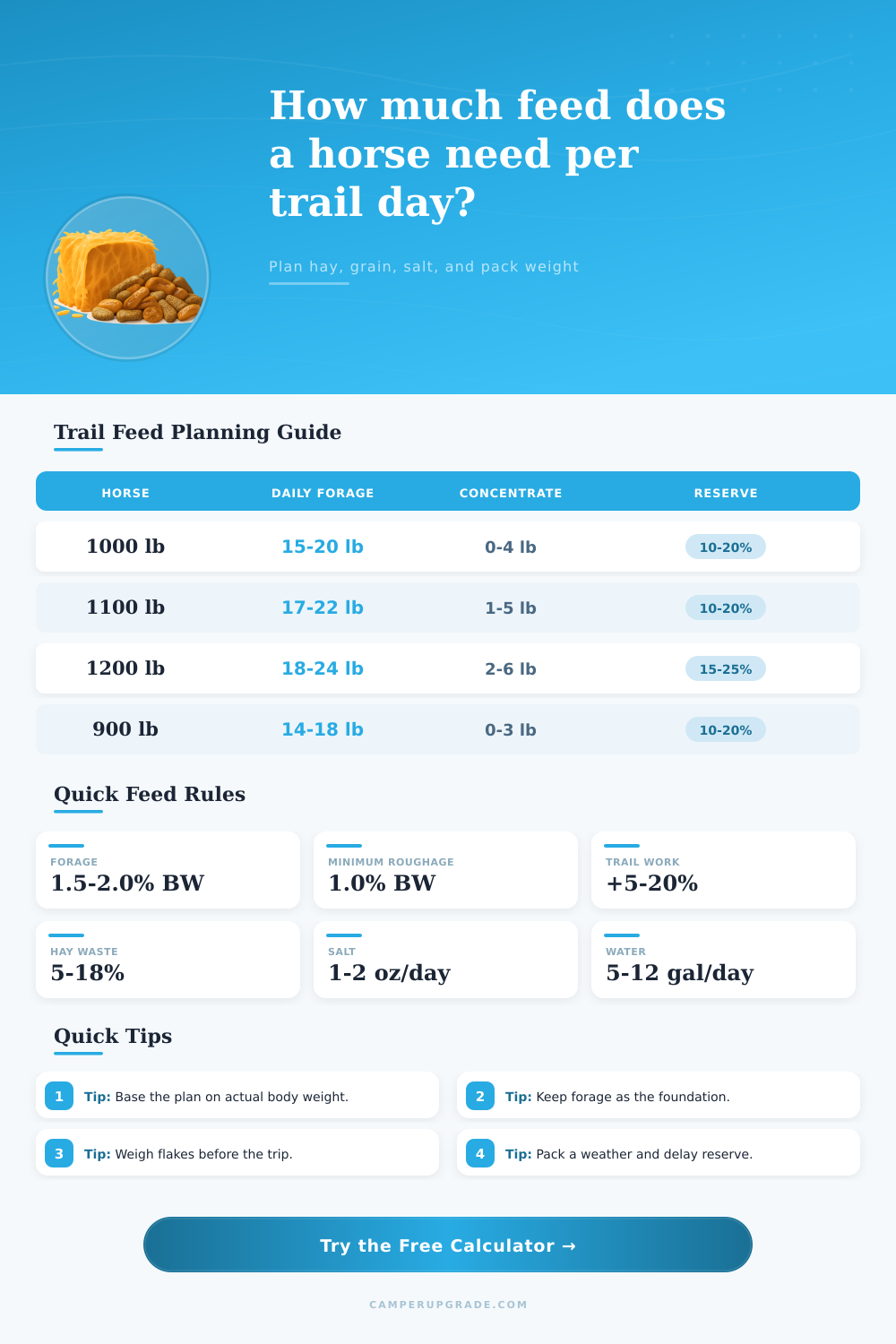
| Minimum long-stem forage | About 1.0% body weight | Safety warning if plan drops below it | For gut function, boredom, and chewing time. |
| Common daily forage plan | 1.5-2.0% body weight | Default is 1.8% | Raise for cold, hard work, or hard keepers. |
| Total dry intake | Often near 2.0-2.5% body weight | Forage plus concentrate and supplement | Do not make abrupt concentrate changes on trail. |
| Salt / electrolyte | Label-based, often 1-2 oz/day salt equivalent | Separate small-weight planning line | Never force salty water as the only water source. |
| Clean water | Often 5-12 gal/day, more with heat or dry hay | Displayed as a camp logistics flag | Feed plans fail quickly if water access is uncertain. |
| Feed form | Approx. packed density | Best use | Watch-outs |
|---|---|---|---|
| Loose or small bale hay | 5-8 lb/cu ft | Vehicle camps, short trailhead trips | Bulky and prone to handling waste. |
| Compressed hay bale | 10-14 lb/cu ft | Pack trips and resupply caches | Open early enough to inspect quality. |
| Hay cubes | 18-24 lb/cu ft | Dense pack feed, controlled ration bags | Many horses need them soaked or introduced slowly. |
| Hay pellets | 28-36 lb/cu ft | Small caches, mash, senior horses | Less chewing time than long-stem forage. |
| Mixed forage | 12-18 lb/cu ft | Hay foundation plus dense backup | Balance chewing time, water, and packing space. |
| Trail situation | Feed adjustment | Water note | Planning check |
|---|---|---|---|
| Cold wet camp | Add reserve | Offer warm mash if safe | Protect hay from rain. |
| Hot dry climb | Keep forage steady | Water demand rises fast | Do not overuse electrolytes. |
| Sparse grazing | Pack full ration | Natural water may be limited | Verify legal grazing rules. |
| Cache resupply | Split by segment | Keep feed dry | Label date and animal count. |
| Hard keeper | Add dense feed slowly | Plain water must remain available | Introduce feed before trip. |
⚠Trail Feeding Checks
Usually it’s at mile four, when sun goes over the ridge and tank is dry, that you remember: oh yeah, we need hay. That’s because trail feed planning are as much about moving supplies as it is about nutritional science. It is a moving supply chain. You have to manage two hundred pounds per meal. It is a train of supplies that never want to stop to resupply.
The tool handles the math but knowing what values to use keeps the panniers balanced and your horse calm. All rations begin with forage. Because horses must graze, reducing hay volumes to fit more in are risky business. To balance packing limits against gut health, our calculator assumes about 1.8 percent of bodyweight, which is default setting. Unless you add more cubes or grain, dropping below one percent long-stem fiber risks hindgut acidosis. This is not a recommendation; it is a physiological hard limit.
How to Plan Horse Feed for a Long Trip
If you have guessed your horse’s weight (most riders do) based off how they look, you’ve made an error. Taping around the girth give you a much truer picture of what your horse weigh than your eyeballs ever can. They might look lean but be carrying some extra insulation from grazing on grass for the last six months of winter.
The base number is affected by terrain. Four hours of riding on flat prairie land doesn’t burn as much fuel as four hours up and down steep switchbacks carrying a heavy load. The workload selector include that mechanical stress along with those extra calories required to fight gravity when lifting mass.
Weather enters the equation here too. Dry hot air requires more water while cold nights require more hay to generate internal heat. Not only do you need to pack for what the weather says but for what would of been the worst day reasonably possible. A sudden storm adds weight from wet blankets and slow your pace. This means you end up sitting at camp longer than expected with hungry mouths to feed.
Trail budget: Waste is a silent killer of your supplies. Muddy muzzles stick to loose hay; it gets blown around in wind or covered by mud. Compressed bales takes up less space, though trimming down is tricky and the trimmings aren’t useful. Waste as a % of total input connects math to dirty-field reality.
Packing pelleted cubes or pellets will reduce your waste % number, but you’ll sacrifice packing capacity (volume) for packing tightness (compaction). The denser the feed, the tighter it pack into saddlebags, but it offers less chewing time, which can matter if he’s a stressy type who likes to pick off the occasional twig all day long. Mixing some ration variation tend to keep morale better then a perfect calorie count does.
Amounts of salt and electrolytes vary according to water management. The reserve percentage add a buffer for things like a horse that simply won’t eat on the first day of camp changes. A salted mash won’t hydrate a horse forced to drink from a muddy cow tank. The reserve percentage is a buffer in case your trip takes longer than expected, a closure occurs, or delays happen. The reserve is insurance.
Weigh a handful of flakes at home before zipping saddlebags closed. Bag them by day and animal so you don’t have to do math in the dark. That way you don’t have to do math in the dark when you arrive. Boring (and safe) trips involve knowing there’s enough feed for all meals before pulling out of driveway. Knowing you have some extra meals mean you get to enjoy the view while packing up your horses rather than fretting over what you’re going to make for dinner tomorrow.