Hitch Receiver Class Selector Calculator
Compare trailer GVWR, tongue weight, receiver limits, ball mount limits, cargo carrier load, weight distribution, and safety margin against common hitch classes.
Rating breakdown
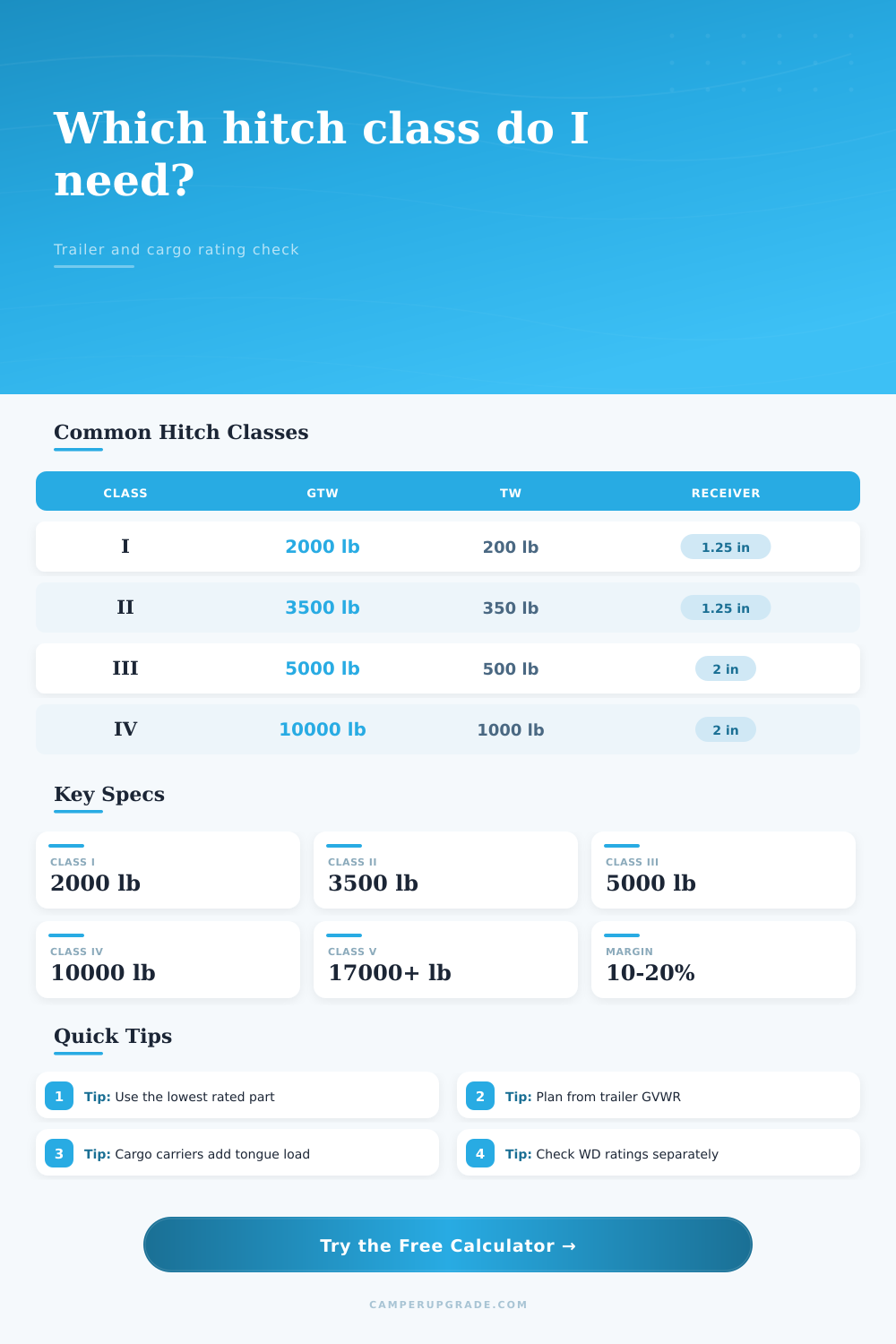
| SAE-style class | Typical max GTW | Typical max TW | Common receiver opening |
|---|---|---|---|
| Class I | Up to 2,000 lb | Up to 200 lb | 1.25 inch light-duty receiver |
| Class II | Up to 3,500 lb | Up to 350 lb | 1.25 inch or 2 inch receiver |
| Class III | Up to 5,000 lb | Up to 500 lb | 2 inch receiver |
| Class IV | Up to 10,000 lb | Up to 1,000 lb | 2 inch heavy-duty receiver |
| Class V | 17,000 lb and higher | 1,700 lb and higher | 2.5 inch or 3 inch receiver |
| Component | Rating to check | Load type | Calculator use |
|---|---|---|---|
| Vehicle | Tow rating and tongue limit | Gross and vertical | Can limit even if the receiver is stronger |
| Receiver hitch | WC and WD labels | Gross and tongue | Uses WD ratings only when WD is selected |
| Ball mount | Stamped gross and tongue | Gross and tongue | Compared with the same margin as the receiver |
| Hitch ball | Gross trailer rating | Gross trailer | Included as a gross tow limit |
| Cargo carrier | Load plus carrier weight | Vertical load | Added to tongue load with lever factor |
| Trailer or cargo setup | Planning weight | Typical vertical load | Likely class before vehicle check |
|---|---|---|---|
| Hitch cargo rack only | 0 lb trailer | 150 to 350 lb | Class II to Class III |
| Small utility trailer | 1,500 to 2,500 lb | 150 to 300 lb | Class II to Class III |
| Pop-up camper | 2,000 to 3,500 lb | 250 to 450 lb | Class III |
| Single axle travel trailer | 3,500 to 5,000 lb | 450 to 700 lb | Class III to Class IV |
| Large travel trailer | 6,000 to 10,000 lb | 700 to 1,200 lb | Class IV to Class V |
| Safety margin | Use case | 3,500 lb trailer need | 500 lb tongue need |
|---|---|---|---|
| 0% | Exact rating comparison | 3,500 lb | 500 lb |
| 10% | Known weights, short local trips | 3,850 lb | 550 lb |
| 15% | Normal planning buffer | 4,025 lb | 575 lb |
| 20% | Variable cargo and water load | 4,200 lb | 600 lb |
| 25% | Remote or hard-to-weigh setup | 4,375 lb | 625 lb |
Class tables are planning references. Always follow the lower rating shown on the vehicle, receiver, hitch ball, ball mount, weight-distribution equipment, and trailer labels.
Weight carrying
Simple ball mountUses the receiver's WC gross and tongue ratings. Cargo carriers also use vertical receiver capacity.
Weight distribution
Separate ratingUses WD receiver ratings only when the receiver label, vehicle, hitch, and trailer support WD use.
Ball mount
Stamped limitThe drawbar, adjustable mount, hitch pin, and ball must meet or exceed the same planned load.
Cargo carrier
Tongue loadCarrier cargo adds vertical load even when there is no trailer attached, especially with extensions.
That square tube look solid enough to haul anything. From the back of your truck where you stand, it’s just that; just a square tube. But remember: A hitch system isn’t as strong as the frame it’s bolted to. It’s as strong as its weakest link. That means choosing proper hitch class.
Your receiver’s capacity depend on what the hitch ball, ball mount, and vehicle’s tow rating will allow. And the calculator up top do all the math for you. It takes into account safety margins, cargo carrier loads and tongue weight to find that bottleneck before you get out onto road.
Why Hitch Safety Matters
It begins by inputting your trailer’s gross weight. Then it calculate the vertical load, and this is where people goes wrong. Downward force (tongue weight) on the hitch tend to be ten to fifteen percent of the trailer’s weight. If you’re filling the freshwater tank or packing gear behind axle, that percentage changes.
If you don’t have a scale, use the tool to input a percentage estimate, or an actual tongue weight measurement. Remember that adding cargo carrier like a hitch-mounted utility carrier or bike rack adds considerable vertical load, and it’s located further from vehicle. Using this force increase this stress on the receiver, meaning even a small carrier isn’t negligible. A heavy carrier may require more vertical capacity then a light trailer tongue.
There are also hardware limitation. One thing people often focus on is saying, “Well, it’s a two inch receiver. It’s a one and a quarter inch receiver,” and they think that defines the class. That is a myth. Because you can have a one and a quarter inch receiver with right size shank on it. It is rated for three thousand five hundred pounds.
What you need are stamped ratings for the receiver itself and the ball mount. The hitch ball also. Each of those pieces has a maximum tongue weight and a maximum gross trailer weight, and the weakest part of the system are whatever is lowest on that list. So if you have a receiver that’ll hold five thousand pounds but your ball mount will only hold three thousand, your system is limited to three thousand. This thing take into account all those parts and compares them to what you expect to put in there.
Hitches that shift weight redistribute tongue weight to the trailer axles and front axle, relieving some of vertical load on the receiver. But they don’t alter gross trailer weight limit. Even with weight redistribution, you’ll require a ball mount and receiver rated to handle total trailer weight. By selecting that mode, the tool switch to weight distribution ratings. That protects against exceeding the receiver capacity in WD situations.
That’s what makes this a safety tool as opposed to a way to bend a shank or strip threads. And then there is the safety margin. Safety margin are the last line of defense, and it’s also the most important. If something shifts in your cargo unexpected, if the wind suddenly picks up, or if you need to make an abrupt turn, these dynamic forces is not included in the static load rating and will push you right to the edge. Add a ten to twenty percent margin of safety and rest assured that whatever hardware you’re using is far below its elastic limit and will get you there safely.
It is the difference between a hitch-free journey and a huge roadside repair bill. Underestimating how much you have on board happens when you plan based off an optimistic loaded weight instead of the trailer’s GVWR. It’s not enough to select a class; you want to make sure each link in this chain will do its part. So you’re seeking balance between the load, hitch and vehicle. The math add up.
That makes towing mundane… Which is the entire idea. It’s your desire to have such a strong system that it fades into the background. You’re no longer concerned with the stress on your receiver. Instead, you simply get to enjoy the journery.