Hitch Ball Height Calculator
Find the ball mount rise or drop needed after tow vehicle squat, weight distribution recovery, coupler height, target trailer stance, hole spacing, and tongue weight rating checks.
🚚Real Towing Presets
⚙Receiver, Coupler, Mount, and Rating Inputs
📏Spec Grid
📊Reference Tables
| Measurement | Where to Measure | Use in Formula | Common Mistake |
|---|---|---|---|
| Receiver height | Ground to inside top of receiver tube | Loaded receiver after squat | Using unloaded height only |
| Coupler height | Ground to bottom of level coupler socket | Target ball height | Trailer not leveled first |
| Squat | Receiver drop after tongue load | Subtract from receiver | Measuring before cargo is loaded |
| Recovery | Height restored by WDH or support | Add back to receiver | Counting recovery twice |
| Target offset | Nose down or nose up preference | Add to coupler height | Confusing drop hitch with trailer drop |
| Exact Need | 1 in Step | 1.5 in Step | Setup Note |
|---|---|---|---|
| Drop 1.2 in | Drop 1 in | Drop 1.5 in | Both usually close |
| Drop 2.7 in | Drop 3 in | Drop 3 in | Recheck stance loaded |
| Drop 5.4 in | Drop 5 in | Drop 6 in | Needs enough drop range |
| Rise 1.6 in | Rise 2 in | Rise 1.5 in | Watch tailgate clearance |
| Rise 3.3 in | Rise 3 in | Rise 3 in | Confirm shank orientation |
| Trailer Type | Usual Stance | Why It Matters | Recheck Trigger |
|---|---|---|---|
| Travel trailer | Level to 1 in down | Stable axle loading | Water or WDH change |
| Boat trailer | Near level | Ramp launch angle | Gear moved fore or aft |
| Utility trailer | Level to slight down | Predictable tracking | Equipment moved |
| Car hauler | Level deck | Load ramp and axle balance | Vehicle position change |
| Horse trailer | Near level | Comfort and axle load | Livestock or tack change |
| Preset | Receiver | Coupler | Typical Mount |
|---|---|---|---|
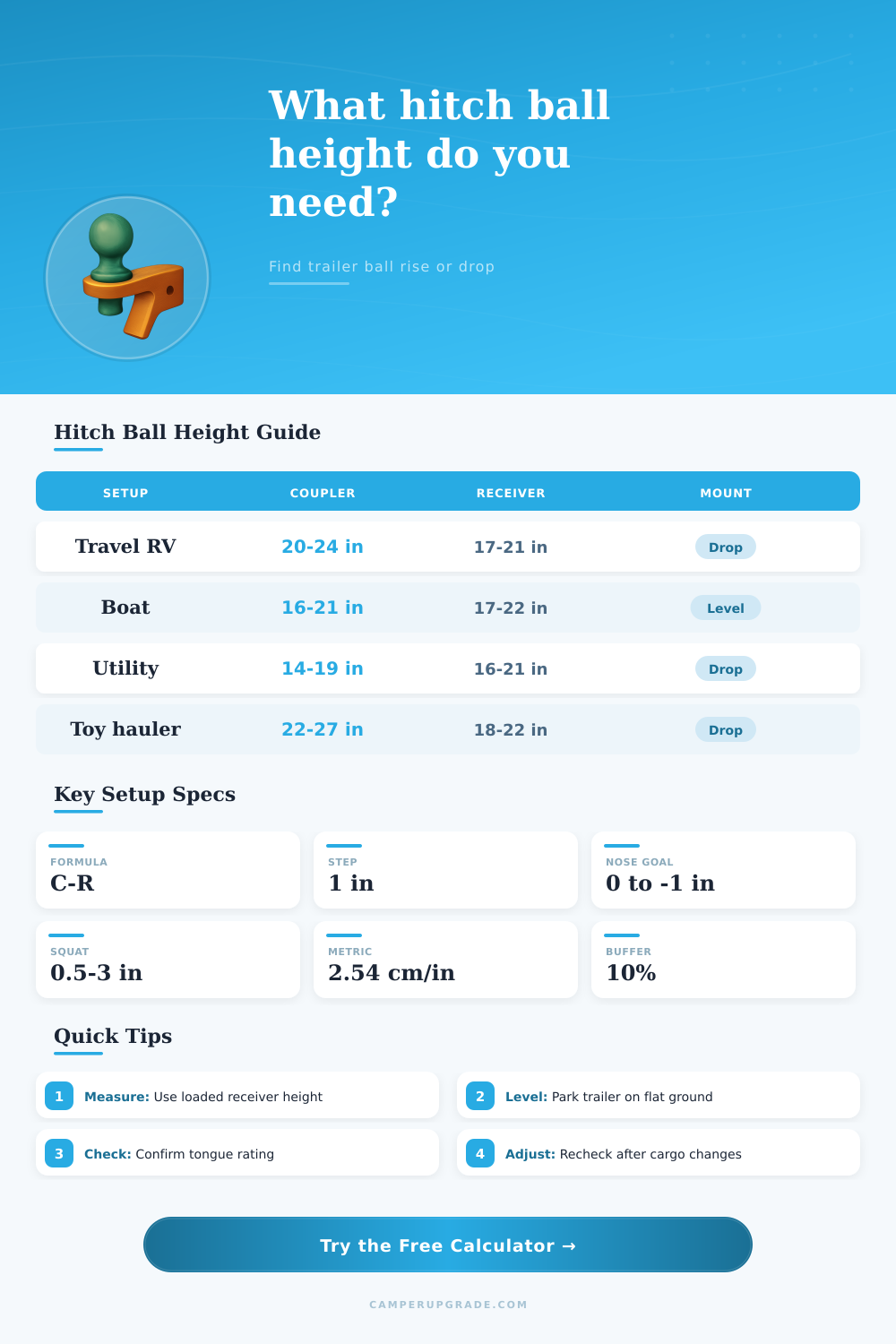
| Half-ton travel trailer | 18-21 in | 21-24 in | 2-5 in drop |
| Crossover teardrop | 15-18 in | 14-18 in | Level or rise |
| Lifted truck camper pull | 23-29 in | 18-24 in | 5-10 in drop |
| Boat trailer | 17-22 in | 16-21 in | 0-3 in drop |
| Toy hauler | 18-22 in | 23-28 in | 3-7 in drop |
💡Setup Tips
Proper hitch ball height are necessary for towing, and proper hitch ball height will ensure that the tow vehicle and trailer perform in a correctly manner. If the hitch ball is set too high, the front end of the tow vehicle may sits light on the ground, and the high hitch ball height will affect the tow vehicle’s steering. If the hitch ball height is set too low, the rear of the tow vehicle will squat when towing the trailer, and the low hitch ball height will cause the tow vehicle’s headlights to point toward the sky.
Many people does not realize that the hitch ball height is incorrect until they are on the road with the tow vehicle and trailer. However, calculating the hitch ball height before driving the tow vehicle will allow people to avoid these issue. The hitch ball height must be measure with the tow vehicle in its loaded state.
How to Measure and Set the Hitch Ball Height
This is to account for the weight of the trailer. The driver must consider the tongue weight of the trailer, as well as the effect that the trailer’s tongue weight will have upon the suspension of the tow vehicle. The measurement of interest is the loaded receiver height.
This value will help determine the hitch ball height that are required to provide for the proper towing of the trailer. The hitch ball rise and drop calculator will use the tow vehicle’s unloaded receiver height and the trailer coupler height to calculate the correct hitch ball rise or drop. Most tow vehicle will have a slight nose down stance with the trailer towed behind the tow vehicle.
A trailer might be level with the tow vehicle, but a slight nose down stance, around 1/2 inch, is the target for tow vehicles and trailers. The hitch ball height calculator will provide a number that demonstrate the hitch ball rise or drop for towing the trailer. Furthermore, the calculator will round the hitch ball height to the nearest hole on the tow vehicle hitch mount.
Another value to consider is the tongue weight rating of the hitch mount. The hitch mount must be able to support the tongue weight of the trailer. When purchasing the hitch mount, utilize the buffer setting.
This ensures that the hitch mount will not be operate at maximum capacity. The hitch mount’s capacity should be higher then the tongue weight of the trailer, even if the tow vehicle acquires additional fuel or gear. One of the most common mistake with hitch ball height is to measure the receiver height of the tow vehicle when it is empty of any cargo.
The loaded tow vehicle will have a different height than when it is empty of cargo. Furthermore, many people do not remember that weight distribution hitch systems can change the height of the rear end of a tow vehicle. It can also restore some of the height lost to weight distribution hitch system.
People must account for such changes. The type of trailer that is being towed will have different requirement for hitch ball height. For example, travel trailers will have a hitch ball height that feature a drop in height.
The reason for this is that the tongue weight of a travel trailer is high. Boat trailers require a hitch ball height that is close to level with the towing tow vehicle. This is due to the angle of the boat trailer when it launch the boat.
Finally, toy haulers and car trailers may require a drop in hitch ball height from the tow vehicle. This is due to the tow vehicle’s receiver mounting higher than the trailers coupler height. The distance from the hitch ball to the trailers axle will affect how the trailer react to adjustments to hitch ball height.
A trailer with a long wheelbase and short distance from hitch ball to axle will exhibit a different towing experience than a trailer with a short wheelbase and a long distance from hitch ball to axle. Furthermore, the angle of the trailer deck will change relative to hitch ball height, as this angle is important when loading a trailer or a boat. After the trailer has been towed on the road for the first time, the hitch ball height should be rechecked.
The hitch ball height might need to be adjust because the trailer may have changed the weights of the tow vehicle. This is especially true with trailers that carry water tanks or other types of cargo. The hitch ball height will help people to determine whether the tow vehicle and trailer are balanced correctly or whether the hitch mount must be moved to a different hole on the tow vehicle.
To complete this procedure, people must measure the hitch ball height, perform the hitch ball rise and drop calculations, determine the hole to select on the tow vehicle hitch mount, then verify the hitch ball height on the road.