💧 Hiking Water Calculator
Find out exactly how much water to bring on your next hike — by distance, duration, heat & intensity
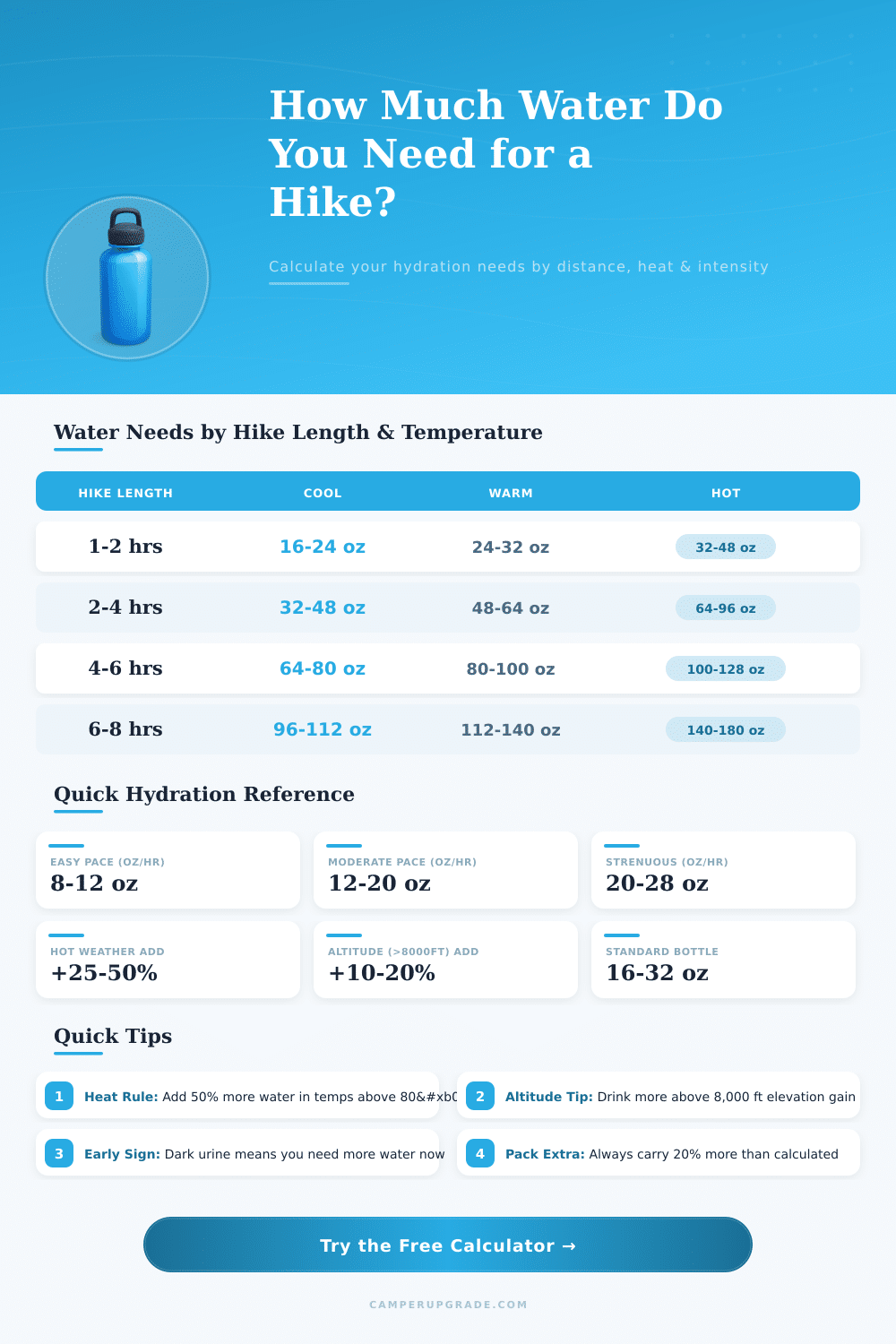
| Hike Duration | Cool (below 60°F) | Warm (75–85°F) | Hot (85°F+) |
|---|---|---|---|
| 1–2 hours | 16–24 oz | 24–40 oz | 40–56 oz |
| 2–4 hours | 32–48 oz | 48–72 oz | 72–100 oz |
| 4–6 hours | 64–80 oz | 80–104 oz | 104–136 oz |
| 6–8 hours | 96–112 oz | 112–144 oz | 144–180 oz |
| 8+ hours | 128+ oz | 160+ oz | 192+ oz |
| Container Type | Capacity | Best For | Notes |
|---|---|---|---|
| Standard Plastic Bottle | 16.9 oz (500 mL) | Short hikes | Lightweight, disposable |
| Sport Bottle | 20–24 oz | Half-day hikes | Squeeze top, easy sip |
| Nalgene (wide mouth) | 32 oz (1 L) | Day hikes | Durable, BPA-free |
| Nalgene (large) | 48 oz (1.5 L) | Long day hikes | Heavy when full |
| Hydration Bladder (S) | 1.5 L (51 oz) | Active hikers | Hands-free drinking |
| Hydration Bladder (M) | 2 L (68 oz) | Full day hikes | Most popular size |
| Hydration Bladder (L) | 3 L (101 oz) | Strenuous/hot hikes | Best for long days |
| Collapsible Bottle | 17–34 oz | Backup / ultralight | Packs flat when empty |
Stay hydrated during hiking up mountains is one of those tasks that seems easy but requires attention to details. How much water you need depends on your body, on the surrounding heat, on the moisture and on the weight of the path. Use around half liter water for every hour of medium motion in average conditions.
Many choose to bring a liter for every two hours of rise. Even so, in very warm or cool weather, you must drink more. If you climb steep hills and sweat a lot, the need grows even more.
How Much Water to Bring on a Mountain Hike
On an average day without rise, people need between two and three liters water. Adding hiking to the equation, that amount at least doubles, because you lose much liquid through sweat. For instance people weighing 150 pounds need around 75 units of water per day in average conditions, as a base for counting.
It is better to drink water often during the hiking than follow a strict time plan. The habit of little sips regularly helps a lot. Some hikers turn that into fun, taking a drink when they pass a little stream or arrive to a flat bit of the way.
Everything depends on drinking befroe, before the thirst hits.
water weighs a lot. Three liters in a hydration system can reach more than seven pounds of extra weight, which slows the carrying. Preparing the plan for hiking includes knowing, where one finds reliable water sources.
For short trips, simply bring the needed amount of water is the simplest way. During long treks, one must filter or clean water from natural surroundings.
Among popular filters is the Sawyer Squeeze, that fits on a usual water bottle, and the Katadyn Hiker Pro. Cleaning tablets work well as an extra option. Having a backup filter or cloth together with tablets gives extra safety.
In winter, mind, that tubes of hydration packs can freeze, and reaching unfrozen water for a filter device becomes more of a challenge in cold places.
Because one must carry water, hydration packs, like a three liter water packet, work well together with folding bottles for extra time. Some hikers like reusable metal bottles for one day rises, but switch to more lightweight versions for longer days. Others simply recycle empty Gatorade bottles for some months, until they replace them.
Anything that does not leak works well.
Food plays a role also. Water helps the body stay hydrated, but food delivers energy and minerals. Snacks, energy bars, dried meats and ready water usually work for one day hiking.
Bringing an extra bottle with minerals besides the main water is another usual fix. Water from a spring, that flows off peaks, is not safe without cleaning, even if itlooks clear.