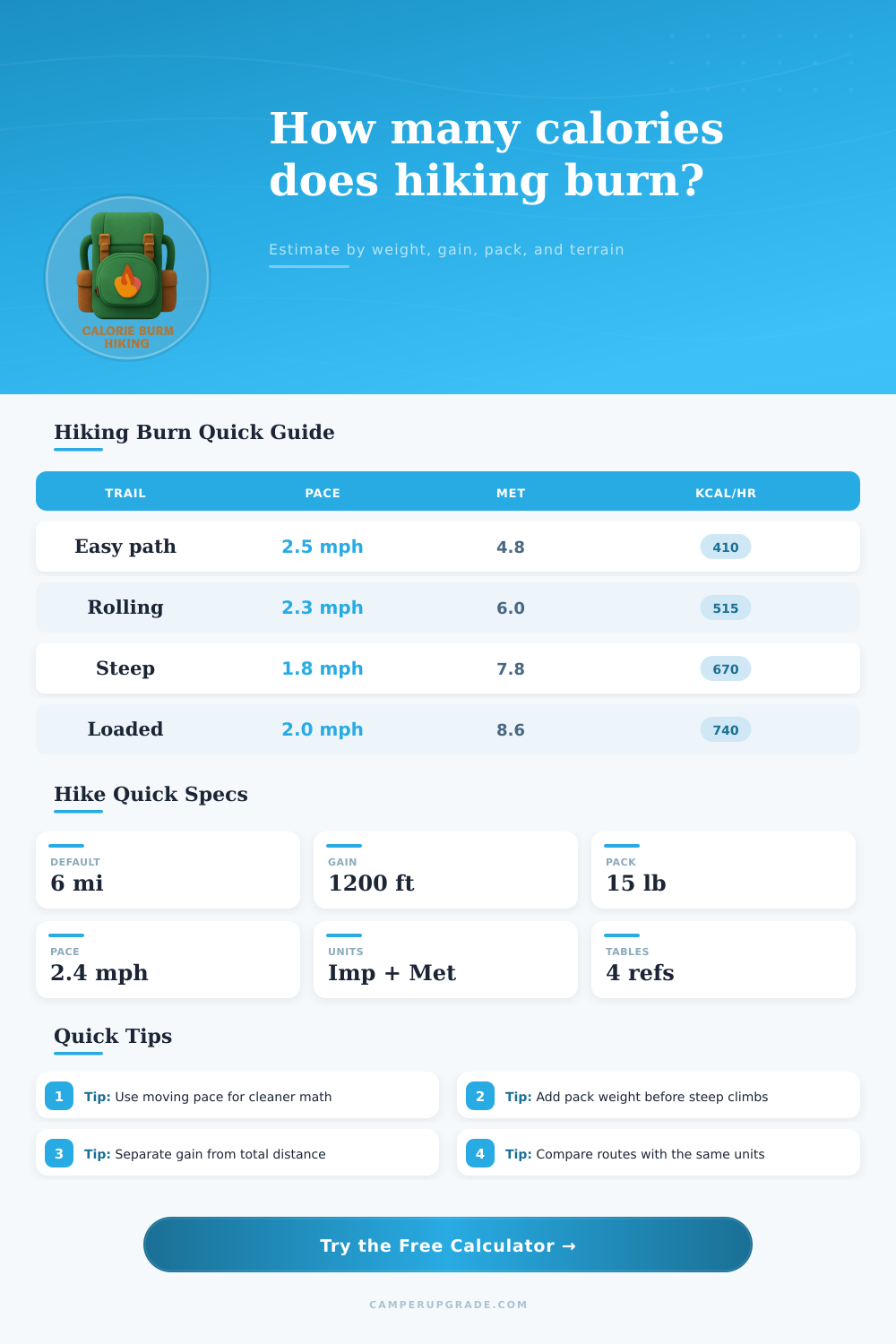
Calorie Burn Hiking Calculator
Estimate trail energy burn from body weight, route distance, elevation gain, pace, pack load, terrain, altitude, and weather.
🧭Trail Presets
📝Calculator Inputs
🧮Formula Cards
⛰Terrain and Spec Grid
📊Hiking MET by Pace and Terrain
| Hike Style | Pace | Base MET | Terrain Factor | Best Use |
|---|---|---|---|---|
| Easy path | 2.0-2.7 mph | 3.8-4.8 | 0.92-1.00 | Greenway or lakeside tread |
| Moderate trail | 2.0-2.5 mph | 5.3-6.0 | 1.00-1.08 | Maintained dirt hiking route |
| Rocky trail | 1.6-2.3 mph | 6.0-7.0 | 1.18 | Uneven steps and loose rock |
| Steep climb | 1.2-2.0 mph | 7.0-8.5 | 1.10-1.28 | Sustained switchbacks |
| Loaded climb | 1.2-2.0 mph | 7.5-9.5 | 1.18-1.32 | Overnight or alpine approach |
📈Calories per Hour by Body Weight
| Body Weight | Easy 4.5 MET | Moderate 6.0 MET | Hard 8.0 MET | Loaded 9.5 MET |
|---|---|---|---|---|
| 140 lb (64 kg) | 300 kcal | 400 kcal | 535 kcal | 635 kcal |
| 165 lb (75 kg) | 354 kcal | 472 kcal | 630 kcal | 748 kcal |
| 185 lb (84 kg) | 397 kcal | 529 kcal | 706 kcal | 838 kcal |
| 210 lb (95 kg) | 450 kcal | 600 kcal | 800 kcal | 950 kcal |
🎒Pack Load and Elevation Adjustment
| Pack Ratio | Load Factor | Gain per Mile | Climb Add | Route Note |
|---|---|---|---|---|
| 0-5% body wt | 1.00-1.03 | 0-150 ft | +0.0-0.4 MET | Light day hike |
| 6-10% body wt | 1.04-1.08 | 151-300 ft | +0.5-1.1 MET | Rolling trail |
| 11-15% body wt | 1.09-1.14 | 301-500 ft | +1.2-2.0 MET | Big climb day |
| 16-25% body wt | 1.15-1.24 | 501-800 ft | +2.1-3.2 MET | Overnight pack |
| 26%+ body wt | 1.25-1.30 | 801+ ft | +3.3-4.0 MET | Expedition load |
🌡Altitude and Weather Multipliers
| Condition | Factor | Trigger | Calories Impact |
|---|---|---|---|
| Low altitude | 1.00 | 0-4000 ft | Baseline effort |
| High trail | 1.03-1.08 | 4000-9000 ft | Small to moderate rise |
| Alpine air | 1.09-1.12 | 9000+ ft | Breathing cost rises |
| Hot exposure | 1.04-1.10 | 85-100°F | Thermal strain increases |
| Cold layers | 1.03-1.08 | Below 35°F | Clothing and footing cost |
When you have just finished a long day of hiking, you may want to know how many calories were burned during that hike. While many people may guess at the number of calories that they burned based off the distance or the elevations that they climbed during that hike, those guesses are not always accurately. In truth, the number of calories that an individual burns during a hike can be difficult to calculate, as there are a variety of different factor that contribute to that total number of calories burned, even if the distance that they traveled is the same during the hike.
One factor in the calculation of calories burned is the weight of the individual that is hiking and the weight of any pack that they may be carrying. An individual must expend energy to move their own body weight, as well as the weight of any pack that they are carrying. Thus, a fifteen-pound pack may burn fewer calories than the same weight of pack if that individual is climbing a steep hill.
What Affects the Calories You Burn on a Hike
The calorie calculator account for both the weight of the individual and the weight of the individuals pack (as separate variable), as well as the steepness of the route that they take. Because the calorie calculator separately calculates the impact of each of these variables, it is able to more accurate show how the variable of weight can impact the calories that are burned during hiking. Terrain is another variable that may impact the number of calories that are burned while hiking.
For instance, if the hike includes only even, smooth terrain, the calories that are burned will be less than on a terrain that includes rocks, sand, and other surface that may require more energy to move over. The calorie calculator accounts for terrain by permitting the individual to account for different types of terrain in the calorie calculation for the hike. Other factors, such as the elevation that is gained during the hike and the weather during that hike, may also impact the number of calories that are burned.
For instance, higher altitude require the body to work harder to move oxygen through the body, which may burn more calories. Similarly, weather that is hot or cold can burn more calories as the body must work to maintain its normal body temperature. Thus, a trail may burn more calories at a high altitude in hot weather than a trail at sea level with mild weather.
The calorie calculator accounts for these factor. The pace at which an individual hikes is another factor that may impact the calories that are burned. While it is true that if an individual hikes at a faster rate, they will burn more calories during that hike (per hour), they will be on the trail for less time.
Additionally, the number of calories that are burned during a hike also relate to the level of conditioning of that individual. For instance, an individual that is highly conditioned may burn fewer calories than an individual that is less conditioned and who may be taking breaks en route. The calorie calculator accounts for both the calories per mile that are burned and the total number of calories that can be burned, allowing for these two different variables to be accounted for in the hike calories calculation.
The way that elevation is distributed along a trail may impact the body’s perception of the hike (as well as the number of calories that are burned). For instance, a thousand feet of elevation may be considered easy if the elevation is gained over many mile, as compared to a thousand feet of elevation that is gained over one mile. Though the total elevation may be the same, it is distributed differently along the trail.
The calorie calculator accounts for the grade profile that the hike will take, allowing an individual to more precise calculate the number of calories that will be burned during that hike. Though the calorie calculator includes variables for most factors that impact the number of calories that are burned while hiking, there are still some variables that cannot be accounted for. For instance, the amount of rest that the individual took prior to beginning the hike, the number of calories that they consumed prior to beginning the hike, the amount of water that they are carrying (due to the uncertainty of where water source may be along the trail), as well as other factors, will impact the number of calories that are burned.
Thus, while the calorie calculator will allow an individual to determine the baseline number of calories that may be burned during a hike, it is also recommended that each individual account for these other variables related to there body and the hike itself. The best way to use the calorie calculator is prior to beginning a hike. For example, an individual may use the calculator to determine if adding five miles to their hike will burn enough calories to be worth the extra energy that their body must expend.
Furthermore, an individual may use the calorie calculator to determine that if they reduce the weight of their pack, they will find that some hill or climbs that they are to undertake will be easier to hike. Thus, using the calorie calculator can become a planning tool for individuals to determine the number of calories that will be burned, as well as to determine the best way to plan their hikes to minimize the number of calories that they burn (or to maximize that number if desired). Additionally, the more that individuals use such a calculator, the more that they will begin to recognize patterns in the number of calories that may be burned during hikes of similar distances, elevations, terrain, weights, and more.