🥾 Hiking Boot Break-In Time Calculator
Estimate the hours, days, and first-hike limits needed to soften new hiking boots safely
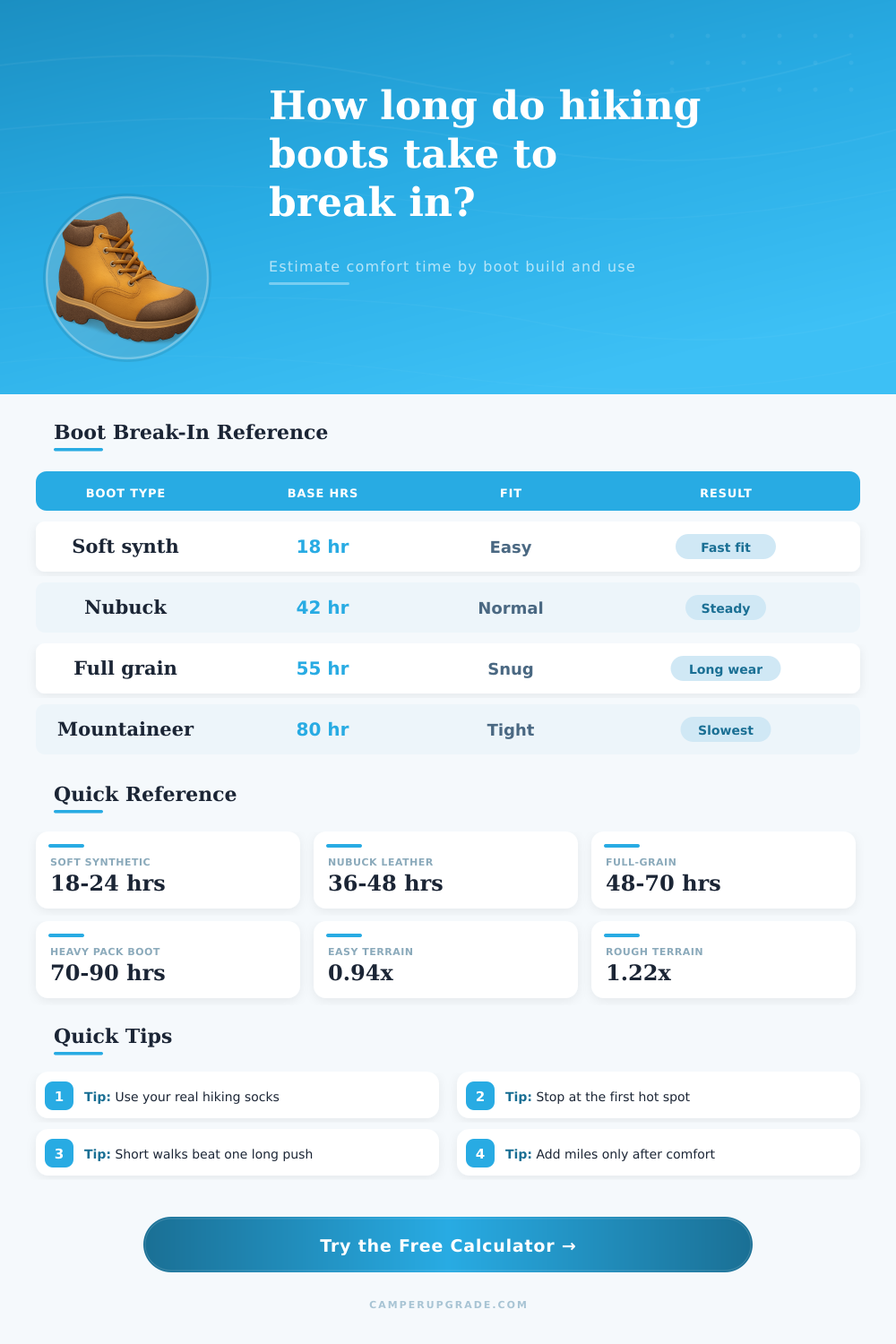
| Construction | Base hrs | Stiffness | Typical feel |
|---|---|---|---|
| Synthetic textile | 18 | 2-4 | Fast flex |
| Suede trail boot | 30 | 4-5 | Quick softening |
| Nubuck leather | 42 | 5-6 | Moderate hold |
| Waxed hybrid | 34 | 4-6 | Mixed response |
| Full-grain leather | 55 | 7-8 | Firm and durable |
| Insulated leather | 65 | 7-9 | Warmer, slower |
| Work-to-trail | 38 | 5-7 | Busy mid-range |
| Mountaineering | 80 | 9-10 | Longest break-in |
| Fit/Sock | Multiplier | Hotspot bias | Best match |
|---|---|---|---|
| Roomy + liner | 0.82x | Low | Easy days |
| Ideal + light | 1.00x | Normal | Most hikers |
| Snug + mid | 1.16x | Medium | Trail use |
| Tight + heavy | 1.34x | High | Expect pain |
| Wide + light | 1.24x | Medium | Width issues |
| Terrain | Factor | Session cap | Pace |
|---|---|---|---|
| Indoor walks | 0.78x | 30 min | 2.3 mph |
| Pavement | 0.94x | 60 min | 2.2 mph |
| Mixed loops | 1.00x | 90 min | 2.0 mph |
| Packed trail | 1.10x | 120 min | 1.8 mph |
| Rocky trail | 1.22x | 150 min | 1.5 mph |
| Technical | 1.35x | 180 min | 1.2 mph |
| Hours | Stage | Body signal | Next move |
|---|---|---|---|
| 0-4 | Fresh | Stiff flex | Indoor wear |
| 5-12 | Starting | Heel settles | Short walks |
| 13-24 | Softening | Fewer hotspots | Easy trail |
| 25-40 | Useful | Toe bend improves | Short hike |
| 41-60 | Comforting | Upper molds in | Normal hikes |
| 60+ | Dialed | Boot feels yours | Full use |
New hiking boots requires a break-in period. This is due to the fact that hiking boots is generally made of stiff material. If people wore hiking boots for long periods without a break-in period, friction and moisture builds up on the feet.
Friction and moisture often cause blister on the feet. Blisters are painful and can prevent the wearer from walking proper on the ground. Hence, people must understand the break-in process of hiking boots to ensure their comfort on there feet during hiking adventures.
How to Break in New Hiking Boots
The material out of which the hiking boots is made will determine the length of the break-in period for the hiking boots. Materials such as full-grain leather and nubuck is stiff in design to provide the wearer with long periods of durability. Hence, these materials will take longer to soften.
Synthetic materials is generally more flexible than leather. Hence, hiking boots made of synthetic materials will require less time to break in. The more rigid the hiking boot is, the more time it will take for the boot to bend and allow the material to soften.
Hiking boots made of soft synthetic materials will flex more easy and take fewer hour of wear before molding to the shape of the wearer’s feet. The type of socks that the wearer put on will impact the hiking boot break-in period. Thinner socks will allow the wearer’s feet to move more easy within the hiking boots.
Hence, thinner socks will speed up the hiking boot break-in period. Wearing thick and heavy socks will impact the hiking boot break-in period as the heavy socks will press against the leather of the hiking boots. Hence, the hiking boot will take longer to break in with the use of heavy socks.
People should opt for socks that will provide comfort within the hiking boots while hiking on different terrain. The terrain that the wearer put on hiking boots and the weight of the wearer’s gear will impact the hiking boot break-in period. Hiking boots can be worn on pavement, which is a gentle way to wear hiking boots.
However, hiking on rocky trail will provide an intense way to wear the boots. When hiking on rocky trails, people will develop hotspot on their feet due to the impact of rocks on the hiking boots. The heavier the pack that the wearer carry, the more the hiking boots will flex with the weight of the pack.
Hence, hiking with a heavy pack will speed up the hiking boot break-in period. However, the wearer will experience fatigue within there body. People can follow a process to break in their hiking boots.
For example, people can wear their hiking boots indoors for short period of time such as 30 minutes at a time. This will allow them to check if there will be any friction and discomfort between the boots and their feet. Once people has acclimated to the hiking boots while wearing them indoors, they can walk on the path near their homes.
People should stop wearing the hiking boots if they feel warmth or friction on their skin as this can lead to blisters. People should always add mile to the hiking boots gradually so as not to experience inflammation on their feet. There are many way to break in hiking boots.
People can use treatment to soften the leather of the hiking boots. People can manually flex their hiking boots or stuff them with newspaper to help the hiking boots mold to their feet over time. People should also pay attention to the way that they lace their hiking boots as this will prevent their heel from slip within the hiking boots.
If people prevent their heel from slipping within the hiking boots, they will experience reduced friction between their heel and the hiking boots. The total length of time that hiking boots need to break in is cumulative. This means that the total number of hour that people wear their hiking boots is more important than the number of day that they wear them.
For instance, if a pair of leather hiking boots requires 55 hour to become comfortable with the wearer’s feet, then people can achieve 55 hours by wearing the hiking boots for 90 minutes four times each week. By following this process for hiking boots, over time the hiking boots will mold to the wearer’s feet so that they experience comfort while they are on hikes with there backpacks and gear.