Heat Stress Work Rest Cycle Calculator
Estimate corrected WBGT, rest minutes per hour, water planning, and heat safety flags for trail crews, camp builds, events, and hot-weather chores.
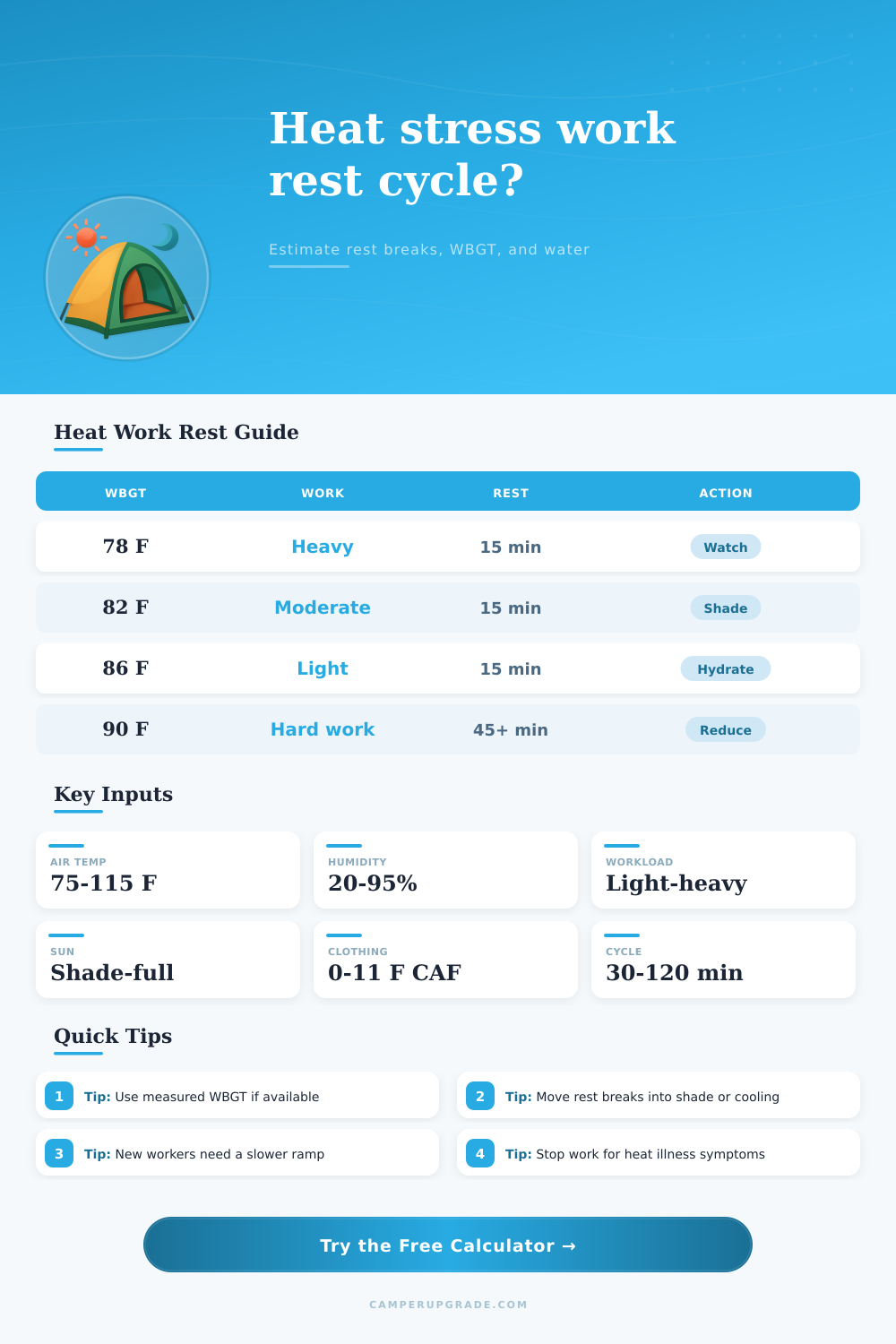
| Corrected WBGT | Typical planning meaning | Field action | Watch item |
|---|---|---|---|
| Below 78 F / 26 C | Lower heat strain for most acclimatized light/moderate work | Normal breaks, water access, symptom checks | Humidity can still matter on long shifts |
| 78 to 82 F / 26 to 28 C | Heavy work starts needing planned recovery | Add shade breaks and rotate hard tasks | New workers and heavy PPE |
| 82 to 86 F / 28 to 30 C | Moderate work may need 15 to 30 min rest per hour | Use buddy checks and cooling stations | Rising heart rate, dizziness, confusion |
| 86 to 90 F / 30 to 32 C | Hard work becomes difficult to sustain safely | Shorten cycles, reduce pace, move work earlier | Heat illness symptoms require stopping work |
| 90 F+ / 32 C+ | High heat strain for most field work | Consider postponing heavy work or using active cooling | Medical response plan and supervision |
| Class | Approx. metabolic rate | Examples |
|---|---|---|
| Light | 180 W | Spotting, sorting gear, slow walking |
| Moderate | 300 W | Steady hand tools, camp setup, mowing |
| Heavy | 415 W | Digging, hauling water, fast hiking, heavy tools |
| Very heavy | 520 W | Saw work, roof work, pack hauling, emergency response |
| Clothing/PPE | Added WBGT | Planning note |
|---|---|---|
| Breathable work clothes | 0 F / 0 C | Baseline for most simple schedules |
| Long sleeves, pants, sun hat | 2 F / 1 C | Sun protection with small heat penalty |
| FR or heavier woven workwear | 4 F / 2 C | Vent breaks and loosen when safe |
| Rain shell or low-breathability layer | 8 F / 4 C | Sweat evaporation is strongly limited |
| Disposable coverall | 11 F / 6 C | Use conservative cycles and active cooling |
| Worker status | Heat exposure planning | Calculator adjustment | Practical check |
|---|---|---|---|
| New or returning | Start at roughly half of usual hot work duration | Lowers tolerance and increases rest | Close supervision and buddy checks |
| Partial acclimatization | Use shorter cycles until several heat days are completed | Moderate tolerance reduction | Reassess after lunch and after task changes |
| Acclimatized | Can tolerate more heat but still needs breaks | Baseline threshold | Watch hydration, sleep, illness, medications |
| After illness or time away | Treat as reduced acclimatization | Select partial or new worker | Do not rely on last season's tolerance |
Light Cotton Blend
Comfortable in shade but can stay wet. Good for camp chores when breaks are frequent and airflow is available.
Wicking Polyester
Dries quickly and supports evaporative cooling. Useful for hiking support, event work, and moving crews.
FR Workwear
Often heavier and less breathable. Add clothing adjustment and plan longer seated cooling breaks.
Rain Shell
Blocks wind and evaporation. Shorten work cycles when storms, wet brush, or pressure washing force shell use.
Disposable Coverall
High heat burden for cleanup and dusty work. Use conservative cycles, buddy checks, and a cool rest zone.
Ice Vest or Cooling Towel
Can reduce strain during rest or short tasks. It helps most when paired with shade, water, and task rotation.
That’s why we have the heat stress work rest cycle calculator: Intuition makes an awful safety tool when it’s hot out. This continues until you don’t feel fine. Because WBGT (Wet Bulb Globe Temperature) measure more than just ambient air temperature, taking humidity, wind and radiant heat into account. It tells you what really matters.
And it converts that information into a straightforward plan of rest minutes and work minutes so your crew isn’t making guesses about whether they’ll make it another hour before the dig starts. The biggest error that folks make is to think about the thermometer alone.
Why We Need a Heat Stress Calculator
So what? It’s 90° out there, but it’s also really dry; I’ll just sweat off the heat. Sure, maybe for a while. But it’s 85° out there and humid at 90% (you’re screwed before lunchtime). That’s why the calculator include an option for your workload class.
Tasks like hauling and sawing create loads of internal body heat (they turn your muscles into ovens). The calculator accounts for this, dropping its safe working window to match such work. This means you don’t give yourself the same tolerance levels for a light packing task as you would for a heavy roof repair.
And then there’s clothes. This is more than most people realize. When you put on coveralls or rain gear, sweat gets trapped next to the body where it can’t evaporate. Dead stop. That increases the actual heat index by adding a clothing adjustment factor to the calculator. That is why all those numbers say this is good for someone wearing cotton but bad for someone dressed in some fire-retardant weave of workwear.
It doesn’t have to do with comfort, it has to do with science. Sweat if it can’t get off your body stays on your body and raises your internal temp no matter what you may believe yourself to be made of. That all can change with getting used to it.
On the first couple of days at a new job site, you’d take about 1/2 your normal heat exposure time if you’re a new guy or one who’s been away from work for a month and hasn’t worked hard in awhile. Your body isn’t adapted to conserving salt and sweating better yet. The tool takes that into account for new guys or those somewhat acclimated. It slows down the cycle and makes the planner go slower during the ramp-up. This prevents early season incidents where folks think they’re as good as last August, but they typically aren’t.
The results include water planning, but drinking that water doesn’t guarantee you won’t collapse. If you’re standing in the full sun with no shade breaks, you can drink gallons and still go down. While the calculator will estimate how much water you’ll need for your crew size, the true benefit comes from recommended rest stops that it mandates. Only those resting minutes in an actual area where you will cool off (or at least be shaded) count. Just sitting under a tree doesn’t cut it if the ground underneath is baked asphalt and radiating its heat back up into you.
The page has a clear reference table outlining these limits. For the most part you can stick to regular breaks below seventy-eight degrees. When above ninety, you’re flirting with danger doing any kind of heavy work.
Heat stress management is about structure, not willpower. You cannot fight thermodynamics with grit. Grit won’t overcome thermodynamics. The calculator provides a defensible plan by asking you to plug in what matters, your rest area quality, solar exposure, etc. This ensures you do not leave break schedules to supervisor judgment calls regarding safety on the fly.
Safety isn’t an emergency response. Safety is a schedule. You sit down when the air is heavy and thick. At that point, you stop relying on how you feel. Instead, you start trusting the numbers that tell you it’s time to sit down.