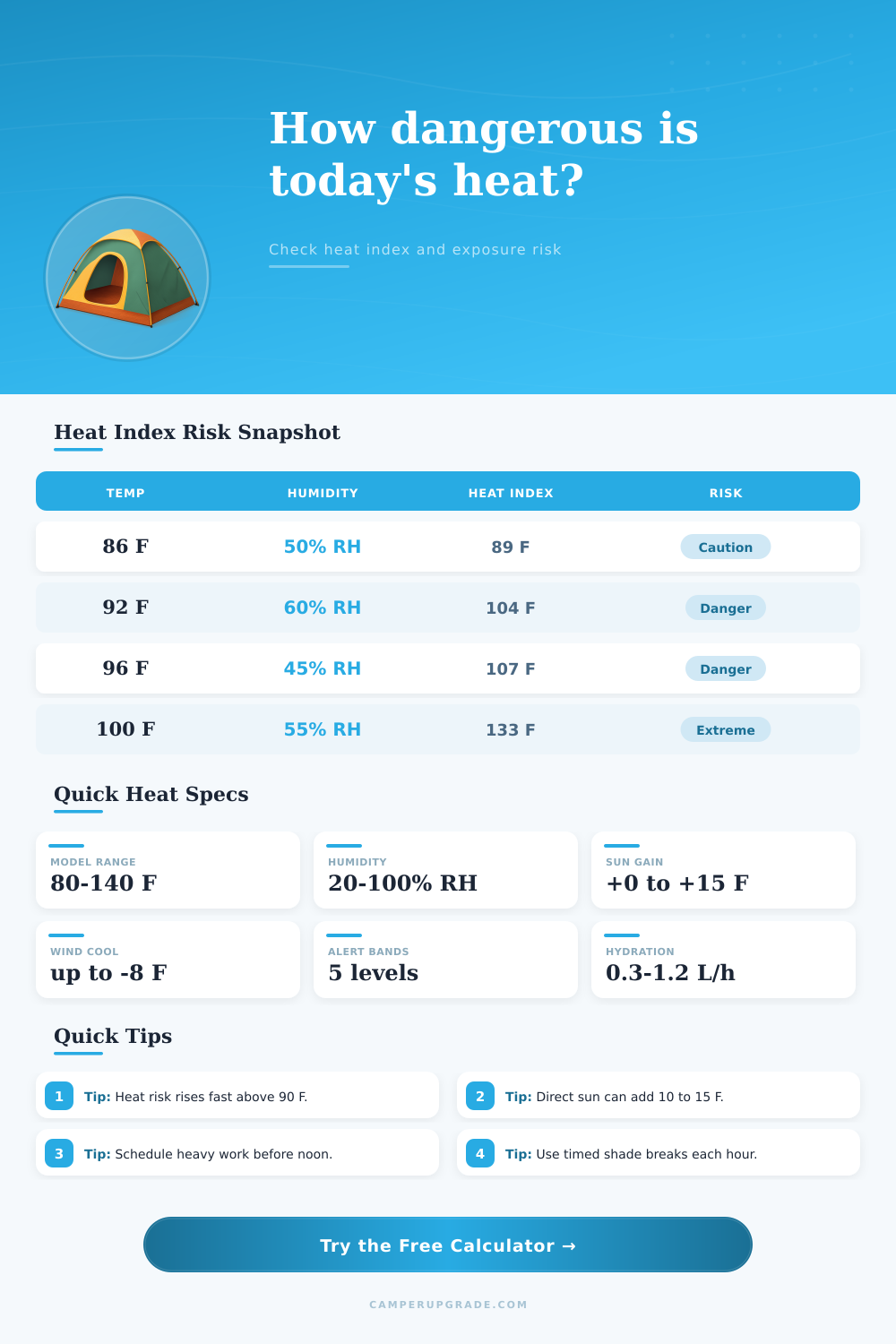
Heat Index Calculator
Model heat stress with humidity, sun load, wind, activity intensity, and exposure duration for safer outdoor planning.
☀Scenario Presets
🌡Measurement System
⚙Heat Load Inputs
📊Heat Factor Grid
📘Reference Tables
| Heat Index Band | Range (F) | Range (C) | General Concern |
|---|---|---|---|
| Lower | Below 80 | Below 26.7 | Minimal stress risk |
| Caution | 80-90 | 26.7-32.2 | Fatigue with long exposure |
| Extreme Caution | 90-103 | 32.2-39.4 | Possible heat cramps |
| Danger | 103-124 | 39.4-51.1 | Heat illness likely |
| Extreme Danger | 125+ | 51.7+ | Heat stroke possible |
| Adjusted Feels-Like | Light Activity | Moderate Activity | Heavy Activity |
|---|---|---|---|
| Below 90 F | 55/5 cycle | 50/10 cycle | 45/15 cycle |
| 90-103 F | 50/10 cycle | 40/20 cycle | 30/30 cycle |
| 103-115 F | 40/20 cycle | 30/30 cycle | 20/40 cycle |
| 115+ F | 30/30 cycle | 20/40 cycle | 10/50 cycle |
| Condition | Sweat Rate (L/h) | Sodium Range (mg/h) | Hydration Plan |
|---|---|---|---|
| Cool light work | 0.3-0.5 | 250-450 | Frequent small sips |
| Warm moderate work | 0.5-0.8 | 400-700 | 250 ml every 15-20 min |
| Hot sustained work | 0.8-1.0 | 600-900 | 350 ml every 15 min |
| Extreme heat load | 1.0-1.2 | 800-1200 | Active cooling breaks |
| Preset Scenario | Temp / RH | Adjusted Feels-Like | Risk Band |
|---|---|---|---|
| Gulf Coast Noon Shift | 95 F / 70% | 128 F | Extreme Danger |
| Desert Hike Dry Heat | 101 F / 20% | 104 F | Danger |
| Humid Forest Trek | 90 F / 80% | 119 F | Danger |
| Sunrise Recovery Walk | 78 F / 65% | 80 F | Caution |
The heat index, sometimes called the apparent temperature, tells how hot it really feels when you combine the actual temperature with the relative humidity. It is also known as the “real feel”. In short, it mixes the air heat and the humidity in shady places to estimate the temperature that people feel outside.
Even at 80°F the air can feel much more warm if it is muggy and there is little wind
What Is the Heat Index and How It Affects Camping
The real calculation of heat index considers only the temperature and humidity. Wind or sun do not affect it. The formula is used only when the temperature goes over 80 degrees.
It shows that: in zero wind and zero humidity the index is how warm the air should be so that your body feels the same.
The human body always makes heat and dumps the excess in the air. In warmer air less body heat exits. Hence humidity plays such a role.
Swamp coolers work better in dry climates, because they cool by means of evaporation. When you add humidity to the air, the heat index rises and everything seems warner.
For campers that is a big deal. The National Weather Service says that direct sunshine can raise the heat index value by up to 15 degrees. Also the protection against the sun matters.
Ninety-degree heat feels different in an open meadow than in shady woods. Going to the mountains during camping often settles the heat problem.
Camping in great heat is possible, but is difficult. Some trips had heat index values above 100 almost always. Once in southeast Oklahoma it reached even 110.
During a trip in a state park with index above 100 the RV’s air conditioner worked to keep the cold and did not stop until midnight. Close all windows and curtains, lay reflecting material in the windows and use pillows for the roof vents. Sunshine in the RV heats everything it touches and the interior becomes much more warm.
Air conditioners must work at maximum efficiency during big heat. The coils can get full of dirt and need cleaning. Stay hydrated, drink a lot of water and stay in shade, that is basic.
A closed RV can become an oven and reach 110 to 140 degrees inside. The heat index gives great help to estimate the impact on the human body, especially outdoors.