Hand Warmer Duration Calculator
Estimate usable heat time, heat-hours, pack coverage, and extra warmers for air-activated packets, toe warmers, charcoal cases, catalytic warmers, gel packs, and USB rechargeable hand warmers.
🏕Real Camping Presets
⚙Warmer And Weather Inputs
🧪Material And Spec Comparison Grid
📊Reference: Warmer Type Runtime Ranges
| Warmer type | Typical active heat | Best use | Duration limiter |
|---|---|---|---|
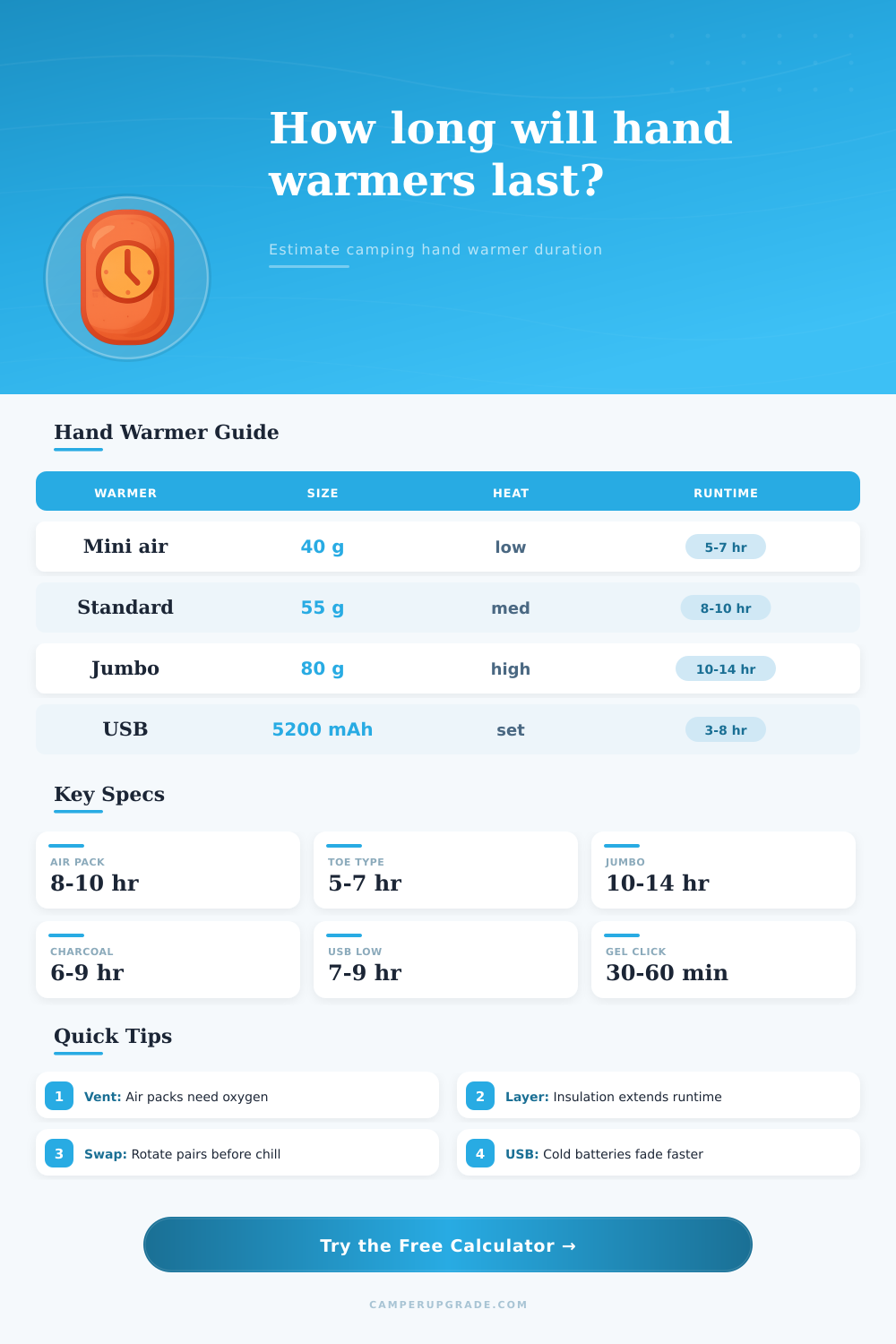
| Mini air-activated packet | 5 to 7 hr | Kids gloves, short hikes | Small iron powder mass |
| Standard air-activated packet | 8 to 10 hr | Gloves and jacket pockets | Oxygen and insulation |
| Jumbo air-activated packet | 10 to 14 hr | Hunting, basecamp, long shifts | Bulk and airflow |
| Adhesive toe warmer | 5 to 7 hr | Boot toe boxes | Low oxygen in tight boots |
| Large body patch | 10 to 12 hr | Core warmth under layers | Placement and skin safety |
| Charcoal stick warmer | 6 to 9 hr | Reusable pocket case | Charcoal burn rate |
| Catalytic fuel warmer | 12 to 18 hr | All-day pocket heat | Fuel fill and snuffer use |
| USB rechargeable warmer | 3 to 8 hr | Adjustable pocket heat | Battery size and setting |
| Gel click pack | 0.5 to 1 hr | Quick warmup and first aid kits | Stored heat of gel |
🌡Reference: Cold And Exposure Multipliers
| Condition | Runtime factor | Heat feel | Calculator input |
|---|---|---|---|
| Indoor RV or still shelter | 1.08x | Warmers feel stronger | Wind and exposure |
| Light wind on trail | 1.00x | Baseline outdoor use | Wind and exposure |
| Windy lift or boat | 0.82x | Heat stripped from pocket | Wind and exposure |
| Inside insulated mitten | 1.10x | Longer useful warmth | Placement |
| Wet boot or glove liner | 0.78x | Moisture absorbs heat | Moisture level |
| Below 10 F average | 0.75x to 0.90x | More heat loss and battery sag | Temperature |
🔋Reference: USB Warmer Battery Estimates
| Battery size | Low setting | Medium setting | High setting |
|---|---|---|---|
| 3000 mAh compact | 4 to 5 hr | 2.5 to 3.5 hr | 1.5 to 2.5 hr |
| 5200 mAh common size | 7 to 9 hr | 4 to 6 hr | 2.5 to 3.5 hr |
| 7800 mAh large pocket | 10 to 13 hr | 6 to 8 hr | 3.5 to 5 hr |
| Cold battery penalty | minus 10% to 25% | depends on pocket warmth | shown by age condition |
🧮Reference: Common Trip Pack Counts
| Scenario | Warmth window | Warmers active | Starter count | Reasonable reserve |
|---|---|---|---|---|
| Cold campsite morning | 3 hr | 2 at once | 2 standard packets | 1 spare packet |
| Winter day hike | 8 hr | 2 at once | 4 standard packets | 2 spare packets |
| Toe warmers in boots | 6 hr | 2 at once | 2 toe warmers | 2 spare toe warmers |
| Dawn hunting stand | 7 hr | 2 at once | 2 jumbo packets | 2 standard packets |
| Ice fishing shelter | 10 hr | 2 at once | 4 standard packets | 2 spare packets |
| RV heater outage night | 8 hr | 2 at once | 2 body patches | 2 hand packets |
💡Planning Tips
It’s tough to sit comfortabley in a deer stand at daybreak when your coffee is gone cold and your digits has turned numb. Your skill is reduced; you can’t keep yourself alert or fiddle with gear.
Enter hand warmers; but these are tricky devices. If you stuff a packet into a small pocket or climb up a breezy ridge, what was good for 10 hours on the shelf will be toast in six. Guesswork won’t help; knowing why they work different helps. This calculator removes much of the guessing and accounts for insulation level, wind chill, and oxygen access to run math for you.
How Hand Warmers Work in Cold Weather
Most of us think that a typical air-activated pack just kind of dies when the air runs out…but that’s not quite true. Air-activated packs is relying on an oxidation reaction: iron powder with oxygen. So if you trap one in a baggie or seal it up super tight inside a thin glove liner, then it’ll starve for some air and run cool…but if you expose it to a nipping wind, then it will blow off heat faster then it generates. The tool ask for your airflow conditions and where you’ve placed your warmer. It uses that information to calculate a likely usable duration, instead of just showing manufacturer’s best-case numbers from a lab.
Wind exposure is a really effective killer of thermal comfort. If you’re hiking on a sheltered trail, a light breeze barely affects your heat retention. But stand on boat deck or open lift line and that exposure will cut into your runtime pretty drastically. Exposure multiplies are listed in table on this page, which lists how they work with ambient temps.
When you factor in moisture, the physics don’t get any friendlier. Wet fabric lose its ability to retain heat and instead conducts the heat away from your body very quickly. That means your glove liners absorbs the warmth generated by your packet before it ever has a chance to reach your hands. So dryness trumps flame ratings.
USB warmers offer adjustable heat levels and portability, but you have to carry the extra weight of a battery that won’t hold as much charge in cold weather. Below freezing temps means lithium batteries sag and high heat settings might not hold up as well on sub-zero morning outings than they would in the warmth of your home. This is reflected in the calculators where you can choose your target heat level along with your charge condition.
It is a small detail but important for angler who plans to be out there all day on a 10 hour ice fishing trip and can’t get back into town to recharge. Do I have enough to make it till dark or am I going to fizzle out before the early morning bite?
Smart packing involves planning by simultaneous use. If you use two packets together, you don’t have four hours of heat from carrying four packets; you’ve got two periods of warmth. The tool assume you’re deploying multiple units at once. It calculates your pack coverage accordingly and avoids the frequent problem of bringing half the ammo necessary for the battle.
Always err on the side of adding a reserve margin. Plans goes longer than the map, conditions change, and sometimes packs don’t activate as expected. For day hikes, a twenty percent buffer is usually sufficient; remote trips demand more.
What you’re really paying for: This is where things get tricky, what you’re really getting is time before your extremities shut down. If you use hand warmers, gel packs, or charcoal sticks, the idea is the same, to keep your fingers warm and distraction-free. Use them as a part of your layering system… Not a stand-alone solution.
Don’t put them against your bare skin to avoid low-temperature burns, and don’t forget about ’em until they turn cold. Because you sure as hell could of not afford cold hands while you trudge through rough stuff in winter weather.