🪑 Hammock Weight Capacity Calculator
Estimate safe load, line tension, and suspension limits for solo or two-person hangs with instant metric equivalents.
| Hang angle | Side multiplier | Load feel | Use note |
|---|---|---|---|
| 20deg | 1.46x | Very high | Too tight |
| 25deg | 1.18x | High | Stiff hang |
| 30deg | 1.00x | Balanced | Best all-round |
| 35deg | 0.87x | Lower | More sag |
| 40deg | 0.78x | Lower | Loose lay |
| 45deg | 0.71x | Low | Deep sag |
| Style | Typical rating | Style factor | Profile note |
|---|---|---|---|
| Gathered-end | 300-400 lb | 1.00x | Classic trail use |
| Bridge | 350-450 lb | 1.12x | Rigid support path |
| Spreader-bar | 200-300 lb | 0.88x | Higher arm tension |
| Double-layer | 400-550 lb | 1.18x | More fabric reserve |
| Chair / seat | 180-240 lb | 0.75x | Single-seat posture |
| Stand-hung | 350-500 lb | 1.05x | Frame supported |
| Component | Working load | Metric | What it means |
|---|---|---|---|
| Tree straps | 400 lb | 181 kg | Webbing support |
| Whoopie slings | 300 lb | 136 kg | Light suspension |
| Carabiners | 650 lb | 295 kg | Connector limit |
| Mature trees | 350 lb | 159 kg | Per-side anchor |
| Hammock stand | 600 lb | 272 kg | Frame support |
| Roof beam | 700 lb | 318 kg | Heavy-duty anchor |
| Span | 30deg sag | Side length | Comment |
|---|---|---|---|
| 8 ft | 2.3 ft | 4.6 ft | Short hang |
| 10 ft | 2.9 ft | 5.8 ft | Compact rig |
| 12 ft | 3.5 ft | 6.9 ft | Balanced span |
| 14 ft | 4.1 ft | 8.1 ft | Roomier lay |
| 16 ft | 4.6 ft | 9.2 ft | Wide anchor gap |
| 18 ft | 5.2 ft | 10.4 ft | Stretchy pitch |
Hammock weight capacity depend on various factor, and understanding these factor ensures that a hammock setup will remain safe. A hammock’s weight capacity is more than the maximum load the hammock’s fabric can take. It is the combined strength of the hammock’s fabric, suspension lines, anchors, and the movement of an individuals who will use the hammock.
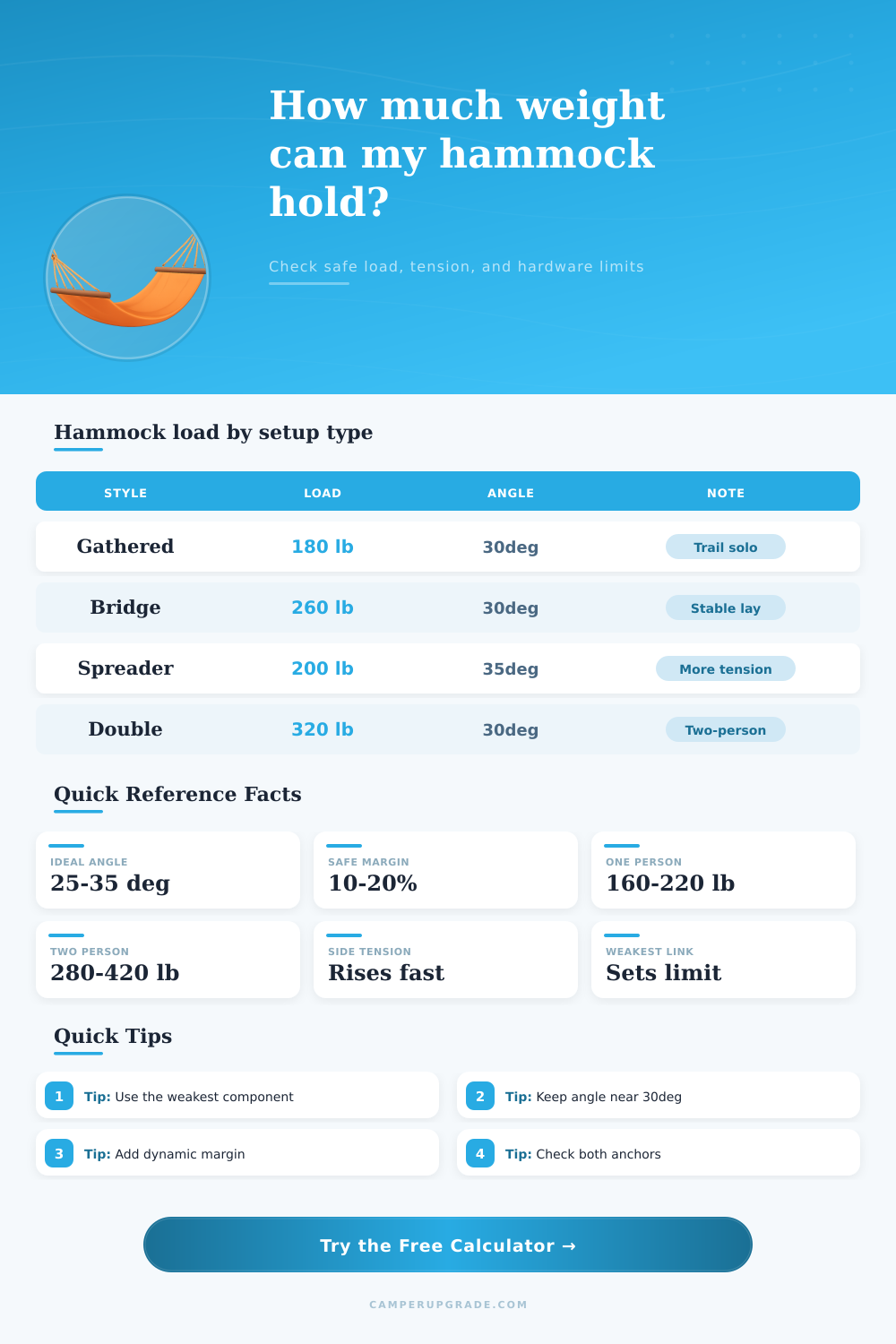
If any part of a hammock system is weak, that component will fail, resulting in the failure of the whole hammock system. The angle at which you hang a hammock directly affect the tension on the hammock’s suspension lines and anchor points. Hanging a hammock at a 30-degree angle allow each anchor to take the full weight of the individual in the hammock.
What Affects a Hammock’s Weight Limit
If the hammock is hung at a 20-degree angle to allow the hammock to sag more tight between two anchor points, the tension on the suspension lines and anchor points will increase by 46%. If you increase the angle to 45 degree, the hammock will sag more between the trees, and the tension will decrease in the suspension lines. The distance between two anchor points also has an effect on the tension in the suspension lines.
An 18-foot span between two trees will place more tension on the suspension lines than if a hammock was hung between two trees 12 feet apart. The movement of an individual in a hammock create more force than the static weight of the individual. If an individual is sitting in a hammock, the force required to lower into the hammock is 20% more than when the individual is sitting still.
If a child is bouncing up and down in a hammock, the force increase 45% more than when an individual is sitting still in the hammock. Therefore, the force that a hammock’s components can take must be more than the static weight of the individual who will use the hammock. Another factor that affect a hammock’s weight capacity is the weight limit of the anchor points.
Trees have specific weight limits for the branches on which a hammock is hung. The branches of a mature tree can take 350 pound, but deck posts can only take around 260 pounds before they splinter. A stand can take up to 600 pounds, but a roof beam can take up to 700 pounds when correctly bolt into the beams of a house’s structure.
However, you must also consider the weight limits of the suspension gear. Carabiners can take 650 pounds, but basic rope may only be able to take 220 pounds. The weight limit of the weakest component of a hammock will determine the total weight limit of the hammock system.
The style in which you hang a hammock will also affect the weight limits of the hammock. For instance, a gathered-end trail hammock evenly distribute the weight of an individual in the hammock; however, the capacity of a gathered-end trail hammock decrease if two individuals use the hammock at once. A bridge hammock allows an individual to maintain a sleeping posture that is more comfortable than when using a standard hammock because of its rigid support.
However, bridge hammock lines must be tensioned to a precise angle to prevent the hammock from twisting. A spreader-bar hammock allow for increased comfort for those who use the hammock because it opens wider than other type of hammocks; however, a spreader-bar hammock place stress on the arms of the individuals using the hammock. When calculating the weight capacity of a hammock, a safety margin for unexpected variable must be included.
For example, a 15% safety margin can account for the additional weight of wet gear or individuals caught in strong wind gusts. If two individuals will use the hammock, a 20% or 30% safety margin is advised due to the movement of the individuals. There are some common mistake people make when setting up a hammock.
One of the most common mistakes is not accounting for the weight that gear, such as a backpack or quilt, will add to the total weight of an individual using the hammock. Many people also do not account for the weight of other individuals when a hammock is only rated to support the weight of one person. Additionally, people often make a mistake with measuring the angle of the hammock.
Finally, people must inspect the suspension gear for any frayed webbing or corroded metal components of gear like carabiners; it is difficult to account for the strength of the gear when purchasing a hammock; any damage to the gear will reduce the strength of the system. External factor will also change the capacity of a hammock to support the weight of the individuals who use it. For instance, wind can increase the side force that acts on the anchor points by 30%.
Rain can also reduce the strength of the fabric of a hammock by up to 15%. The temperature of the environment will cause the lines of a hammock to stretch out due to expansion and contraction of metal. Additionally, the ultraviolet light in the environment will also degrade the nylon of the hammock over time.
Therefore, the environment in which it will be used, the angle from which it will be hung, the components from which it will be suspended, and the safety margin that is provided for unexpected variable determine the weight capacity of a hammock.