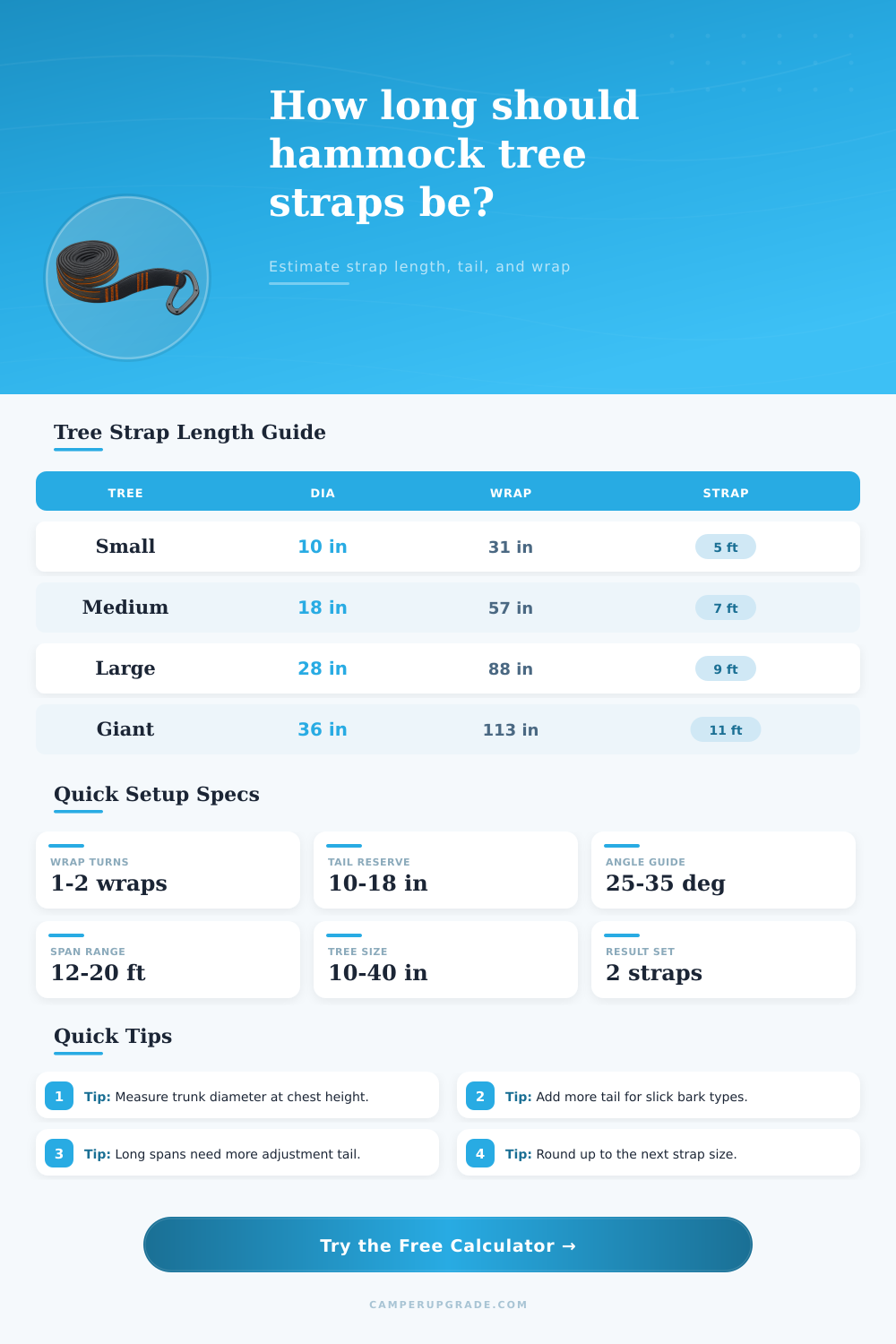
🌳 Hammock Tree Strap Length Calculator
Estimate wrap length, tail reserve, and a safe strap size for each tree so your hammock setup stays adjustable without running short.
| Tree Diameter | 1 Wrap | 2 Wraps | Suggested Kit |
|---|---|---|---|
| 10 in | 31.4 in | 62.8 in | 5-6 ft |
| 16 in | 50.3 in | 100.5 in | 7-8 ft |
| 24 in | 75.4 in | 150.8 in | 9-10 ft |
| 32 in | 100.5 in | 201.1 in | 11-12 ft |
| 40 in | 125.7 in | 251.3 in | 13-15 ft |
| Scenario | Span | Tree Size | Strap Note |
|---|---|---|---|
| RV lot pair | 13-15 ft | 12-18 in | 8 ft is often enough |
| Forest balanced | 15-17 ft | 14-22 in | Keep 2 ft extra tail |
| Wide lake edge | 17-20 ft | 18-28 in | Favor 10 ft straps |
| Giant hardwood | 18-22 ft | 24-36 in | Move to 12 ft kit |
| Short trail gap | 11-13 ft | 10-16 in | 6 ft kit can fit |
| Hang Angle | Tail Reserve | Tension Trend | Use Case |
|---|---|---|---|
| 20-24 deg | 18-24 in | High | Very flat hang |
| 25-29 deg | 14-18 in | Medium-high | Flat diagonal lay |
| 30-33 deg | 12-16 in | Moderate | Balanced comfort |
| 34-40 deg | 10-14 in | Lower | Deep sag setups |
| System | Tail Add | Stretch | Best Fit |
|---|---|---|---|
| Cinch buckle webbing | 18 in | Low | Easy micro-adjust |
| Daisy chain strap | 14 in | Very low | Fixed step setup |
| Whoopie sling + strap | 12 in | Very low | Lightweight rigs |
| Continuous loop strap | 10 in | Low | Compact trail kits |
| Tree saver webbing | 16 in | Moderate | Wide bark contact |
This model estimates strap length from trunk circumference, wrap count, system tail, bark buffer, and hang geometry. Use manufacturer ratings and inspect every component before a real hang.
To set up a hammock corectly, you have to consider teh diameter of the trees and the length of the hammock straps. Many people finds that the length of the straps is too short for the diameter of the trees. When you wrap a hammock strap around a tree, the circumference of the tree will consume some of the length of the hammock strap.
For example, if the tree has a 16-inch diameter, a tree will consume 50 inches of hammock strap to complete one single wrap of the strap around the tree’s circumference. In the case of a slick piece of bark that doesnt allow the hammock strap to remain in place with one wrap, there must be two wraps of the hammock strap around the tree. To measure the diameter of the tree, use a tape measure to find the circumference of the tree at a height of approximately a persons chest height.
Choose the Right Hammock Straps for Your Trees
The diameter of a tree will be the widest at the base of the tree and will narrow as the height of the tree increases. The hang angle of a hammock will also have an impact on the length of the hammock straps that will be required to hang the hammock properly. A shallow hang angle, which is less than 25 degrees, will require more tension on the hammock straps.
When there is tension on the hammock straps, there will be more of the hammock straps that pass through the buckles of the straps. For this reason, a deeper hang angle that require more of a hammock to sag will require less tension on the straps. A good hang angle for a hammock is between 28 and 33 degrees as this will allow for even distribution of the body weight of the person who will be using the hammock.
Should the two trees that you will use to hang the hammock be of different sizes, the hammock straps should be sized for the larger of the two trees. There are different types of hammock strap systems that come with different amounts of adjustment room. For example, cinch straps allow a person to make many micro-adjustments to the hammock straps.
However, the cinch straps will require approximately 18 inches of the hammock straps to pass through the cinch. Another type of strap system is the continuous loop, which takes up little space when the hammock is hung between two trees. However, there will be only approximately 10 inches of extra hammock strap provided by the continuous loop system.
For daisy chains and whoopie slings, there is limited adjustment room for the hang angle of the hammock. Tree savers will protect the bark on the trees but will stretch more than other hammock strap systems. For each of these systems, there will be a certain amount of extra length in the hammock straps for adjustments.
A person must choose a system that will provide enough extra length for the diameter of the trees in the selected hanging area. There must always be a buffer length for the hammock straps. There may be irregularities to the bark of the trees, and there may be slippery areas on the bark that will make it difficult to complete a single wrap of the hammock straps around the circumference of the tree.
To account for this, there should be at least 10 percent extra length to the total length of the hammock straps. Additionally, there must be enough distance between the two trees for the hammock to hang properly. The distance between the trees will create a catenary curve between the two trees.
The longer the distance between the two trees, the longer the catenary curve. Therefore, there must be enough length between the two trees to allow for the catenary curve to be formed. It is also necessary to re-check the tension of the hammock straps after sitting in the hammock for the first time.
The fabric of the hammock and the straps may have stretched when the body weight was placed upon the hammock. Some of the mistakes that people make when setting up a hammock is to underestimate the diameter of the tree. If a person underestimates the tree diameter, there will not be enough length for the hammock straps to create the proper hang angle.
Another mistake is to fail to wrap the hammock straps twice around trees with smooth bark. This will result in the hammock straps slipping on the trees. To avoid these mistakes, wrap the straps around the trees first.
This will give a person a better idea of the length of the hammock straps that will remain after accounting for the trees diameter. With the diameter of the trees and the hang angle considered, there will be enough length for the hammock straps to create a properly hanging hammock. You should of checked the trees first so you dont make these mistakes.