🧳 Hammock Quilt Size Calculator
Estimate underquilt and top quilt dimensions, cut size, insulation volume, and fill weight from real hammock geometry.
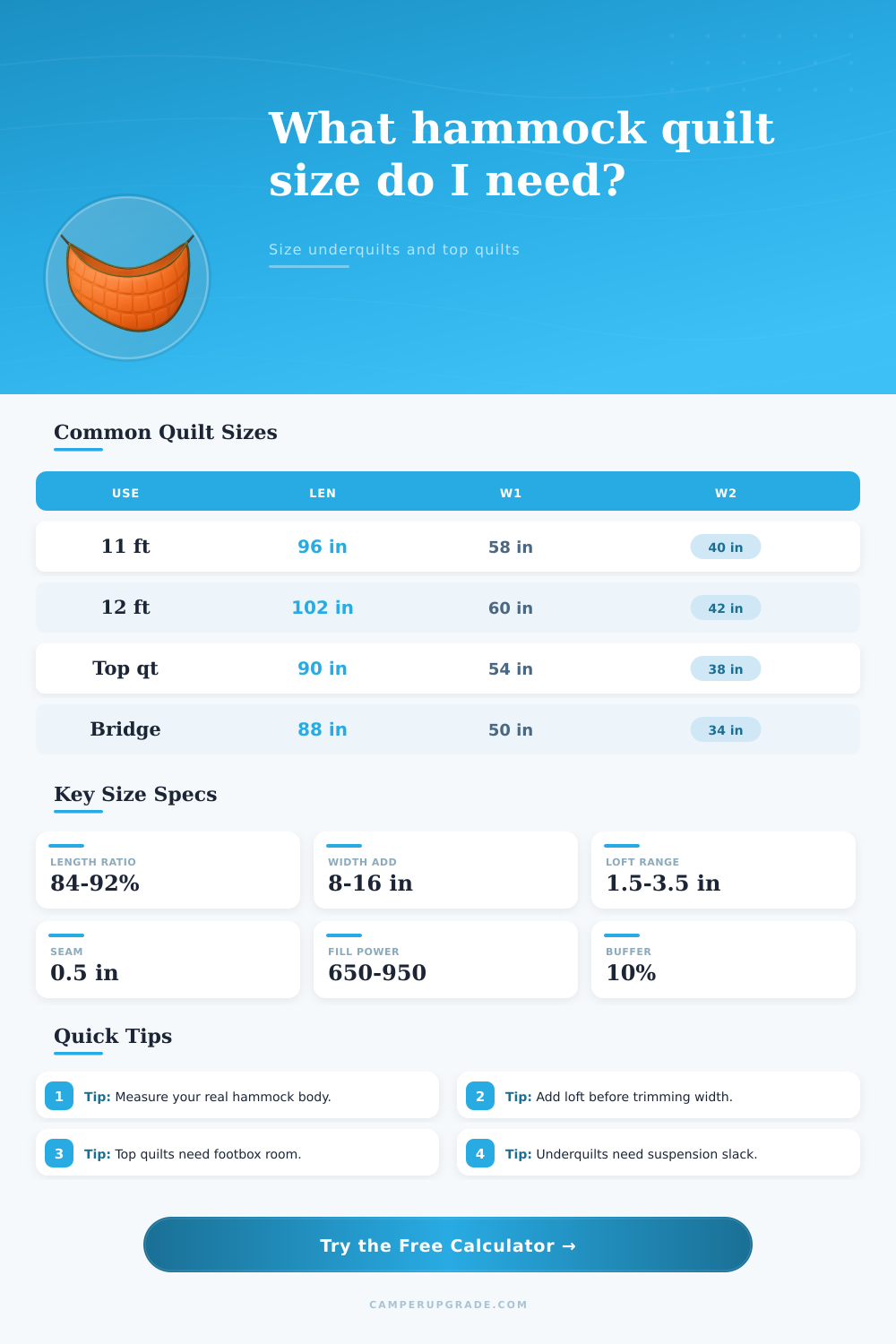
| Build | Length | Shoulder | Foot |
|---|---|---|---|
| 11 ft GE | 96 in | 58 in | 40 in |
| 12 ft GE | 102 in | 60 in | 42 in |
| Top Quilt | 90 in | 54 in | 38 in |
| Bridge | 88 in | 50 in | 34 in |
| Winter GE | 106 in | 62 in | 44 in |
| Wide Side | 98 in | 60 in | 41 in |
| Loft | Feel | Use | Notes |
|---|---|---|---|
| 1.5 in | Thin | Summer | Smallest pack size |
| 2.0 in | Light | 3-season | Good all-round cut |
| 2.5 in | Mid | Cold shoulder | Most common start |
| 3.0 in | Full | Winter | Increase width too |
| 3.5 in | Deep | Deep winter | Needs more fill |
| 4.0 in | Bulky | Extreme cold | Cut carefully |
| Insulation | Eq fp | Shell | Best Use |
|---|---|---|---|
| 950 Goose | 950 | Light | Ultralight quilts |
| 850 Duck | 850 | Light | Balanced premium |
| 650 Down | 650 | Mid | Budget warm |
| Apex 5.0 | 500 | Mid | Winter synthetic |
| Apex 2.5 | 300 | Light | Three-season synth |
| Primaloft | 420 | Mid | Compressible fill |
| Allowance | Effect | Use | Note |
|---|---|---|---|
| 0.5 in | Normal seam | Most builds | Balanced baseline |
| 0.75 in | More room | Winter quilts | Easier boxing |
| 1.0 in | Large seam | Trial cut | Keep spare cloth |
| 10% | Safety buffer | Common start | Accounts for waste |
| 15% | More margin | Cold weather | Prevents undersize |
| 20% | Heavy buffer | Uncertain build | Use with caution |
An underquilt or a top quilt must fit correct within a hammock. Any quilt that dont fit correctly within a hammock will allow cold air to reach the sleeping body. A quilt that is to small for the sleeping body will ride up the sleeping person’s shoulders or allow the quilt to pool at the sleeping persons hips.
Therefore, a sleeping person must ensure that a quilt covers there entire body. Unlike ground pads,quilts for hammocks must drape over the sleeping person correctly. The contours of the sleeping persons body will affect the size of the quilt require to sleep comfortabley within the hammock.
Choose the Right Quilt for Your Hammock
Therefore, choosing the wrong size for a quilt will result in the sleeping person having to carry a significant amount of weight or feeling cold within the hammock while sleeping. The sleeping position within the hammock will determine the length of the quilt that is required for the sleeping person. The sleeping persons height will determine the length of the quilt.
However, this is not the only measurement that is necessary to determine the length of the quilt. A sleeping person will have a significant amount of space required for their shoulders. The sleeping person will have to measure the distance between both shoulder and add some extra space for sleeping comfort.
The sleeping persons hips are going to be narrower then the sleeping persons shoulders, so the quilt should be designed in the same shape as the sleeping sleeping persons body. Therefore, sleeping on an empty hammock while measuring the sleeping persons body diagonally will determine the span that the quilt should have. This span will be between 84 to 92 percent of the length of the hammock.
This will ensure that the sleeping person feel comfortable with no issue of the quilt being too short for there body. Quilt loft will determine the thickness of the insulation within the quilt. Summer quilts will have a lower loft than winter quilts.
The loft of the insulation within a quilt take up space for the sleeping person. For example, if a quilt has 2.5 inch of loft, the sleeping person will have to provide extra width for the sleeping persons shoulders. If the sleeping underquilt has too much insulation compressed between the sleeping sleeping persons shoulder blades, the underquilt will lose its ability to provide sleeping warmth to the sleeping person.
The same is true for the top quilt. A taper on the top quilt will help ensure that the sleeping person does not lose warmth due to the movement of cold air along the sleeping persons leg. The suspension system for the hammock will affect the quilts that will be used within the hammock.
An underquilt will have some slack within the hammock. Therefore, the underquilt will have to be approximately 10 percent longer than the ridgeline of the hammock. If the underquilt is too short, it will result in the sleeping person lose some of the warmth that the underquilt will provide while sleeping.
If there is too much slack within the underquilt, cold air will be able to enter the sleeping persons body underneath the underquilt. A top quilt should allow the sleeping sleeping persons body to rest on the ridgeline of the hammock. The top quilt should also have a footbox so that the top quilt covers the sleeping sleeping persons toes.
Quilt insulation will ultimately determine the sleeping persons total weight of the quilt and how warm it will make the sleeping person within the hammock. Down insulation will have a significantly higher fill power than synthetic insulation. Down quilts will be lighter then synthetic quilts of the same thickness.
However, synthetic insulation will hold up better within wet sleeping conditions. For example, down quilts can weigh 14 ounce compared to synthetic quilts that can 20 ounces of the same thickness. The shell weight of the quilt will also contribute to the total weight of the quilt.
The best way to ensure that a quilt fits within a hammock correctly is to test the quilt within your real-world setting. Some people may find that their quilt will bunch at the sleeping sleeping persons shoulders when sleeping on their side. In this case, the sleeping person will have to adjust the quilt to provide more width for the sleeping sleeping persons sleeping shoulders.
Other sleeping people will find that their quilt has excess volume within the footbox of the top quilt. Therefore, these sleeping people will have to trim the top quilt to their sleeping sleeping persons body. The sleeping persons total width for the hammock will be a limit to how much the sleeping sleeping person can spread themselves out in the hammock.
This width will also be a consideration when purchasing a quilt. Pre-established sizes for quilts are available to sleeping people to assist them with determining the size of the quilt that best fit their body and their sleeping hammock. These presets will help sleeping people to start with an established size for quilts to purchase and then make modifications to that quilt to accommodate the sleeping sleeping persons body.
These sizes can be checked by hanging the quilt within the sleeping persons hammock and sleeping on the quilt with the sleepers body weight. If the sleeper finds that the loft within the quilt is not even throughout the quilt, the sleeping sleeping person will have to redistribute the insulation within the quilt. If the sleeping sleeping person uses a quilt designed to work as a ground pad within sleeping sleeping persons sleeping area, the quilt should have a rectangular shape and be longer than the sleeping sleeping persons total body length.