Hammock Daisy Chain Length Calculator
Calculate strap reach, recommended clip loop, anchor height, tree wrap loss, and hang tension for daisy-chain hammock suspension.
Daisy Chain Sizing Results
| Named strap | Length per side | Approx loop spacing | Published rating | Material note | Best fit scenario |
|---|---|---|---|---|---|
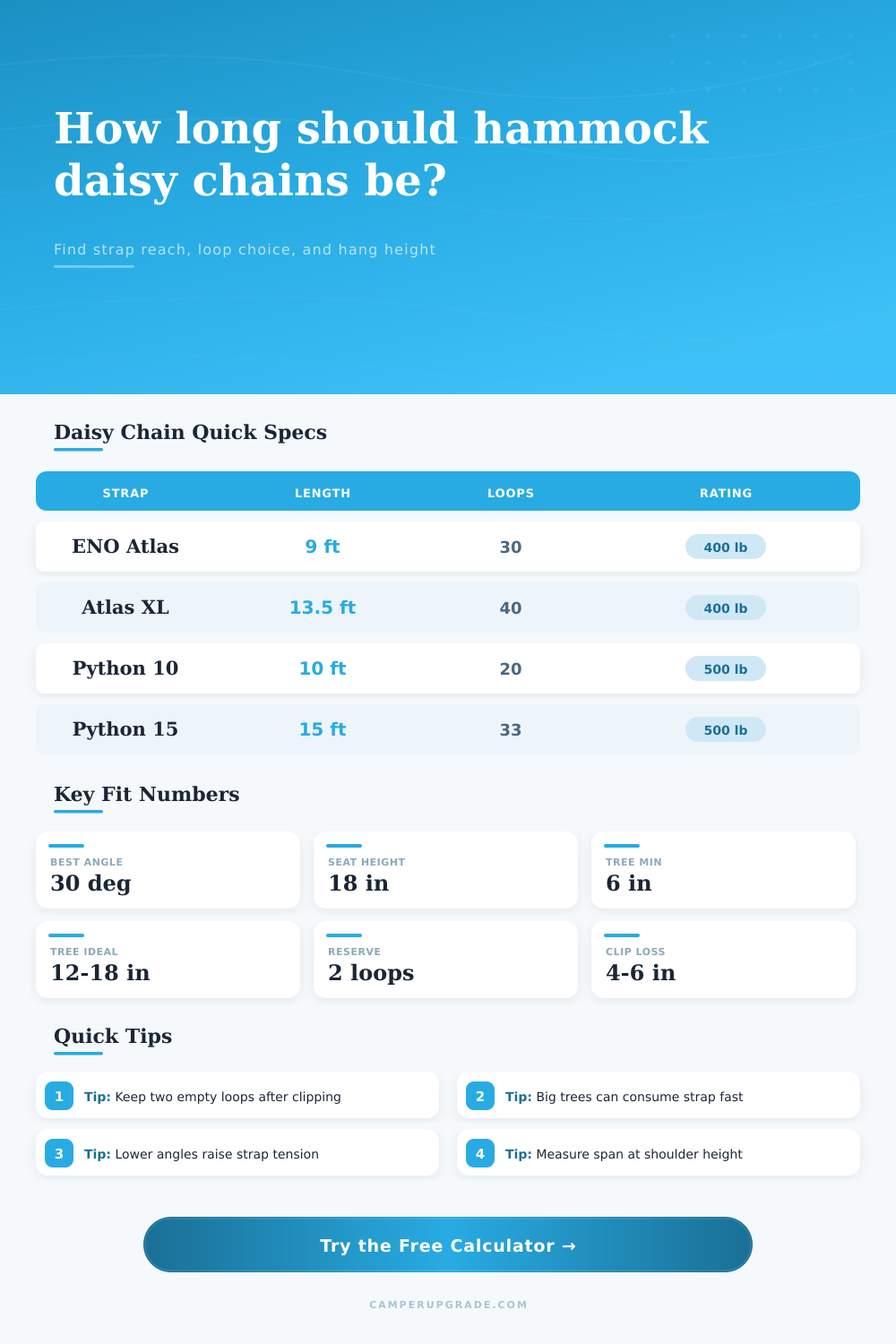
| ENO Atlas | 9 ft / 2.74 m | About 3.5 in | 400 lb pair | Polyfilament webbing | Normal campsite spans |
| ENO Atlas XL | 13.5 ft / 4.11 m | About 4 in | 400 lb pair | Polyfilament webbing | Wide trees or larger trunks |
| Kammok Python 10 | 10 ft / 3.05 m | About 5 in | 500 lb pair | Polyester webbing | Balanced reach and strength |
| Kammok Python 15 | 15 ft / 4.57 m | About 5 in | 500 lb pair | Polyester webbing | Very wide anchor spans |
| Grand Trunk Trunk Straps | 10 ft / 3.05 m | About 4.5 in | 400 lb pair | Polyester webbing | Car camping and parks |
| Wise Owl Talon XL | 10 ft / 3.05 m | About 4 in | 400 lb pair | Polyester webbing | Roomy adjustment range |
| Sea to Summit Suspension Strap | 10 ft / 3.05 m | About 6 in | 400 lb pair | Webbing with buckle loops | Quick compact suspension |
| Hummingbird Tree Straps Plus | 10 ft / 3.05 m | About 8 in | 400 lb pair | UHMWPE blend | Ultralight backpacking |
| Anchor span | Horizontal gap per side with 9.2 ft ridgeline | Suspension reach at 30 deg | Anchor height for 18 in seat | Minimum strap after 12 in tree wrap |
|---|---|---|---|---|
| 12 ft / 3.66 m | 1.4 ft / 0.43 m | 1.6 ft / 0.49 m | 28 in / 71 cm | 6.0 ft / 1.83 m |
| 14 ft / 4.27 m | 2.4 ft / 0.73 m | 2.8 ft / 0.85 m | 35 in / 89 cm | 7.2 ft / 2.19 m |
| 16 ft / 4.88 m | 3.4 ft / 1.04 m | 3.9 ft / 1.19 m | 42 in / 107 cm | 8.3 ft / 2.53 m |
| 18 ft / 5.49 m | 4.4 ft / 1.34 m | 5.1 ft / 1.55 m | 48 in / 122 cm | 9.5 ft / 2.90 m |
| 20 ft / 6.10 m | 5.4 ft / 1.65 m | 6.2 ft / 1.89 m | 55 in / 140 cm | 10.6 ft / 3.23 m |
| Tree diameter | Circumference | 0.75 wrap loss | 1.0 wrap loss | 1.5 wrap loss | Remaining reach on 9 ft strap |
|---|---|---|---|---|---|
| 6 in / 15 cm | 19 in / 48 cm | 14 in / 36 cm | 19 in / 48 cm | 28 in / 72 cm | 7.4 ft / 2.25 m |
| 10 in / 25 cm | 31 in / 80 cm | 24 in / 60 cm | 31 in / 80 cm | 47 in / 120 cm | 6.4 ft / 1.94 m |
| 14 in / 36 cm | 44 in / 112 cm | 33 in / 84 cm | 44 in / 112 cm | 66 in / 168 cm | 5.3 ft / 1.62 m |
| 18 in / 46 cm | 57 in / 144 cm | 42 in / 108 cm | 57 in / 144 cm | 85 in / 215 cm | 4.3 ft / 1.31 m |
| 24 in / 61 cm | 75 in / 191 cm | 57 in / 144 cm | 75 in / 191 cm | 113 in / 287 cm | 2.8 ft / 0.84 m |
| Hang angle | Tension formula multiplier | Load per side at 200 lb | Effect on strap length | Practical use |
|---|---|---|---|---|
| 15 degrees | 1.93x body weight | 386 lb / 175 kg | Longer reach, flatter hang | High stress, avoid when possible |
| 20 degrees | 1.46x body weight | 292 lb / 132 kg | Moderately long reach | Usable only with ample rating |
| 25 degrees | 1.18x body weight | 237 lb / 107 kg | Balanced reach | Good when anchors are low |
| 30 degrees | 1.00x body weight | 200 lb / 91 kg | Standard reach | Comfort target for most hangs |
| 35 degrees | 0.87x body weight | 174 lb / 79 kg | Shorter reach, more sag | Useful for close trees |
| 40 degrees | 0.78x body weight | 156 lb / 71 kg | Shortest reach | Can feel too curved |
| Loop spacing | Adjustment precision | Loops on 9 ft strap | Loops on 10 ft strap | Loops on 15 ft strap | Best use |
|---|---|---|---|---|---|
| 3 in / 7.6 cm | Fine | 36 | 40 | 60 | Dialing in hammock height |
| 4 in / 10 cm | Fine-medium | 27 | 30 | 45 | Most daisy-chain straps |
| 5 in / 13 cm | Medium | 22 | 24 | 36 | Python-style loop spacing |
| 6 in / 15 cm | Coarse | 18 | 20 | 30 | Compact simple suspension |
| 8 in / 20 cm | Very coarse | 14 | 15 | 23 | Ultralight minimum hardware |
The hammock won’t hang on these trees in this spot. But it’s the perfect spot, you’re at a campground with most beautiful trees ever! But the straps don’t fit. They’re too short. Or they are too long, and you can’t adjust anything else to change length. Because, see, instead of thinking of tree hanging as geometry, you think it is intuitive.
Hanging a hammock properly are about balancing three variables: angle (comfort), tree size (thickness), and tree spacing (distance apart). Ignore one of those variable, and everything collapses.
How to Hang Your Hammock Correctly
With this calculator (above), you no longer have to guess in the dark. Simply enter your hang angle, desired seat height, your tree’s diameter and span, and it’ll run the math for you. It will let you know exactly how long each strap should of be.
Why? Because most folks only consider the distance between trees. They fail to realize that wrapping a strap around a thick oak take up a large amount of your available length. For example, a twelve-inch diameter tree will eat up nearly two feet of webbing… just for the wrap alone! That’s a lot and it greatly limits your adjustment range.
Then there’s the physics of it all. Knowing how much strap the tree steals will help you realize you need to consider it. Each component in the system are under different tension depending on the angle you’re clipped into the daisy chain. For example, when you have a shallow angle, the hammock hang higher with a firmer feel. But it also increases amount of force exerted on your straps and carabiners.
At a thirty-degree angle, the tension is equal to your body weight (plus whatever gear you’re carrying). Drop that angle to fifteen degrees and now you’re asking your suspension hardware to support close to four times as much. That’s too much work for typical webbing to bear. To protect your gear and your trees from getting pulled over in the wind, keep the angle moderate.
Straps used commercially tend to have their loops spaced from 3-5 inches apart. That provides sufficient granularity to dial in your height without spending twenty minutes fiddling with knots. But loops aren’t endless. You can’t take absolute final one on your strap and expect to be able to clip there. There’s got to be some reserve length to account for uneven ground conditions, slack in the webbing when seated, and shock loads. So we provide a couple extra loops as a buffer which the calculator factors in. It makes sure that the recommended spot to clip will leave enough webbing hanging back to absorb the shock load should someone jump on the hammock or roll off of it.
Here is a little bit about the materials, too. Polyfilament webbing has more stretch than polyester. UHMWPE straps is super strong and super light. However, they can slips out if they are not tightened properly. With this tool, you’re able to pick which models you want to use and check what size and length they’re rated for compared to what is present on site.
For example, if you read that you require eight feet of reach on a ten-foot strap, that’s pretty good. If it tells you ten feet, you may want to go with tighter trees or longer straps. It’s a pre check, and it makes a long and frustrating exercise in trial and error a fast one.
Before leaving home, you’ll be able to picture your hang and know how far apart the trees are (span), how thick they is (thickness), and what angle will keep things manageable. So when you get to camp you already have an idea of what loops to clip and if your gear is up to the task.
It stops being a puzzle and starts being a plan, you tie off, lie down, and let the forest do its thing. You will no longer worry about whether your anchors holds, so you can get some well-deserved rest.