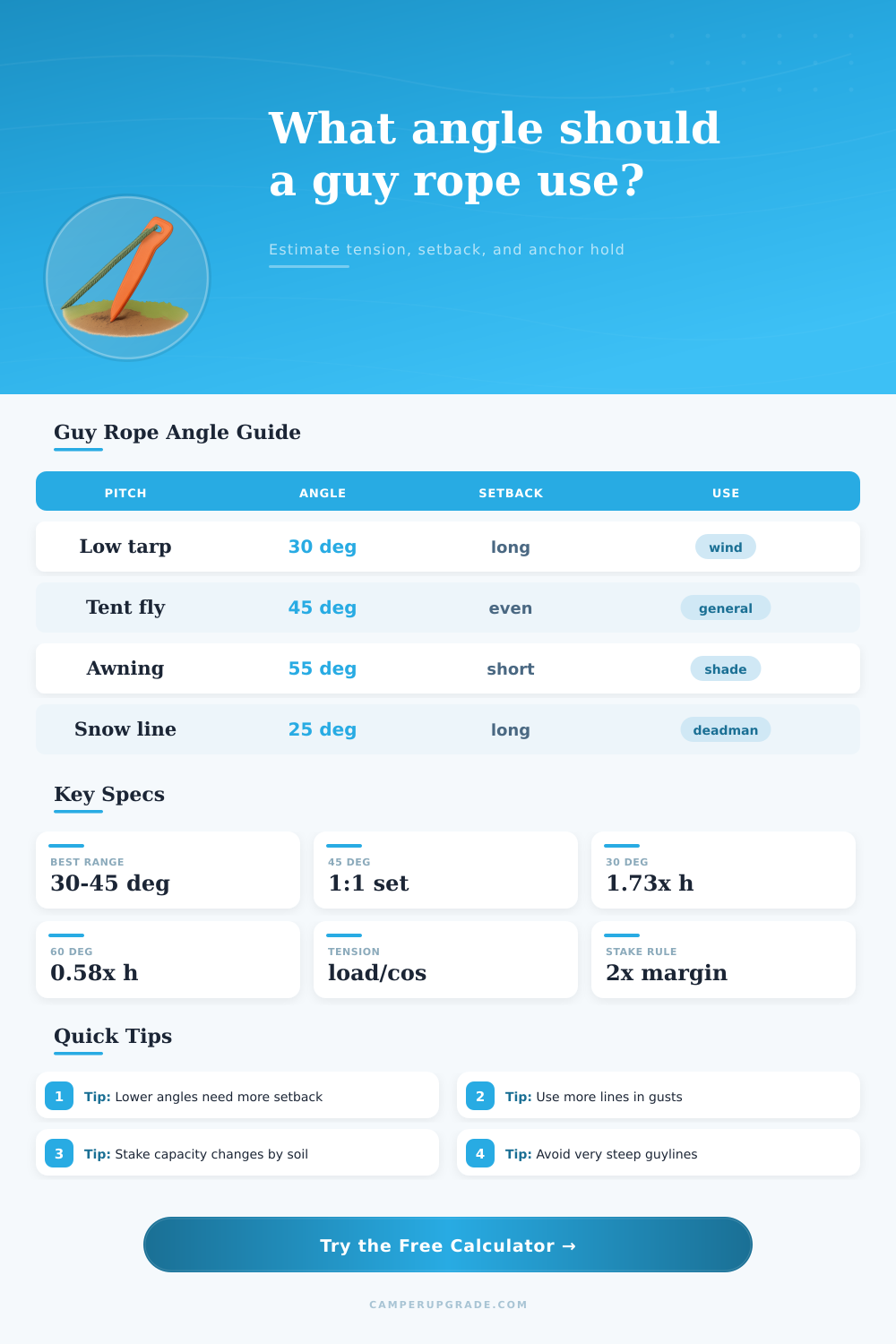
Guy Rope Angle Calculator
Estimate anchor setback, guyline length, line tension, horizontal pull, vertical lift, and holding margin for a tent, tarp, awning, or camp shelter guyline layout.
| Angle from ground | Setback for 4 ft height | Line span for 4 ft height | Geometry note |
|---|---|---|---|
| 20 degrees | 11.0 ft | 11.7 ft | Very long, low storm angle |
| 25 degrees | 8.6 ft | 9.5 ft | Useful for snow or sand deadmen |
| 30 degrees | 6.9 ft | 8.0 ft | Strong horizontal pull with moderate length |
| 35 degrees | 5.7 ft | 7.0 ft | Common tarp side tie-out angle |
| 45 degrees | 4.0 ft | 5.7 ft | Setback equals attachment height |
| 55 degrees | 2.8 ft | 4.9 ft | Compact footprint with more vertical lift |
| 65 degrees | 1.9 ft | 4.4 ft | Steep and less efficient for weak anchors |
| Anchor type | Firm soil planning hold | Soft ground adjustment | Best use |
|---|---|---|---|
| 6 in wire peg | 25 lb | Use 0.55x | Small tent corners and mild weather |
| 7-8 in Y stake | 55 lb | Use 0.65x | General tent and tarp guylines |
| 9 in V stake | 70 lb | Use 0.70x | Larger fly panels and mixed soil |
| 10-12 in nail stake | 85 lb | Use 0.75x | Hard packed sites and awning corners |
| Sand or snow stake | 60 lb | Use profile-specific soil factor | Broad surface anchor in loose media |
| Buried deadman | 120 lb | Use 0.80x in weak snow or sand | High-load shelter or storm line |
| Tree, rock, vehicle | 200 lb | Connection usually controls | Strong tie-off when line rub is managed |
| Gust speed | Pressure estimate | Typical shelter response | Guyline planning note |
|---|---|---|---|
| 15 mph | 0.6 psf before drag | Light breeze | Small tents often need modest pretension only |
| 25 mph | 1.6 psf before drag | Noticeable fabric push | Use all main tie-outs on exposed sides |
| 35 mph | 3.1 psf before drag | Strong gust loading | Lower pitch and divide load across extra lines |
| 45 mph | 5.2 psf before drag | Severe for camp shelters | Use storm anchors or relocate if possible |
| 60 mph | 9.2 psf before drag | Damage-risk conditions | Small awnings and shade walls are poor candidates |
| Setup | Useful angle range | Setback habit | Main tradeoff |
|---|---|---|---|
| Backpacking tent fly | 35-50 degrees | About 0.8-1.4x height | Balances footprint and holding power |
| Storm tarp side | 25-35 degrees | About 1.4-2.1x height | Needs longer guylines and more space |
| Porch tarp or awning | 45-60 degrees | About 0.6-1.0x height | Compact but more upward pull |
| Canvas wall tent | 35-45 degrees | About 1.0-1.4x height | More load per line from heavy fabric |
| Snow deadman | 20-30 degrees | About 1.7-2.7x height | Low pull keeps buried anchors seated |
| Pop-up canopy leg | 40-55 degrees | About 0.7-1.2x height | Use multiple anchors per windy corner |
A guy rope must be set at a specific angle for a shelter secured by the guy rope to remain secure against the wind. The angle of a guy rope determine the amount of force that is placed upon the anchor and the stake. If the guy rope is set at a very steep angle to the ground, an upward lifting force can cause the stake to pull out of the ground.
Additionally, if a guy rope is set at a very flat angle to the ground, the guy rope will require more distance between the shelter and the stake in order to accommodate for that angle. Furthermore, many people will set guy ropes by looking at them, but this doesnt take into consideration the forces act upon the anchor. The angle of a guy rope changes the direction of the force that is placed upon the guy rope’s anchor.
How to set up guy ropes for a shelter
If the angle of a guy rope is set at thirty degrees, the force will travel in a direction that the anchor easily resisted. At an angle of fifty-five degrees, however, the force that is applied to the guy rope has less sideways force that is transferred to the ground, but the upward force increase. A calculator can help to determine the force that act upon a guy rope setup, as well as provide an estimate of the length that each guy rope should of be.
The type of soil upon which the guy system is established will impact the force that the anchor resists. A stake may be strong in firm mineral ground, but have less holding power in dry sand or loam. If using a stake in snow, the stake may be buried as a “deadman” to help distribute the load of the shelter across a larger area of snow.
Thus, the type of stake and the condition of the ground will impact the way in which the force of the guy rope impact the stake. The number of guy ropes that are used will impact the amount of force that is placed upon each guy rope. For instance, if four guy rope are used to share a load, each guy rope will bear one-quarter of the total load.
However, if only two guy ropes is used, each will bear half of the total load. Thus, the number of guy ropes will impact the strength of each rope. Additionally, the safety factor for the system can be selected.
The safety factor will impact the strength of each guy rope. Many outdoor enthusiast will use a safety factor of two for the guy ropes; the wind does, after all, arrive in gust! Dividing the height of the shelter by the tangent of the angle of the guy rope can calculate the geometry of the guy rope system.
This will calculate the distance from the shelter to the stake, as well as the length of the guy rope from the shelter to the stake. However, the angle of each guy rope impact the distance between the shelter and stake; the lower the angle of the guy rope, the more far from the shelter that the stake should be placed. Due to the fact that guy ropes may sag or the stake may shift after a gust of wind, retensioning of those guy ropes may provide some relief for a short period of time.
Retensioning, however, will not change the angle of the guy rope or the capacity of the anchor to resist the forces of the wind. Instead, you should check the angle of the guy rope and the capacity of that anchor prior to the arrival of bad weather. The angle of the guy rope should be picked according to the type of shelter that is to be used and the ground upon which it is to be erected.
For instance, backpacking tent may use angles between thirty-five and fifty degrees. Low storm tarps may use an angle of twenty-five or thirty degrees. Awnings and shade structures can utilize steeper angles; these light structure experience less force from the wind than guy ropes used for tarps or other shelter structures.
Once the angle of each guy rope, the number of guy ropes, and the type of anchor are established for a shelter setup, the guy rope tension should be adjusted prior to the arrival of each gust of wind. To do so, a guy rope tension calculator can calculate the length of each guy rope with the assistance of it.