Group Trash Volume Calculator
Estimate loose trash, packed volume, bag count, bin capacity, wet waste, recycling diversion, and pickup timing for group camping trips, RV rallies, scout weekends, and basecamps.
Calculation Breakdown
| Camp waste profile | Loose volume basis | Typical sources | Planning note |
|---|---|---|---|
| Pack-out minimal wrappers | 0.20 gal per person-day | Dehydrated meals, refill bottles | Use for disciplined backcountry or canoe trips |
| Simple RV or tent meals | 0.35 gal per person-day | Basic groceries and snack packaging | Good default for small campsite groups |
| Family cooler and snacks | 0.55 gal per person-day | Mixed wrappers, cans, meal prep waste | Fits most weekend family sites |
| Shared group kitchen | 0.75 gal per person-day | Bulk cooking, paper towels, food scraps | Needs sealed wet waste planning |
| Potluck or event camp | 0.95 gal per person-day | Serving trays, cups, cans, disposable ware | Separate recycling early to avoid overflow |
| Wet scraps and mixed cleanup | 0.85 gal per person-day | Fish trim, greasy towels, damp food waste | Lower bag fill and use rigid bins |
| Bag or bin type | Nominal volume | Useful fill range | Best camp use |
|---|---|---|---|
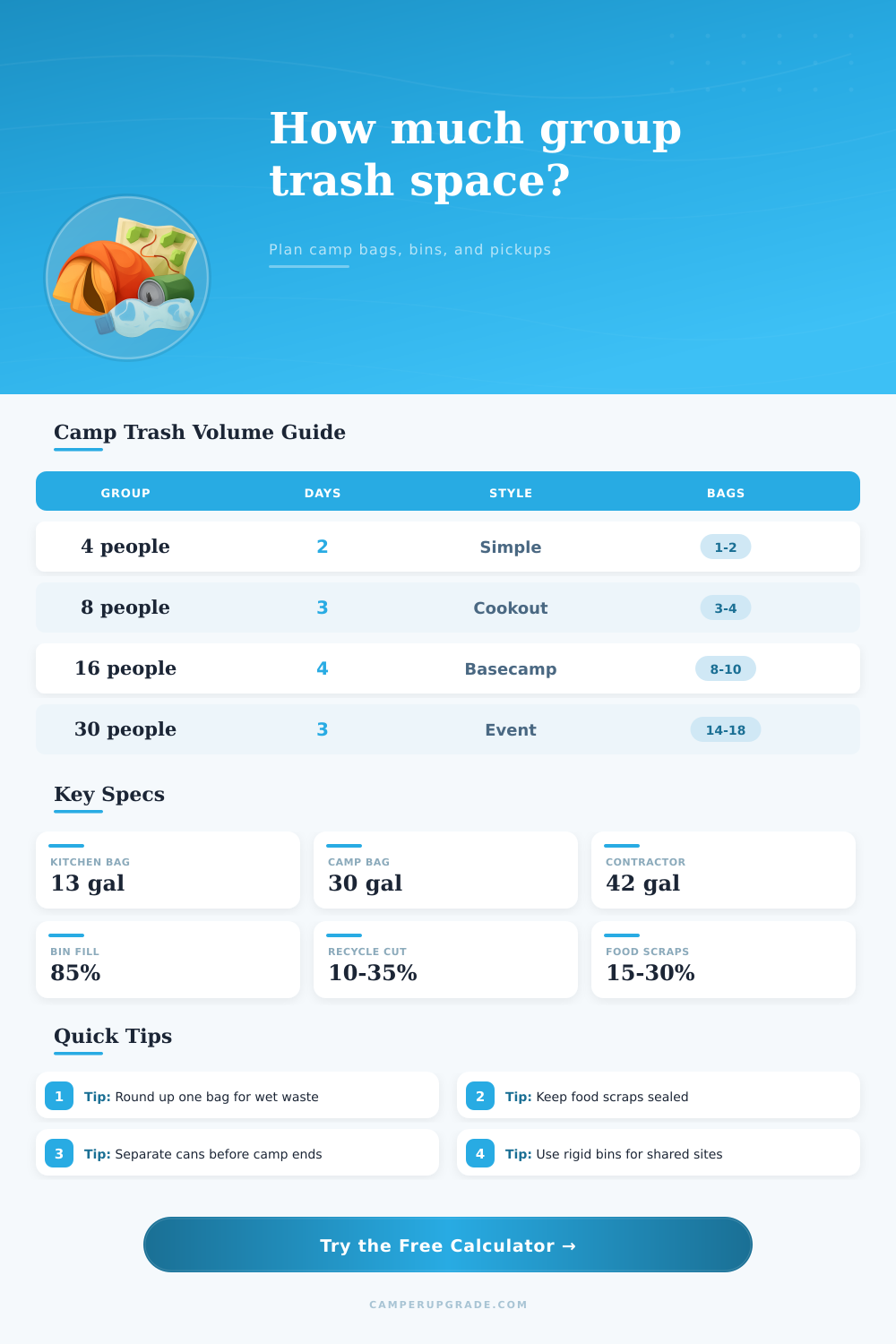
| 13 gal kitchen bag | 49 L | 9 to 11 gal usable | Cabin, camper galley, daily wet waste |
| 20 gal tall camp bag | 76 L | 14 to 17 gal usable | Small group or day station |
| 30 gal outdoor bag | 114 L | 22 to 26 gal usable | General group campsite trash |
| 42 gal contractor bag | 159 L | 31 to 36 gal usable | Bulky dry packaging and event cleanup |
| 32 gal rigid can | 121 L | 27 gal practical storage | Animal-resistant site organization |
| 64 gal rolling cart | 242 L | 54 gal practical storage | RV rally or basecamp collection point |
| Diversion stream | Common volume cut | Works best for | Calculator use |
|---|---|---|---|
| No separation | 0% | Remote pack-out with one trash stream | Set recycling diversion to 0% |
| Cans only | 10% to 20% | Drink-heavy weekends and lake camps | Use when cans are crushed and bagged apart |
| Cans plus bottles | 20% to 35% | RV sites with recycling bins nearby | Good default for mixed drink groups |
| Cardboard and serving trays | 15% to 30% | Potlucks, catered meals, group kitchens | Only count if the site accepts it |
| Food scraps separate | 10% to 25% | Managed basecamps with sealed buckets | Still plan odor-proof storage |
| Group scenario | Example size | Loose trash estimate | Practical bag plan |
|---|---|---|---|
| Couple weekend trailhead camp | 2 people x 2 days | 1 to 2 gal | One kitchen bag or small dry sack liner |
| Family RV three-night site | 5 people x 3 days | 7 to 10 gal | One 13 gal bag plus recycling tote |
| Scout patrol meal cleanup | 8 people x 2 days | 10 to 16 gal | One 20 or 30 gal bag |
| Basecamp shared kitchen | 16 people x 4 days | 45 to 60 gal | Three 30 gal bags or rigid can rotation |
| Small RV rally potluck | 24 people x 2 days | 45 to 70 gal | Two carts or four contractor bags |
| Festival volunteer camp | 35 people x 3 days | 90 to 120 gal | Daily bag pull with recycling station |
Expect to produce more trash when you’re out there together. Most people don’t realize this, but it’s usualy not the bugs, or the weather, it’s simply the limited amount of room available for garbage. Most cars is jammed with wet coolers, three overflowing bags of trash, and a smelly pile of recycling. Yet still, you has no room.
But why? Because most people plan based off their gear and food intake. Then they figure trash will just have to squeeze into what’s left over. And it usualy doesn’t. The more people in your group, the bigger the increase in trash that results. Two person can handle a single kitchen bag. Four make things different. Your dishes will pile up differently, and so will food prep and leftovers. Adding four friends doesn’t simply multiply your trash by 20%. They alters it. How do you clean? What’s being stored where?
How to Pack Trash for Your Trip
The above calculator does the math for you. It considers who, what, and how many. Volume isn’t static. It depends on how you pack, what you pack, and whether or not you will crush those cans beforehand. Now think about the waste profile of your camping trip: Do you choose ultralight meals? Or do you have a shared kitchen at a basecamp where 30 people bring in disposable plates and paper towels? The former produces very little output, while the latter produce a lot of output over a short period of time (hence why it’s called a “spike”). It’s the distinction between using foam trays versus reusable bowls. To account for that, the tool will adjust the base gallons-per-person-day upward or downward based on your choice.
Be honest; what kind of backpacker are you? Do you get all your snacks from individual packs? Pre-cut fruit? Do you buy in bulk? Bump up the load factor of meal packaging accordingly. It’ll save you an overflow situation on day three.
Dry trash is not the same as wet waste. While a greasy towel, fish trim, and food scraps don’t weigh much, they don’t compress well (at least not neatly) and will result in a messy bag if packed to tight. Also, a stronger seal must be used to prevent leaking and stinky smells. For this reason, the calculator breaks it out. Mixing the lightweight packing materials with heavier, sloshy food debris are not ideal. This way you can buy smaller, stronger liners for your wet waste. Then fill the big bags with dry junk, making most of their space.
Your results will change greatly depending on how much you recycle. Plastic bottles and aluminum cans consumes a large amount of void space if left unseparated in the main trash pile. It won’t hurt if you crush them down some, but separating them completely can reduce total trash volume by as much more than twenty to thirty percent. Soda and beer drinkers especially should note this. Check the reference tables on the page for an idea of how different diversion streams affect capacity. If your campsite has a separate bin for recyclable materials, use it! If you’re forced to carry recyclables out, keep them in a separate heavy duty bag so they don’t accidently tear through your dry waste bags during transport.
Now we look at planning versus reality regarding storage capacity. Perhaps you think forty gallons of trash capacity is sufficient for your trip; maybe you realize you have only thirty gallons in your vehicle. How do you make it work? Do you plan on hauling one bag out at some point during your trip (instead of saving them all for the end)? Are there other tools you could of buy, like a rigid rolling cart instead of flexible bags? Rigid bins holds their shape and stack better, but they don’t compress. But flexible bags tend to burst if you overstuff them. The tool compares your anticipated storage needs with how much storage you have in each bin. If you’re likely to run short, it flags it.
Add some buffer: This one’s for those last-minute additions that happen on every trip. Someone’s bringing more food than expected. Hungry? Extra treats. An item that requires more packing than was originally assumed. A fifteen percent margin will cover any surprises so the plan doesn’t fall apart. Having that extra bag is preferable to digging around inside your packed grocery bags trying to make room for random extras.
When you plan well, what could of been a disastrous situation becomes just another detail in the back of your mind. You emerge from the adventure feeling good about leaving the site clean, clear about what’s in your trunk, and guilt-free about your trash production.