Group Stove Count Calculator
Estimate how many camp stoves and burners a group needs from meal timing, pot size, water volume, simmer load, altitude, wind, cooks, and backup margin.
This calculator sizes cooking capacity, not fire safety clearances. Follow the stove maker, fuel maker, campsite, and local rules for ventilation and placement.
| Meal style | Water basis | Burner behavior | Planning note |
|---|---|---|---|
| Freezer bag or drinks only | 0.45-0.7 L per person | Short boil cycles | Pot volume often matters more than simmer time. |
| One-pot entree | 0.35-0.6 L per person | Boil then moderate simmer | Good for shared pots and predictable service. |
| Pasta or rice plus sauce | 0.7-1.2 L per person | High boil volume | Usually needs extra pot cycles or larger burners. |
| Breakfast griddle plus drinks | 0.25-0.45 L per drinker | Parallel hot drink and pan burners | Cook attention can be the limiting factor. |
| Soup, stew, or long simmer | 0.45-0.8 L per person | Long burner occupancy | More stoves reduce the wait between serving waves. |
| Burner output | Typical field use | 1 L boil estimate | Best group role |
|---|---|---|---|
| 3,000-5,000 BTU/hr | Small alcohol or low stove | 11-18 min | Backup drinks or light simmer. |
| 7,000-10,000 BTU/hr | Backpacking canister stove | 5-8 min | Patrol meals and medium pots. |
| 11,000-15,000 BTU/hr | Two-burner propane stove | 4-6 min | Car-camp group kitchen. |
| 16,000-25,000 BTU/hr | Large basecamp burner | 3-5 min | Big stockpots and fast water turns. |
| Setup | People | Typical burners | Kitchen pattern |
|---|---|---|---|
| Family camp | 3-5 | 1-2 | One pot plus one drink or pan burner. |
| Scout patrol | 6-8 | 2 | Separate water and entree burners. |
| Trail crew | 8-12 | 2-3 | Two boil pots with one controlled simmer. |
| Basecamp crew | 12-20 | 4-5 | Parallel pots by meal component. |
| Large group kitchen | 24-40 | 6-10 | Dedicated hot water, entree, and backup stations. |
| Reserve level | Use when | Effect | Field check |
|---|---|---|---|
| 0% | Short, tested, low-risk meal | Smallest stove count | Only use with flexible serving time. |
| 10% | Adult group near vehicle | One small delay covered | Good when pots and fuel are proven. |
| 20% | Normal group camp cooking | Covers wind and staging | Default for mixed experience groups. |
| 30% | Remote, youth, winter, or tight schedule | Often adds a burner or stove | Useful when hot food is mission-critical. |
Planning around a single camp kitchen requires the consideration of many differents factors due to the challenges of camp kitchen planning. While it may be easy to plan for everyone to eat at the same time, the reality may include some individuals eating while others sits with cold coffee due to the challenges in meal timing. Beyond the considerations of the number of stoves required, the number of burners that may be available at the same time is also a consideration as it relates to the cooking ability for the group.
The amount of water that will be required to prepare the meals is related to the type of menu that will be prepared for the group. Meals that require more water, such as pasta, will require more water then meals that use freezer-bag dinner or drinks. Furthermore, the time that each of these recipes will simmer will impact the number of burners that will be required for the meal; the longer meals simmer the more that each burner will be in use.
Plan Stoves, Burners, Water and Fuel for Camp Meals
Additionally, the wind will reduce the amount of heat that is provided to the pot; the same with the air pressure will reduce the boiling point of the water. Therefore, low air pressure and the effect of the wind will impact the amount of fuel that is used to prepare the meals. The amount of attention that the cook can provide to the meals will also impact the cook; cooks can only provide attention to a certain number of burners at once.
One cook may be able to attend to two burners at once, but may struggle with attempt to watch three or more burners at once. Should the cook attempt to attend to too many burners at once, the cooks may boil over and the meal may not be prepared in a timely manner. Therefore, the calculator include this factor in the recommendation.
Another consideration is the inclusion of a reserve capacity for the meals. A twenty percent margin for error in the schedule is often useful to account for the potential lateness of hungry hiker or problems with the stoves that may be used. Without this reserve capacity, groups will likely find themself short of the resources that are required to prepare meals in time for the group to eat.
Therefore, the tool includes this margin when the backup cook level is selected, as the number that is recommended may otherwise be too close to the minimum number for that group. The fuel that will be used is related to the number of burners and the amount of water that is used; the more exposed to the wind, the more fuel that is required. Furthermore, the more number of pot that are heated, the more fuel that is required; each pot cycle requires heat to steam the foods.
The fuel calculations are provided in the weight of isobutane fuel canister that will be required. This number is used to determine if the number of stoves that are provided is enough; the calculation of fuel will indicate if one additional burner will save fuel for the group during the camp trip. Common setups around a campsite can help to determine the number of burners that should be provided for a group.
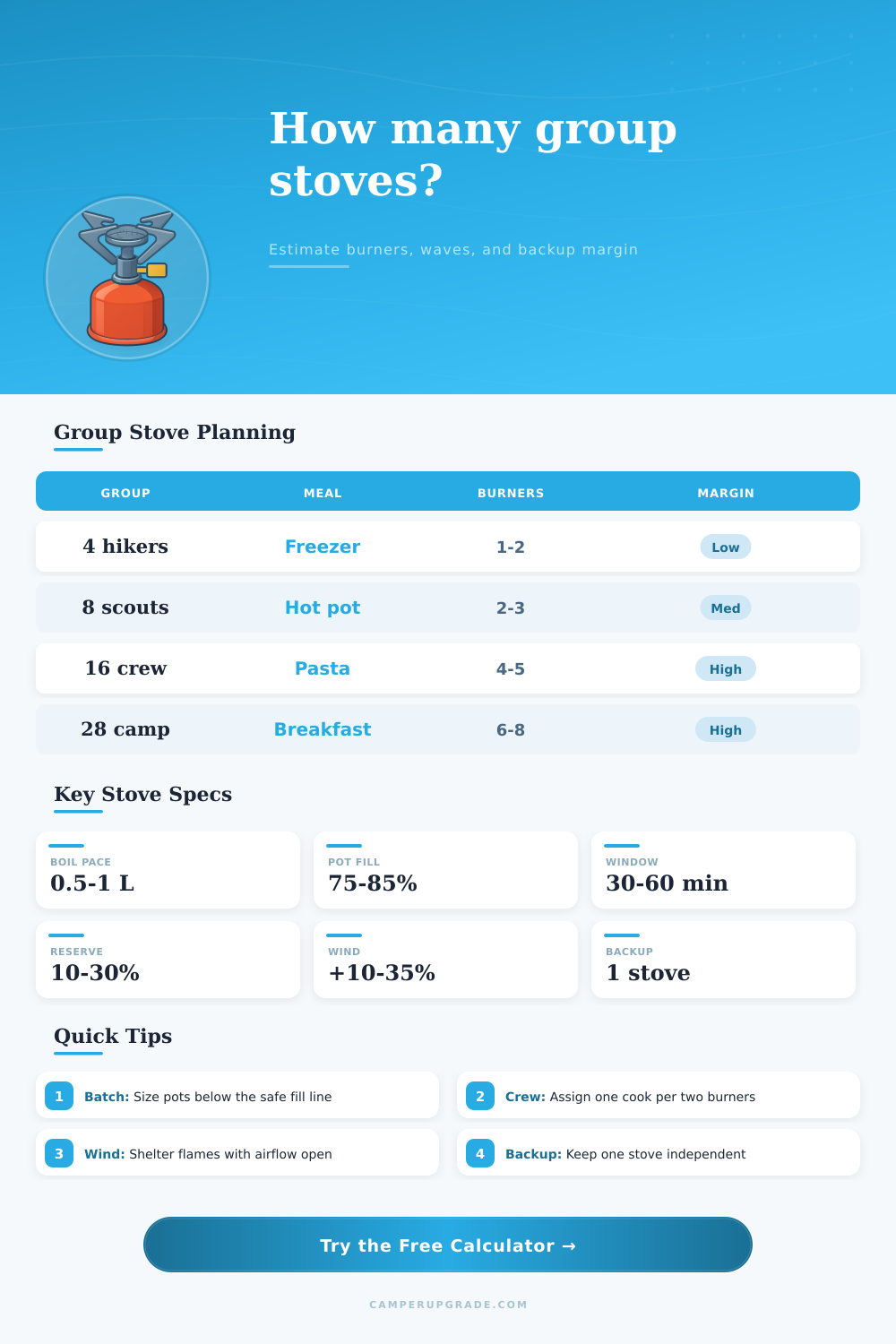
For instance, a family of four may be able to utilize one two-burner stove for their meals. Eight scouts, however, may require two separate one-burner stoves to ensure that both water and entrees are being prepared at the same time. For crews that are even larger, though, four or five burners may be required if pasta or breakfast is to be prepared.
In either case, however, the number of burners must be provided with an amount of water that can provide enough liquid to cook the meals, as well as enough burners to cook each of the number of individuals that will be eating at the table. Finally, the number of stoves and burners that are provided for a campsite is a balance of a variety of elements. Beyond the elements that relate to the load of water that is required, the amount of burners that are required for the meals, and the availability of the cook, there is also the element of providing a reserve capacity for potential problems.
When these elements are balanced appropriately, the campsite will have its meals on time and with enough fuel to last the cook for the trip. Should any of these elements be ignored, though, the campsite and it’s kitchen will become a point of bottleneck for the entire campsite and its individuals.