Group Hiking Pace Calculator
Plan a realistic group hiking pace from the slowest hiker, fastest hiker, route grade, pack loads, terrain, break rhythm, regroup policy, and expected front-to-back spread.
🥾Real Group Hiking Presets
⚙Group, Route, Pack, Break, and Spread Inputs
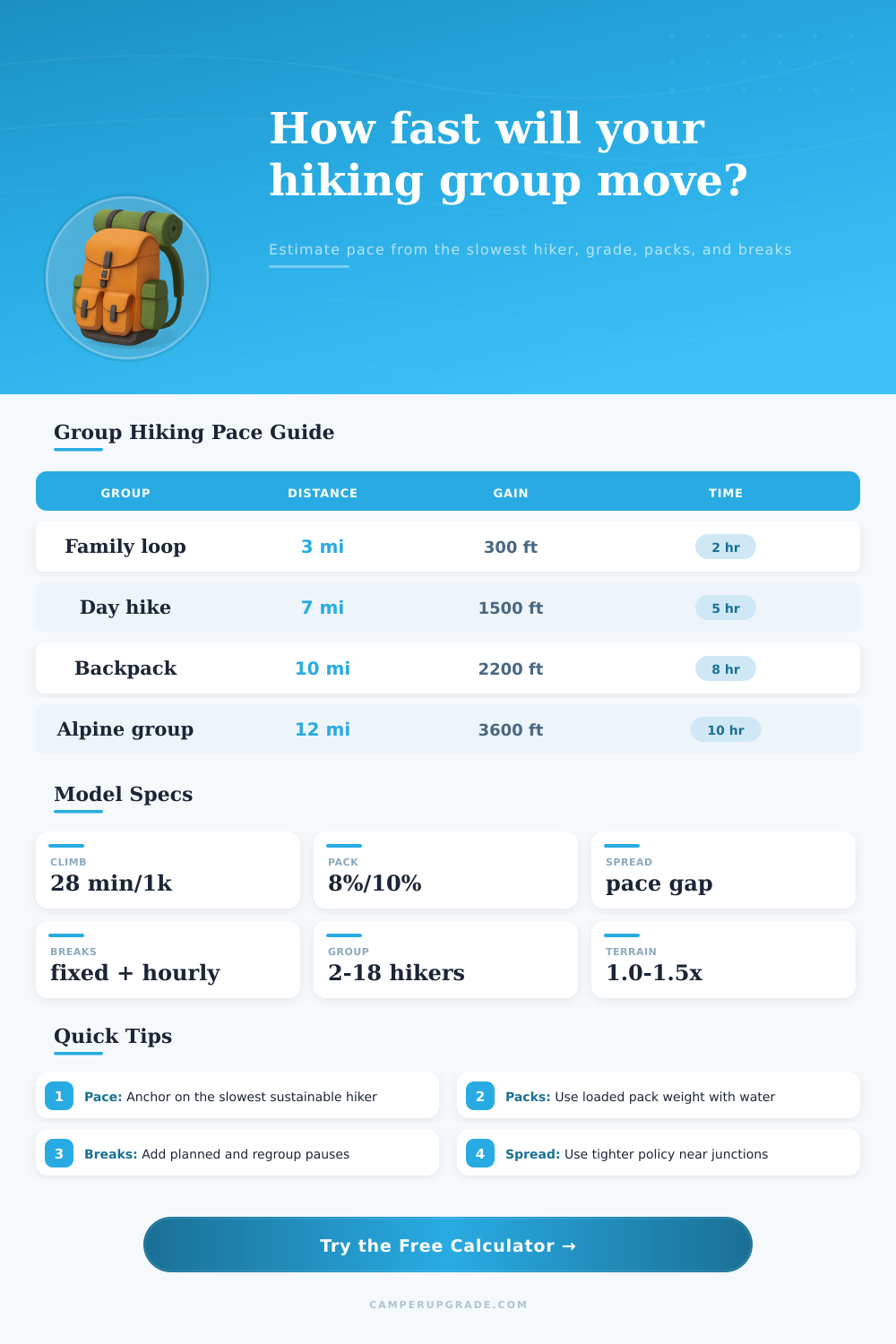
Formula basis: the slowest hiker sets the moving pace. The calculator adds terrain, grade, pack ratio, descent control, fatigue, planned breaks, micro breaks, junction waits, and a group spread estimate from the pace gap between fastest and slowest hikers.
📐Group Pace Spec Grid
📊Group Hiking Reference Tables
| Group Type | Size | Typical Pace | Planning Note |
|---|---|---|---|
| Family nature loop | 3-6 | 28-40 min/mi | Short distance, snack stops, flexible goal |
| Mixed day hike | 5-10 | 22-32 min/mi | Slowest hiker should set the rhythm |
| Club ridge hike | 8-14 | 20-30 min/mi | Regroup at turns and exposed sections |
| Backpack crew | 3-8 | 25-38 min/mi | Pack ratio and late fatigue dominate |
| Alpine group | 2-6 | 24-45 min/mi | Keep spread tight near hazards |
| Terrain | Factor | Descent Add | Group Effect |
|---|---|---|---|
| Smooth signed trail | 1.00x | 5 min/1k ft | Low spread, easy passing |
| Normal mountain trail | 1.10x | 7 min/1k ft | Normal single-file rhythm |
| Rocky or rooty trail | 1.24x | 10 min/1k ft | Slowest footing matters |
| Loose gravel, mud, sand | 1.34x | 12 min/1k ft | More stops and bunching |
| Snow, talus, off-trail | 1.50x | 14 min/1k ft | Tight group management |
| Pack Ratio | Example | Pace Add | Group Check |
|---|---|---|---|
| 0-8% | Light day pack | 0-6% | Usually not the limiter |
| 9-15% | Full day kit | 7-12% | Watch uphill breathing |
| 16-25% | Overnight pack | 13-20% | Breaks become important |
| 26-35% | Heavy backpack | 21-28% | Redistribute shared gear |
| 36%+ | Expedition load | 29%+ | Plan conservative mileage |
| Regroup Policy | Wait Factor | Spread Limit | Best Use |
|---|---|---|---|
| Tight | 1.35x | Short | Kids, junctions, poor visibility |
| Normal | 1.00x | Moderate | Most mixed ability hikes |
| Loose | 0.65x | Longer | Experienced friends on simple trail |
| Sweep | 1.15x | Moderate | Leader protects slowest hiker |
💡Two Practical Group Pace Tips
When a group of individuals go on a hike, the group move at the pace of the slowest individual within that group. Thus, the hiking speed of the slowest individual within a group will determine the speed at which the entire group can move forward on the hike. Groups can experience delay in there hiking due to the difference in the individuals’ speeds within that group.
By using the calculator provided on the page, individuals can input various factor regarding the hike to calculate the time it will take for that group to complete the hike. The weight of the individual’s hiking pack can impact an individual’s speed while hiking. For example, if an individual is carrying a heavy pack, it can impact the individual in relation to how they breathe and move there foot.
How to Plan Group Hike Time
If the weight of an individual’s pack is 25% or more of their body weight, individuals find that they can move much slowerer on climbs that include such heavy pack, and that they will take more time to complete their hike. The calculator applies an 8% penalty to the hiking speed of a group for every 10% of their pack weight is of their body weight. Thus, by redistributing item within the pack to other individuals within the group, the slowest individual will have a lower pack weight, leading to an increased hiking speed for that entire group.
Another factor that can impact the hiking speed of a group is the terrain within which the group will hike and the amount of elevation gain that the group will experience. For instance, if a group must gain a certain amount of elevation during the hike, each individual in that group will have to shorten their stride. Thus, the more elevation gain that the group will have to experience, the more time it will take for the group to complete the hike.
Additionally, if the terrain within which the group will hike is rough or difficult to traverse, the individuals in the group who are hiking at the slowest rates will be impacted, as the entire hiking group will have to slow their rate for those individuals to not fall too far behind of the rest of the hiking group. The calculator uses a baseline hiking speed of 28 minutes per thousand feet of elevation gain, but the hike may take more time if the terrain are rough or difficult. Beyond the various hiking factors related to the group and the hike, such as hiking speed, terrain, and elevation gain, there are other variable related to hiking group management.
Variables like fixed breaks that the group will take, breaks that the individual might take when hiking, and the group’s policy regarding when to stop and wait for those that are hiking at slower rates can all have an impact upon the hike. For instance, if a hiking group has a fixed break at certain points during the hike, they will experience certain breaks in there hiking. Additionally, if the hiking group takes micro-breaks to adjust their hiking gear or to await others that are hiking at slower rates to catch up to the others in the group, those breaks can have an impact upon the hiking speed of the entire group.
Additionally, the hiking group may have a policy within the group of when the group will stop to wait for those that are hiking at slower rates of the hiking group; a very tight regroup policy will have the group stop to wait at every hiking junction. A more loose hiking policy regarding when to stop and wait for those hiking at slower rates will allow the group to travel further from the fastest to the slowest hikers. The distance between those that can hike at the fastest rates and those that can hike at the slowest rates within a hiking group is referred to as the spread of the group.
If the spread of the hiking group is great, it is likely that the fastest hikers are miles away from the slowest hikers within that group. Such a spread can be reduced if the hiking group establishes a more tight policy within the group regarding when to wait for others that are hiking at slower rates, or if those that can hike at the fastest rates are asked to carry the additional weight of those that is slowest hikers. The tables provided within this hike planning page can be used to indicate the impact of certain factors upon hiking time.
For instance, one table can indicate how different types of terrain may impact hiking time, and another table can indicate how different regroup policies will impact hiking time. Thus, these tables ensure that the hiking group knows the potential impacts of different variables upon hiking time. Beyond the calculator and tables that are provided, there is also a baseline that can be established for the hiking group’s hike.
However, the hiking group will have to use their own judgment to ensure that the hike that they plan is safe for each individual within that group. For instance, if the hiking group is made up of individuals that have hiked together for many years, they can adopt a more loose policy for when to stop and wait for those hiking at slower rates. However, a new hiking group may have members that can hike at different rates, and thus, they may have a more tight policy regarding when to stop and wait for each individual in the hike.
Additionally, other factors related to the hike, such as the weather, the amount of daylight during the hike, and whether the hike will include children or individuals that are of an advanced age, may impact the safety of the hike. Thus, the hiking group should consider these factors prior to beginning the hike. In planning the hike, the hiking group should enter the numbers into the calculator to determine the time it will take to complete the hike, and they should also adjust only one variable at a time to determine how that may impact the hiking time of the group.