Gross Combined Weight Calculator
Estimate loaded tow vehicle and trailer weight, then compare the result with GCWR, tow rating, GVWR, payload, and hitch limits.
📌 Named towing presets
⚖ Weight inputs
Loaded combination results
📊 Rating and spec grid
📘 Combined weight reference tables
| Input | Counts toward GCW | Counts toward payload | Common source |
|---|---|---|---|
| Tow vehicle curb weight | Yes | No, already in base vehicle | Scale ticket or spec sheet |
| Passengers and pets | Yes | Yes | Actual occupants |
| Vehicle cargo | Yes | Yes | Bed, cab, roof, cooler |
| Trailer tongue or pin | Yes through trailer weight | Yes on tow vehicle | Scale or percent estimate |
| Trailer cargo and water | Yes | No, except tongue share | Gear list and tank levels |
| Fluid | Weight factor | Example amount | Added weight |
|---|---|---|---|
| Gasoline | 6.3 lb per gal | 25 gal | 158 lb |
| Diesel | 7.1 lb per gal | 25 gal | 178 lb |
| Fresh water | 8.34 lb per gal | 40 gal | 334 lb |
| Propane | 4.2 lb per gal | 9.4 gal | 39 lb |
| Trailer style | Typical tongue/pin | Payload impact | Check closely |
|---|---|---|---|
| Travel trailer | 10-15% loaded trailer | Moderate to high | Receiver and rear axle |
| Fifth wheel | 15-25% loaded trailer | High | Payload and rear axle |
| Toy hauler | 10-20% loaded trailer | Changes with garage load | Tongue balance |
| Pop-up camper | 8-12% loaded trailer | Usually lower | Small SUV payload |
| Flat-towed vehicle | Usually minimal tongue | Low hitch vertical load | GCWR and tow bar rating |
| Rating | What it limits | Calculator comparison | Best source |
|---|---|---|---|
| GCWR | Total combination | Loaded vehicle plus loaded trailer | Tow guide or manual |
| Tow rating | Loaded trailer | Trailer dry plus all trailer loads | Configuration tow chart |
| GVWR | Tow vehicle loaded weight | Curb plus payload items | Door sticker |
| Payload | Added load in/on vehicle | Passengers, cargo, hitch weight | Tire and loading label |
| Hitch rating | Vertical hitch or pin load | Estimated tongue or pin weight | Receiver label |
💡 Calculator tips
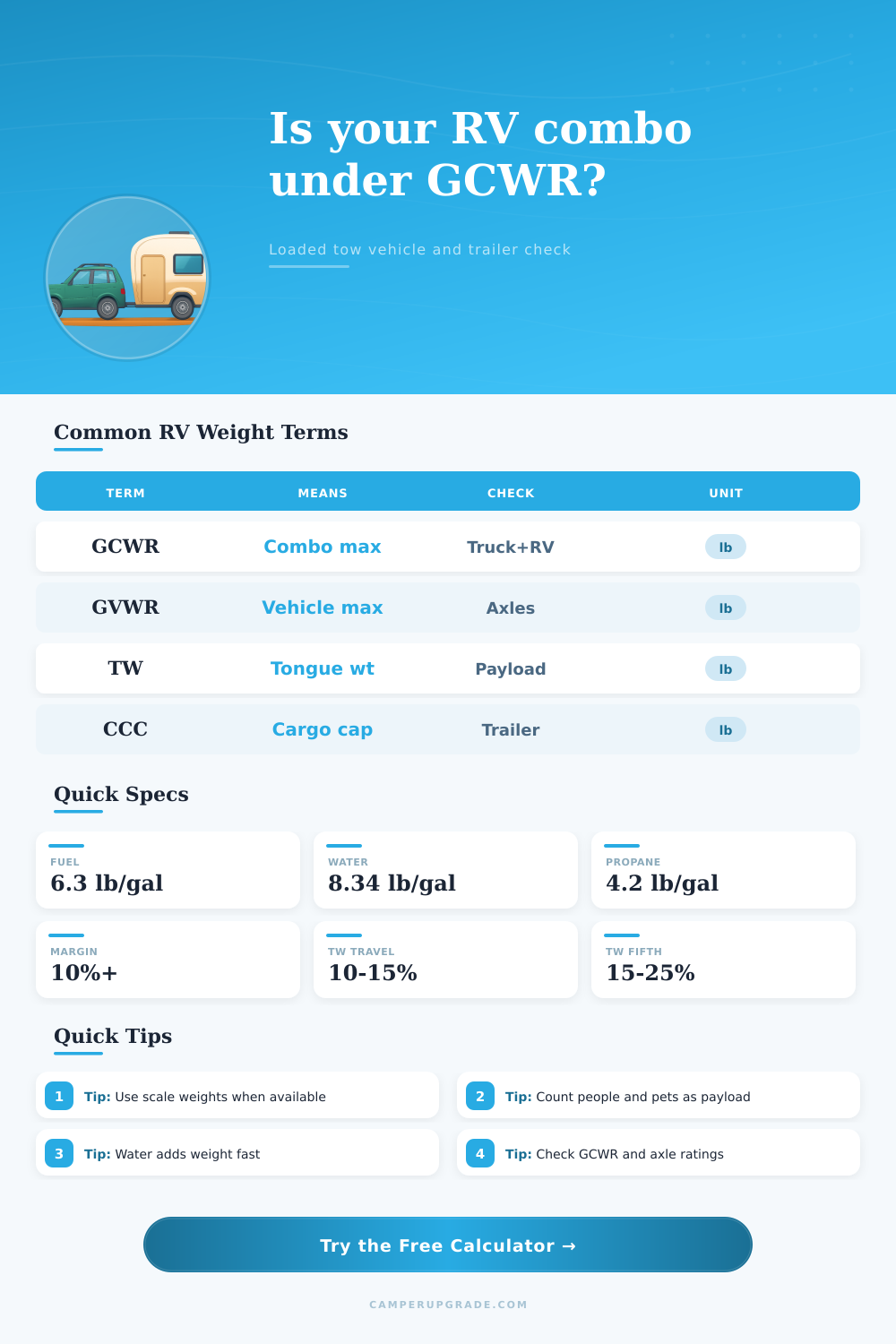
Gross combined weight is the total weight of the tow vehicle and trailer when both the tow vehicle and trailer are loaded for travel. The gross combined weight of the tow vehicle and trailer must not exceed the Gross Combined Weight Rating (GCWR) of the tow vehicle manufacture. The GCWR is the maximum allowable gross weight of the tow vehicle and trailer combination.
The GCWR includes the weight of the passengers, cargo, fuel, and water for the tow vehicle and trailer. Many traveler understand that the tow vehicle is rated for towing trailers of certain weight, but travelers must manage several different weight rating for the tow vehicle. The first weight for a traveler to consider is the curb weight of the tow vehicle.
How to Check the Weight of Your Tow Vehicle and Trailer
The curb weight of the tow vehicle is the weight of the tow vehicle with all fluids necessary for the vehicle as manufactured, but without passenger or cargo. With the addition of passengers, cargo, and fuel to the tow vehicle, the curb weight will increase. Additionally, travelers must also consider the weight of the trailer.
Manufactures often publish the weight of trailers as a dry weight; this is the weight of the trailer without water, propane, and without the contents of the trailer itself. The trailer weight calculator utilize the curb weight of the tow vehicle, the dry weight of the trailer, the weight of the passengers and cargo, and the weight of the fluids of the tow vehicle and trailer to calculate the gross combined weight of the tow vehicle and trailer. Fluid weight is another consideration of the travelers.
Gasoline weighs around six pounds per gallon, and diesel weighs slightly more than six pound per gallon. Fresh water weighs eight and one-third pounds per gallon; thus, a thirty-gallon tank of water will add around two hundred fifty pound to the gross combined weight of the tow vehicle and trailer. Additionally, propane also adds to the gross combined weight of the tow vehicle and trailer once the propane tank are filled with propane.
The trailer weight calculator incorporates these various fluid weights into the calculation of the gross combined weight of the tow vehicle and trailer. Tongue weight is the portion of the trailer’s gross weight that is resting on the tow vehicle’s hitch. For travel trailers, the tongue weight is typically between ten and fifteen percent of the trailer’s loaded weight; fifth wheels has a higher tongue weight.
Tongue weight counts against the payload and hitch weight rating of the tow vehicle; if tongue weight is too high, the load should be balanced within the trailer. Payload is the total weight a tow vehicle can carry in addition to its own weight. You can calculate the payload by subtracting the curb weight of the tow vehicle from the Gross Vehicle Weight Rating (GVWR) of the tow vehicle.
The weight of the passengers and the weight of the cargo of the tow vehicle must fall within the payload rating of the tow vehicle. Additionally, tongue weight counts against payload capacity of the tow vehicle; thus, a loaded trailer will reduce the payload capacity of the tow vehicle more than many people may expect. The trailer weight calculator allows travelers to apply a safety margin to each of the calculated weight.
Application of a safety margin to the gross combined weight, tongue weight, payload, and trailer ratings of the tow vehicle will reduce each of these ratings by a percentage selected by the traveler. After the traveler applies the safety margin to each of the ratings of the trailer and tow vehicle, the calculator will indicate the remaining room that the tow vehicle has for each of the listed rating. Travelers often make mistake when using the trailer weight calculator to determine if the tow vehicle will be within the gross combined weight, tongue weight, payload, and trailer ratings.
For instance, travelers may simply use the dry weights of the tow vehicle and trailer to determine total gross combined weight; this does not account for the weight of the passengers, cargo, and fluids of the tow vehicle. Additionally, travelers may not account for the tongue weight of the trailer; this weight reduce payload and hitch weight capacity of the tow vehicle. Finally, travelers may incorrectly assume that the tow rating of a tow vehicle is for towing trailers that are fully loaded with passengers, luggage, fluids, and other cargo.
The tow rating is for the tow vehicle with the trailer only; it does not factor the weight of the passengers, cargo, or fluids of the tow vehicle. In addition to the ratings of the tow vehicle, there are other factors besides gross combined weight of tow vehicle and trailer that may impact travelers. For instance, heat will increase the tire pressure of the tow vehicle; increased tire pressure impact the way in which the tow vehicle’s gross weight is distributed to its axles.
Additionally, if the tow vehicle is traveling down a mountain grade, most of the tow vehicle’s weight will be placed upon its rear axle. Finally, crosswinds can also affect the driving of the tow vehicle if the tongue weight of the trailer is near the limit of the tow vehicle. These factor do not impact the weight ratings of the tow vehicle and trailer, but they do impact the way in which the tow vehicle’s gross weight impacts the driving of the tow vehicle.
Within the trailer weight calculator, there are reference tables that detail the different types of loads of the tow vehicle and trailer and which of the weight ratings to which each type of load contribute. For instance, the reference tables separate the weights that contribute to the gross combined weight from the payload capacity of the tow vehicle. These tables are helpful to travelers who are having to make decision about where to place certain items within the tow vehicle or trailer; should, for instance, a generator be moved from the tow vehicle’s truck bed into the trailer?
Additionally, when all of the weights of the tow vehicle and trailer are entered into the weight calculator, the trailer weight calculator will provide a status for each of the calculated weights. Each of the ratings will indicate whether the gross combined weight, tongue weight, payload, and trailer of the tow vehicle and trailer has a green, yellow, or red status. A green status means that there is a comfortable margin within the weight rating; yellow means that the gross weight of the tow vehicle and trailer is near the limit of that weight rating; and red means that the gross weight is beyond the limit of that rating even after application of the safety margin.
Additionally, the trailer weight calculator will provide a breakdown of each of the loads. The best method to ensure that the gross weights of the tow vehicle and trailer are within the limits and ratings of the tow vehicle is to actualy weigh the tow vehicle and trailer; the trailer weight calculator makes it easy for travelers to calculate the gross weights, but the responsibility for ensuring that the tow vehicle is within the limits of its manufacturer belong to the traveler who will operate the tow vehicle. It should of been checked carefully.