Grits Camp Water Ratio Calculator
Size dry grits, cooking liquid, hold-back water, salt, cooked yield, and pot room for camp stove, fire-ring, and cabin breakfasts.
🥣Camp Presets
⚙Grits Ratio Inputs
Calculated Camp Batch
📋Grit Type Spec Comparison
📐Reference Tables
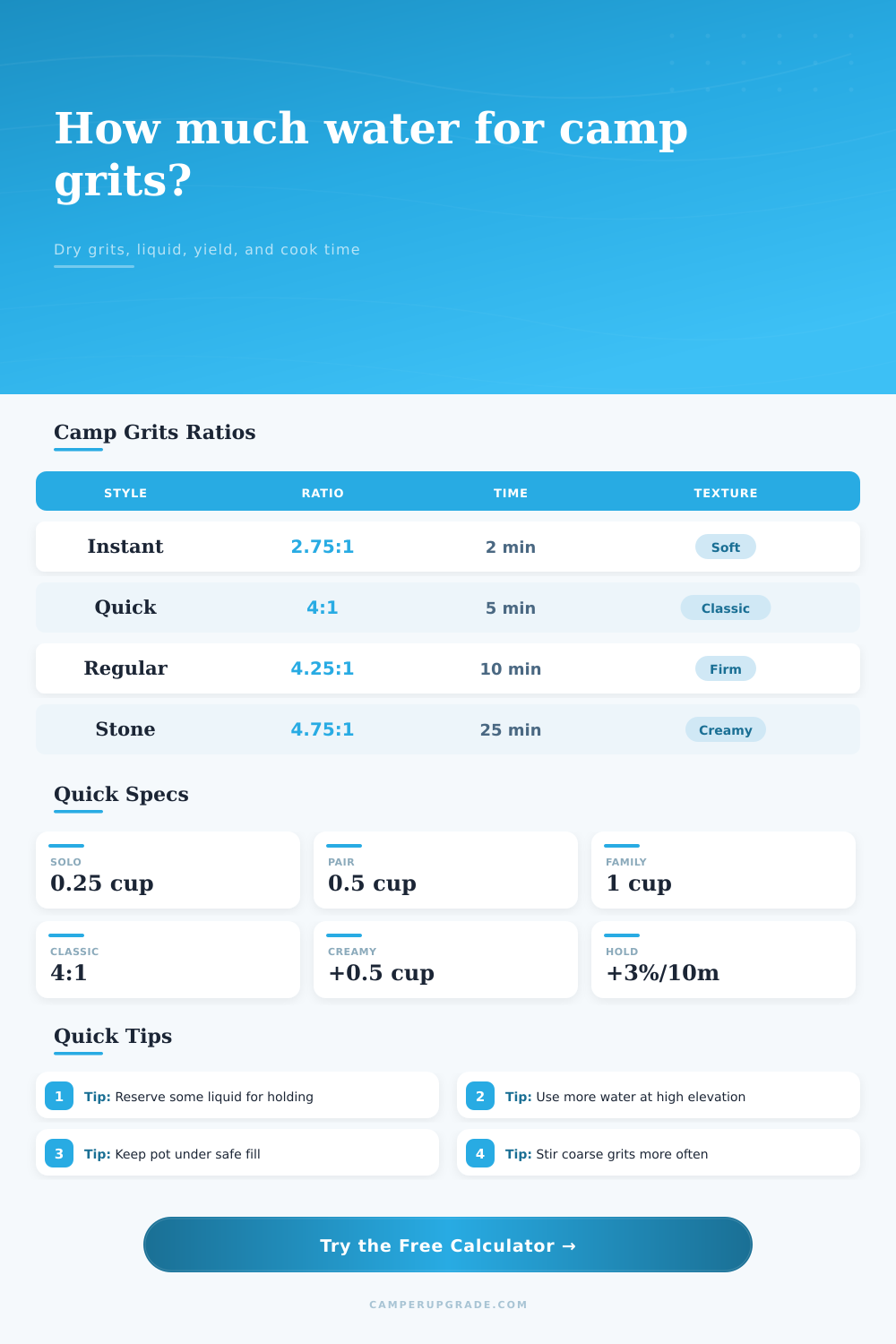
| Grits type | Classic liquid ratio | Typical simmer | Best camp use |
|---|---|---|---|
| Instant grits | 2.75 cups liquid per 1 cup dry | 1 to 2 minutes | Solo mug, backpacker kettle, late plates |
| Quick grits | 4 cups liquid per 1 cup dry | 5 minutes | Camp stove breakfast for 2 to 6 people |
| Regular grits | 4.25 cups liquid per 1 cup dry | 8 to 12 minutes | Steady pot batches with classic texture |
| Stone-ground grits | 4.75 cups liquid per 1 cup dry | 20 to 30 minutes | Dutch oven brunch or basecamp cooking |
| Coarse camp polenta | 5 cups liquid per 1 cup dry | 25 to 35 minutes | Thick side bowls and longer simmer setups |
| Field condition | Liquid add-on | Time add-on | Calculator use |
|---|---|---|---|
| Covered pot below 3,000 ft | 0% to 2% | 0% | Lowest extra water requirement |
| Lid cracked, low simmer | 5% | 5% | Default camp stove assumption |
| Open pot with frequent stirring | 10% | 8% | Useful when watching texture closely |
| Windy burner or fire ring | 15% | 12% | Needs larger reserve and more pot margin |
| Above 6,000 ft elevation | 10% to 15% | 15% to 25% | Compensates for lower boiling temperature |
| Dry grits | Approx servings | Classic quick-grits liquid | Cooked yield |
|---|---|---|---|
| 0.25 cup | 1 camper | 1 cup liquid | About 1 cup cooked |
| 0.5 cup | 2 campers | 2 cups liquid | About 2 cups cooked |
| 1 cup | 4 campers | 4 cups liquid | About 4 cups cooked |
| 1.5 cups | 6 campers | 6 cups liquid | About 6 cups cooked |
| 2 cups | 8 campers | 8 cups liquid | About 8 cups cooked |
| Camp batch | Servings | Dry grits | Classic starting liquid |
|---|---|---|---|
| Trail solo mug | 1 | 0.25 cup | 0.7 to 1 cup |
| Two-person quick pot | 2 | 0.5 cup | 2 cups |
| Family skillet breakfast | 4 | 1 cup | 4 to 4.5 cups |
| Basecamp Dutch oven | 8 | 2 cups | 8.5 to 10 cups |
| Scout patrol stockpot | 12 | 3 cups | 12 to 15 cups |
⚡Calculation Tips
If you’re not paying attention, you might just guess how much water the grits need per pound of cornmeal. How much will boil away due to wind? Altitude? A cooking calculator does all that work for you. Before you light a match, it turns your vague instinct into real plan.
There’s always a risk in cooking grits in the backcountry you don’t face in your own kitchen. There’s no recipe blog you can open as the pot simmers. You cannot make a quick trip to pantry to fetch more water if you miscalculate. Miscalculation result in either watery soup or dry paste. Neither of those options look appetizing when others’ eyes is fixed on you.
Why You Need a Plan for Camp Grits
The key to any decent camp breakfast is knowing not all grits are made alike. Instant packs does cook faster and don’t need as much water. For example, instant grits may only take two and three quarters parts liquid for every one part cornmeal, while coarse grinds soak up close to five. However, they also has their drawbacks. Because the bran isn’t removed in a course grind, it retains its texture and soaks up water slowly. Instant grits can gets gummy if you cook them too long; they can even go past gooey and turn into glue-like mess that sticks to your pot.
In contrast, stone-ground grits need time to break down and fully release starch. It take longer to cook, but if treated as quick grits, they will be hard and gritty.
But there’s one more element of the equation: elevation. At altitudes over three thousand feet, water doesn’t boil until cooler temperatures, which means it’ll take more time for those starches to get gooshy. That’s why the calculator increases the amount of liquid and time, based off your altitude. So even if the water’s boiling like mad, it won’t cause the whole batch to get undercooked.
That’s why it’s important to account for any loss due to wind (or cracking the lid), too. Steam escapes an open pot fast. You want that cushion. And not accounting for wind exposure will make the bottom scorch while the top remains dry and without water.
Another factor that changes the result is texture preference. Some campers like firm, spoonable grits that keep their shape, while others like their grits a bit creamy, melting in your mouth as you eat them. Typically, creamier grits require extra liquid from the beginning of process and frequent stirring toward the end. The tool helps you reach that texture by letting you adjust the base ratio before making smaller changes in the field. It is a small detail, but it matters when you have a specific way you like your breakfast.
When you know ahead of time what you need, you don’t need to debate with your friends whether or not the grits are up to snuff.
The last part of the puzzle that most people miss is holding time. Because grits are a bit like sponges, when you pull them off the heat and let them cool down just a bit, they’ll continue soaking up liquid. If you’re planning to serve your group in waves, or if you intend to keep the pot warmed-up while you finish up other prep, set aside a little water to stir back in later. That way the last person won’t get a solid block of grits by the time they get their bowl. The calculator calculates this reserve amount based on how long you expect the food to sit before eating.
As important as quantity of ingredients is the size of the pots you use. If you let grits come to a boil, they will foam up and rise, and what starts out as a simple breakfast can become a mess to clean up. Pots that are filled too full mean that they’ll likely spill over onto your fire ring or stove top. Leaving about sixty-five percent empty allows for expansion but keeps them contained from bubbling out over the edge. That buffer zone between your ingredients and the brim allows for calmer, safer cooking. This is especially true when using Dutch ovens, which tend to get hot.
There’s really only one key to mastering your camp grits, respect the physics of absorption. Once you’ve accounted for the holding time, grind, altitude, and wind, it’s all just routine. Maybe that initial attempt won’t be perfect, but if you’ve got a game plan, you don’t need to guess. Now you can enjoy the morning light without worrying if you’ll end up eating something or not. Great grits are usualy simply a matter of planning ahead a little bit.