Glacier Rope Team Spacing Calculator
Estimate rope intervals, tied-in travel span, end allowances, rescue reserve, and spacing margin for glacier travel teams using rope length, team size, crevasse width, visibility, and chosen travel mode.
🏔Glacier Rope Team Presets
⚙Rope, Team, Crevasse, and Reserve Inputs
This is a planning calculator, not glacier-travel instruction. Use formal training, local conditions, partner skill, and professional judgment before entering crevassed terrain.
📐Four Formula Cards
Usable Rope
L - ends - reserve - coilsTotal rope minus end tie-ins, planned rescue reserve, and middle-person handling coils.
Even Spacing
usable rope / gapsGaps equal team size minus one, so a four-person team has three equal intervals.
Crevasse Target
width x terrain factorExpected crevasse width is multiplied by bridge, travel-mode, visibility, and buffer factors.
Fit Margin
available - desired spanPositive margin means the requested target fits while keeping the planned reserve intact.
🪢Rope and Team Specification Grid
📊Glacier Rope Spacing Tables
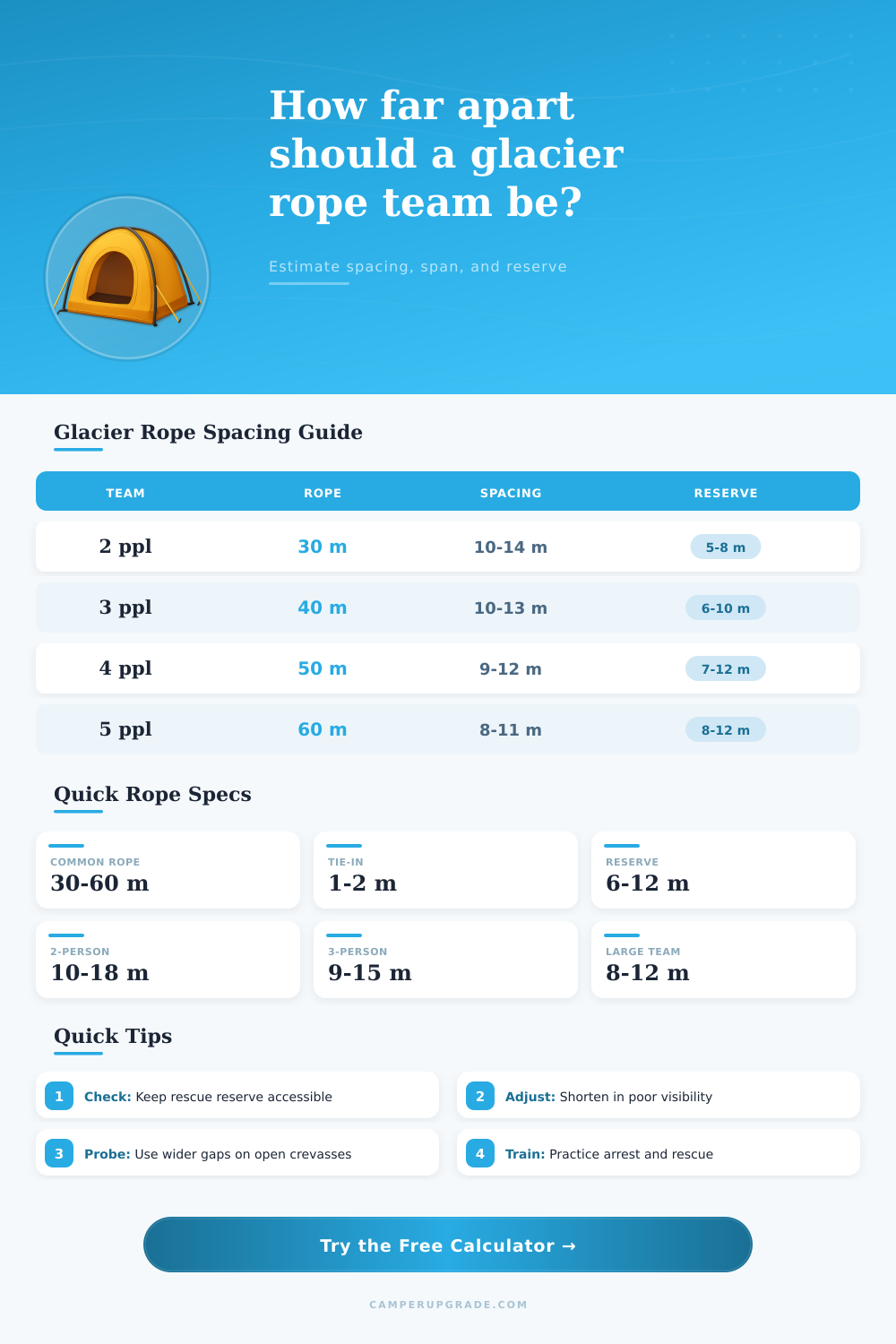
| Team Size | Rope | Reserve | Spacing Range |
|---|---|---|---|
| 2 people | 30 m | 5-8 m | 10-18 m |
| 3 people | 40 m | 6-10 m | 10-15 m |
| 4 people | 50 m | 7-12 m | 9-13 m |
| 5 people | 60 m | 8-12 m | 8-12 m |
| 6 people | 60 m | 8-10 m | 7-10 m |
| Crevasse Pattern | Width | Target Factor | Spacing Goal |
|---|---|---|---|
| Small slots | 1-3 m | 2.2x | 8-10 m |
| Mixed bridges | 3-6 m | 2.4x | 10-14 m |
| Open lanes | 6-10 m | 2.6x | 14-18 m |
| Wandering field | 4-8 m | 2.8x | 12-18 m |
| Whiteout travel | varies | 0.85x cap | shorter |
| Rope Length | 2 People | 3 People | 4 People |
|---|---|---|---|
| 30 m | 17 m | 8.5 m | 5.7 m |
| 40 m | 27 m | 13.5 m | 9 m |
| 50 m | 37 m | 18.5 m | 12.3 m |
| 60 m | 47 m | 23.5 m | 15.7 m |
| 70 m | 57 m | 28.5 m | 19 m |
| Reserve Choice | Use Case | Rope Kept | Spacing Effect |
|---|---|---|---|
| 4-6 m | short easy | low | wider |
| 6-8 m | normal day | moderate | balanced |
| 8-12 m | rescue focus | high | shorter |
| 12-15 m | training | very high | short |
| 15 m+ | complex | special | limited |
💡Glacier Rope Spacing Tips
When you travels across a glacier, you have to maintain a specific distance between yourself and the other peoples on your rope team. The distance between each person on the rope team is critical because this distance will determine how you manage any falls that might occurs on the glacier. If the distance is too small, then if one person fall into a crevasse, they will pull the rest of the team into the crevasse.
However, if the distance is too large, then there will be slack on the rope team, and the slack wont be able to slow the fall of any team members who begins to fall. Therefore, you need to find the perfect distance between yourself and your team members for both safety and rope tension. The total lengths of the rope that you use on a rope team is not the same then the length of that rope that is usable between each team member.
How Far Apart Should Rope Team Members Be
For instance, if you have a fifty-meter rope, you dont have fifty meters of usable distance to use between each team member. Some of the rope is use to create knots in the harnesses of each team member. Additionally, you also use some of the rope for coils to allow each team member to make adjustments to the positioning of each team member.
Finally, you also need to leave some of the rope as a reserve for potential rescue efforts in case one of your team members should fall into a crevasse. You need to have this reserve in case you need to haul one of your team members out of the crevasse. If you use all of your rope for spacing between team members, you will not have any rope left to complete a rescue.
The width of the crevasses that you travel over and the strength of any snow bridge that exist over those crevasses will also impact the distance that each team member should travel from the next. The farther that you must travel over a crevasse, the more distance that should be left between each team member so that those who are not falling can remain on solid ground. Additionally, if the snow bridge that you are crossing is weak, you must travel more cautious because the chance of all team members falling at once is increased.
Thus, the width of the crevasse and the strength of the snow bridge above it will dictate the distance that must be left between each team member. The visibility of the team members and their ability to communicate with one another will also dictate the distance between each team member. If visibility is good, then each team member can see the others and can communicate with shout.
However, in a whiteout, visibility is limit, and each team member cannot see the other members of their rope team. In these situations, team members must travel with less distance between each member to ensure that they are able to communicate with one another. Thus, you sacrifice safety for the security of being able to communicate with each other.
The number of people in a rope team and the terrain over which they will travel will impact the distance between each team member. Teams of two has more flexibility in their spacing than teams of five. As the number of team members increase, the amount of rope that is available for spacing between each team member decreases.
Additionally, the slope on which the team will travel will also affect the distance between team members. On steep slopes, you may need to lessen the distance between team members to allow for a self-arrest if any team member begins to fall. Another factor to consider when determining the distance between each team member on a rope team is the allowance for the coils of rope that each team member will need to move without pulling on the other members of that rope team.
If you do not account for the rope allowance for these coils in the distance between each team member, then the rope may not be long enough for each team member to travel. Thus, you must calculate the distance between each team member when you form your rope team. Use a calculator to find the distance between each team member.
Then, adjust that distance according to the movement of the team and the conditions of the snow and the wind. Finally, ensure that you have enough rope reserve to perform a rescue in case one of your team members should fall into a crevasse.