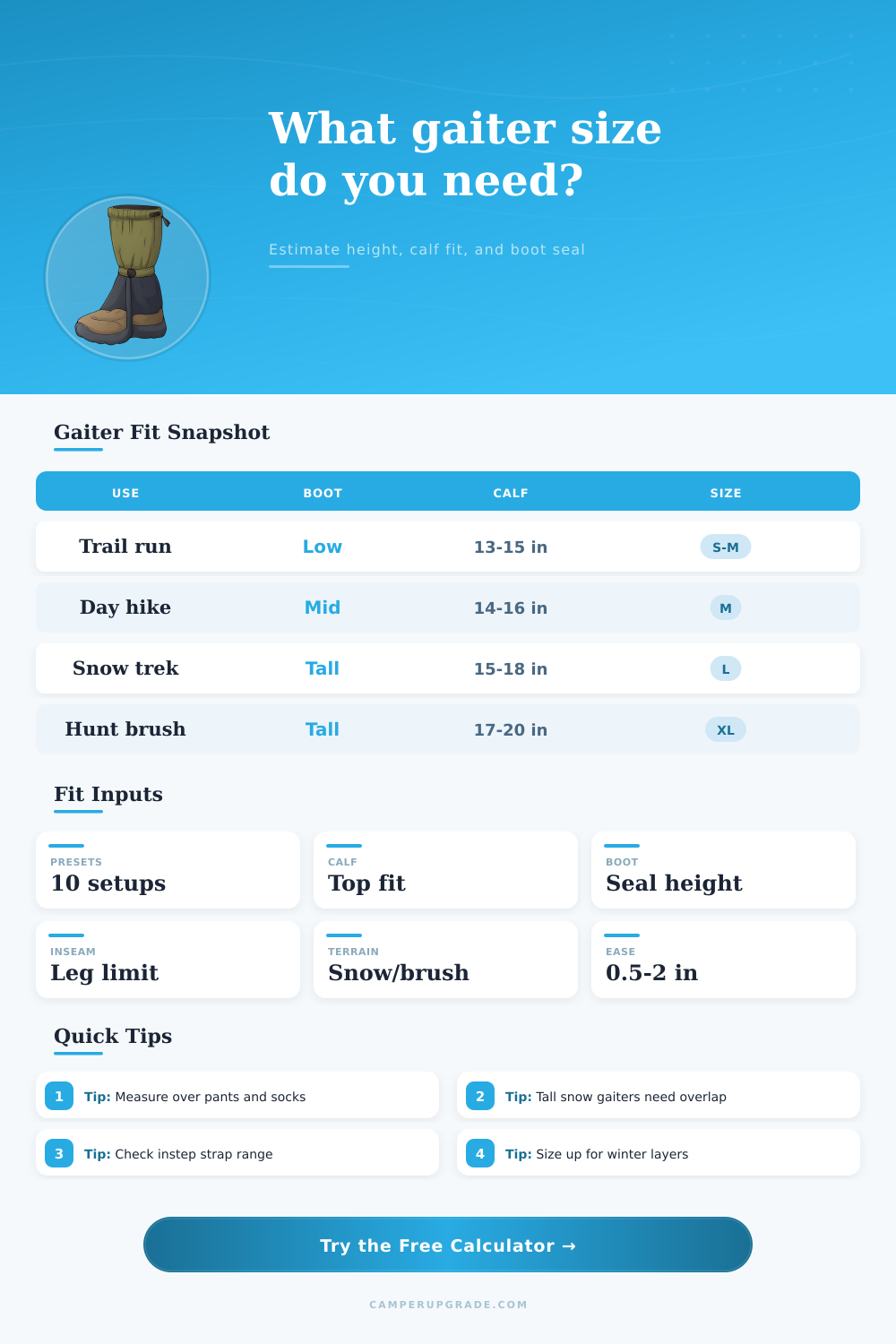
Gaiter Size Calculator
Estimate gaiter height, calf opening, ankle seal, boot coverage, snow or brush clearance, and a practical size recommendation from real footwear and leg measurements.
🥾Footwear and Leg Presets
⚙Leg, Boot, and Terrain Inputs
📏Gaiter Fit Spec Grid
📊Gaiter Reference Tables
| Size | Top Opening | Calf Fit | Best Use |
|---|---|---|---|
| XS | 12-13.5 in | 10.5-12.5 in | Youth, slim trail |
| S | 13.5-15 in | 12-14 in | Trail shoe, light hike |
| M | 15-17 in | 13.5-15.5 in | Most day hiking |
| L | 17-19 in | 15.5-17.5 in | Snow, backpacking |
| XL | 19-21 in | 17.5-19.5 in | Winter layers, brush |
| XXL | 21-23 in | 19.5-21.5 in | Wide calf layering |
| Height Class | Gaiter Height | Boot Match | Coverage |
|---|---|---|---|
| Low | 6-9 in | Trail shoe | Rocks, dust, ticks |
| Ankle | 8-11 in | Low or mid shoe | Light mud, grit |
| Mid | 11-14 in | Mid boot | Wet grass, scree |
| Tall | 15-18 in | Hiking or winter boot | Snow, brush |
| Expedition | 18-21 in | Mountaineering boot | Deep snow, alpine |
| Footwear | Typical Collar | Overlap | Strap Range |
|---|---|---|---|
| Trail shoe | 2.5-3.5 in | 0.5-1 in | 6-9 in |
| Mid hiker | 4.5-6 in | 1-2 in | 8-11 in |
| Backpack boot | 6-8 in | 1.5-2.5 in | 9-12 in |
| Winter boot | 8-12 in | 2-3 in | 10-14 in |
| Mountaineering | 7-10 in | 2-4 in | 10-15 in |
| Terrain | Target Height | Added Ease | Fit Priority |
|---|---|---|---|
| Trail debris | Low to mid | 0.5 in | Snug ankle seal |
| Wet grass | Mid | 0.75 in | Water shedding |
| Brush and burrs | Tall | 1 in | Tear resistance |
| Loose snow | Tall | 1.25 in | Boot overlap |
| Alpine scree | Tall | 1 in | Secure instep |
💡Fit Tips
Selecting the correct gaiter size are a necessary step in the process of utilizing backcountry gear. However, selecting a correct gaiter size will ensure that the gaiter perform it’s primary function of protecting the leg from the environment. A gaiter that is too high may result in the pinching of the skin behind the knee, while a gaiter that is too low may allow for snow or brush to enter the boot.
The different layers that you will wear will impact the dimension of the leg, so it is important to take accurate measurements of the leg. The first decision that must be made is the factor of the environment that are to be protected against. For instance, individuals that will only be utilizing the boots for trail running may only need to protect against dust and rock.
How to Choose the Right Gaiter Size
In contrast, individuals that will be walking in deep snow or dense brush will require more coverage provided by the gaiter. Thus, you must select both the height and the width of the gaiter according to the environment that is to be encounter. Beyond the measurements of the leg, there are additional factor related to the gaiter that must be considered.
For instance, the primary measurement for the gaiter is the circumference of the calf. However, the circumference of the calf alone is not sufficient for determine the size of the gaiter that is required. The circumference of the calf measured a few inches above the widest point of the calf must also be taken to ensure that the gaiter will sufficiently cover that portion of the leg.
Finally, the thickness of the clothing that you will wear while wearing the boot must also be considered. If these measurement are not considered, the gaiter may become too tight when wearing the layers. The height of the boot collar that is to be worn also create a limit to the height of the gaiter.
If the gaiter does not overlap the collar of the boot, debris will become entrapped between the two piece of gear. However, if the gaiter overlaps the boot collar too much, the ankle will be restricted in its movement. The instep portion of the gaiter will also have to be the correct length for the boot that is to be utilized.
If the instep portion of the gaiter is too short for the width of the boot sole, the instep will begin to pull the side of the gaiter towards the center of the foot, causing pressure upon those area. Similarly, if the instep portion of the gaiter is too long for the boot that you will utilize, it may become susceptible to slipping off of the boot if it becomes wet. Additionally, the height of the gaiter is also limited by the inseam and the knee clearance.
Gaits cannot be provide for the crease of the knee, as the gaiter may bunch up against the leg if the boot does move. This bunching of the gaiter can lead to the restriction of the individual’s movement when stepping onto rocks or kneeling down. Thus, the height of the gaiter should of been checked against an individual’s natural of movement.
The type of terrain that will be encounter is one of the factor that will influence the type of gaiter that should be utilized. For instance, if the terrain to be traversed is comprised of loose snow, taller gaits may be required to prevent snow from entering the boots. However, if the trails are packed, the gaiter height can be less.
Additionally, wet brush can require the individual to have a more snug portion of the gaiter around the ankle. Furthermore, exposure to wet brush also require a durable gaiter portion. Finally, taller gaiters provide coverage for snow entering the boots, but also increase the overall weight of the gear that the individual is required to carry.
Unfortunately, many individual make mistakes when selecting the size of their gaiters based off the leg measurements. For instance, individuals often dont consider the clothing that they will be wearing. The circumference of the calf should not be measured over bare skin if the individual will also be wearing pants.
If the circumference of the calf is measured over bare skin, the gaiter will be too small for the individual when wearing pants. Thus, individuals must take into consideration the impact that layers has upon the measurements of the leg. Ignoring the thickness of these layers will result in the purchase of a gaiter that is too tight for the individual when wearing the layers required for the environment.
The benefits of purchasing a gaiter of the correct size include keeping the individual’s boots dry and their leg at a more stable temperature. Additionally, an individual will not have to stop as often when utilizing their boots to remove debris from there boots. A gaiter size can be calculated according to an individual’s leg measurements, but the size must also be able to support the movement that an individual will make throughout the day.