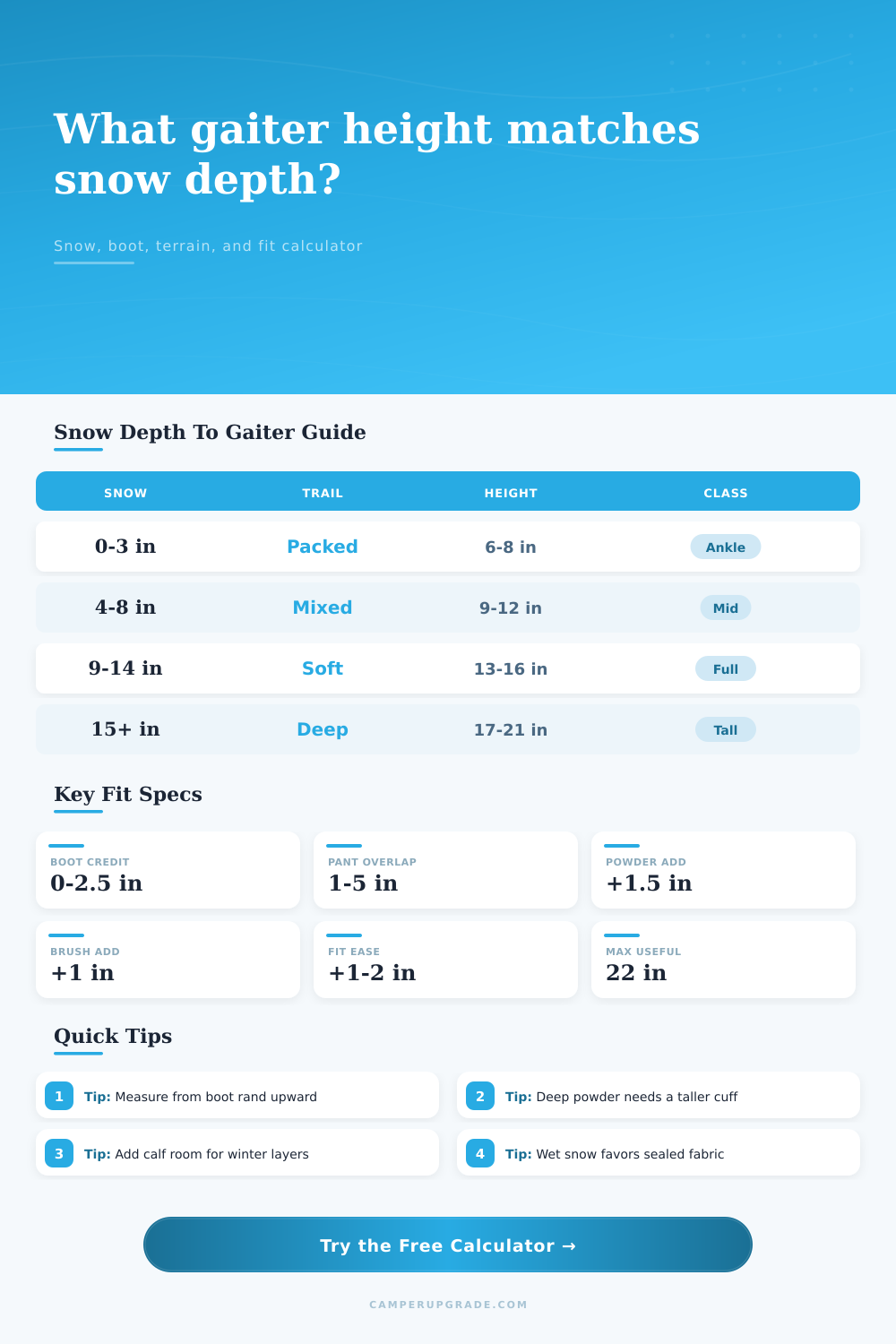
Gaiter Height by Snow Depth Calculator
Estimate the gaiter height, cuff class, entry risk, and calf fit allowance for hiking, snowshoeing, skiing approaches, and winter camp chores.
🏔Named Snow Travel Presets
📏Snow, Boot, and Fit Inputs
Use the depth your boot or snowshoe actually moves through, not a weather-station total.
Add the usual plunge below the surface after each step.
Measured from boot sole edge to the top of the tongue or collar.
Soft-shell or shell pants that shed snow over the gaiter reduce entry risk.
Extra height for side steps, kneeling, brush, or powder splash.
Measure where the top cuff will sit, not at the ankle.
Full Calculation Breakdown
🧵Spec and Material Grid
❄Reference Tables
| Snow Depth | Likely Contact | Baseline Gaiter Height | Best Class |
|---|---|---|---|
| 0-3 in / 0-8 cm | Boot splash, packed path edges | 6-8 in / 15-20 cm | Ankle trail gaiter |
| 4-8 in / 10-20 cm | Toe plow, cuff brushing, shallow drift lips | 9-12 in / 23-30 cm | Mid-calf gaiter |
| 9-14 in / 23-36 cm | Repeated shin contact and posthole spray | 13-16 in / 33-41 cm | Full-height winter gaiter |
| 15-22 in / 38-56 cm | Knee-near powder, side-hill wash, snowshoe throw | 17-21 in / 43-53 cm | Tall alpine gaiter |
| 23+ in / 58+ cm | Deep wading; gaiter cannot cover full snowpack | 20-22 in / 51-56 cm plus route judgment | Expedition-height gaiter |
| Terrain / Activity | Height Add | Risk Add | Why It Matters |
|---|---|---|---|
| Packed trail or plowed camp | 0 in / 0 cm | Low | Snow contact stays below the tongue most of the time. |
| Rolling trail with soft edges | 1 in / 3 cm | Moderate | Side steps and uneven edges push snow above the boot. |
| Brush, deadfall, or crust break | 2 in / 5 cm | High | Brush knocks snow against the shin and opens fabric gaps. |
| Snowshoeing | 2 in / 5 cm | High | Decks throw powder forward and inward with each stride. |
| Mountaineering approach | 3 in / 8 cm | Very high | Steep kick steps, crampon abrasion, and drifted slopes demand more seal. |
| Material Type | Typical Denier | Best Snow Use | Calculator Adjustment |
|---|---|---|---|
| Light coated trail nylon | 70D-210D | Dry packed trails, shoulder-season slush edges | Use only when recommendation is 12 in / 30 cm or lower. |
| Waterproof-breathable laminate | 210D-420D | Wet snow, spring corn, mixed winter hiking | Best default when risk score is moderate or high. |
| Alpine reinforced nylon | 420D-1000D lower panel | Crust, crampons, talus edges, ski edges | Preferred above 16 in / 41 cm or on abrasive approaches. |
| Stretch soft-shell hybrid | Variable woven panels | Fast hiking where breathability matters | Acceptable if snow is dry and depth challenge is limited. |
| Expedition double-layer fabric | Heavy shell plus reinforced lower | Deep cold powder, long approaches, repeated kneeling | Use when final height lands near the 20-22 in ceiling. |
| Calf Layer Setup | Fit Ease Add | Closure Room | Target Result |
|---|---|---|---|
| Thin sock or tights | 0.5 in / 1 cm | 0.5 in / 1 cm | Close cuff that still seals without pinching. |
| Soft-shell pant cuff | 0.8 in / 2 cm | 0.7 in / 2 cm | Normal winter fit for hiking and snowshoeing. |
| Insulated pant or thick sock | 1.2 in / 3 cm | 0.8 in / 2 cm | Extra room so the top strap does not compress layers. |
| Double layers plus shell pant | 1.6 in / 4 cm | 1.0 in / 3 cm | Expedition-style cuff allowance for bulky winter systems. |
💡Calculation Tips
Cold snow gets into your boot, you feel it in your calf. It’s a little thing, but it sucks up the day. And usualy, that’s not even because of the gaiter.
Because most folks purchase gaiters based off some fuzzy notion of winter: either slush, so get one with ankle coverage; or super deep, so go for something that reaches mid-calf. Both fail. Either they let spray up onto your shin, or they tuck your foot inside a wet sock.
How to Choose the Right Gaiters
The calculator do the math after you input your boot profile and local snow depth. That way, you don’t have to guess at fit coefficient.
The second variable is that there isn’t one amount of snow. A trail report might say there are ten inches of snow. Maybe that’s what it said, but previous hikers stomped it down so the actual contact was just three inches. The snow you experience is how much your boot travel through. Don’t take the whole drift layer piled up next to you and use that as your measurement.
Then factor in how far you’ll sink into this stuff. How deep do you go beneath surface with every step? Firm ice means less sinking than dry powder. That added drop draw more snow against your leg. If you don’t account for how much you sink, your gaiters will fit perfectly while you’re standing still, but they will fail as soon as you start walking.
How high? More than most people realize, the higher the better. Why? It is because that is where you start the line. If you wear a very tall mountaineering boot, its high tongue mean less distance for the gaiter to travel and create a seal around leg. Conversely, if you wear a low-cut trail running shoe, more of your skin are exposed which demands a taller gaiter to provide same level of protection. To account for this, tool takes away how much of total snow challenge will be covered by your boots. In other words, it adjusts with some simple math. It will change what type of gear you require. Your boot height (e.g., six inches) might swing you from a mid-calf gaiter into an alpine-style, full-length version.
And then there’s the fit. This is where most purchases fails. People get focused on the height (vertical). They neglect circumference (horizontal). Depending upon what you’re wearing, your calf size will vary. If you wear thin socks, you need a snug fit. If you’re wearing insulated pants in cold weather, your calves is going to bulge out. That bulge will cause your top cuff to pop open if your gaiter isn’t wide enough. The calculator wants your calf size above the layers you’ll be wearing. Not the bare calf size. Allow an inch or two of ease for whatever closure system you choose so it doesn’t dig into soft part of your leg and annoy you. You don’t want a tight gaiter that rubs, or a loose one that collects snow.
Same goes for material selection. Function determines material; environment matter too. A light nylon is great for low abrasion trails that gets packed down. They tear on brush or crust edges. Reinforced fabrics are crampon-friendly. They work better in areas with sharp sticks or crampons. They’re more expensive and less breathable. Waterproof laminate is never negotiable when you’re hiking in wet spring snow. Anything else get soaked through. The page’s reference tables clearly lay this stuff out.
Buying height isn’t all there is. You’re also buying durable material for certain types of terrain hazards. Gaiters are all about finding that sweet spot of connection between you and the snow. Keep the dryness in. Keep the cold out. Don’t compromise mobility. The numbers direct you, but the experience dictates the addition of a safety buffer. You should of added an inch or two of ease for the closure system. You side-step on a slope. Do you kneel in camp often? Those habit require additional height. Trust the math. Trust the movements of your body more. Don’t let the snow in. Keep the warmth in.