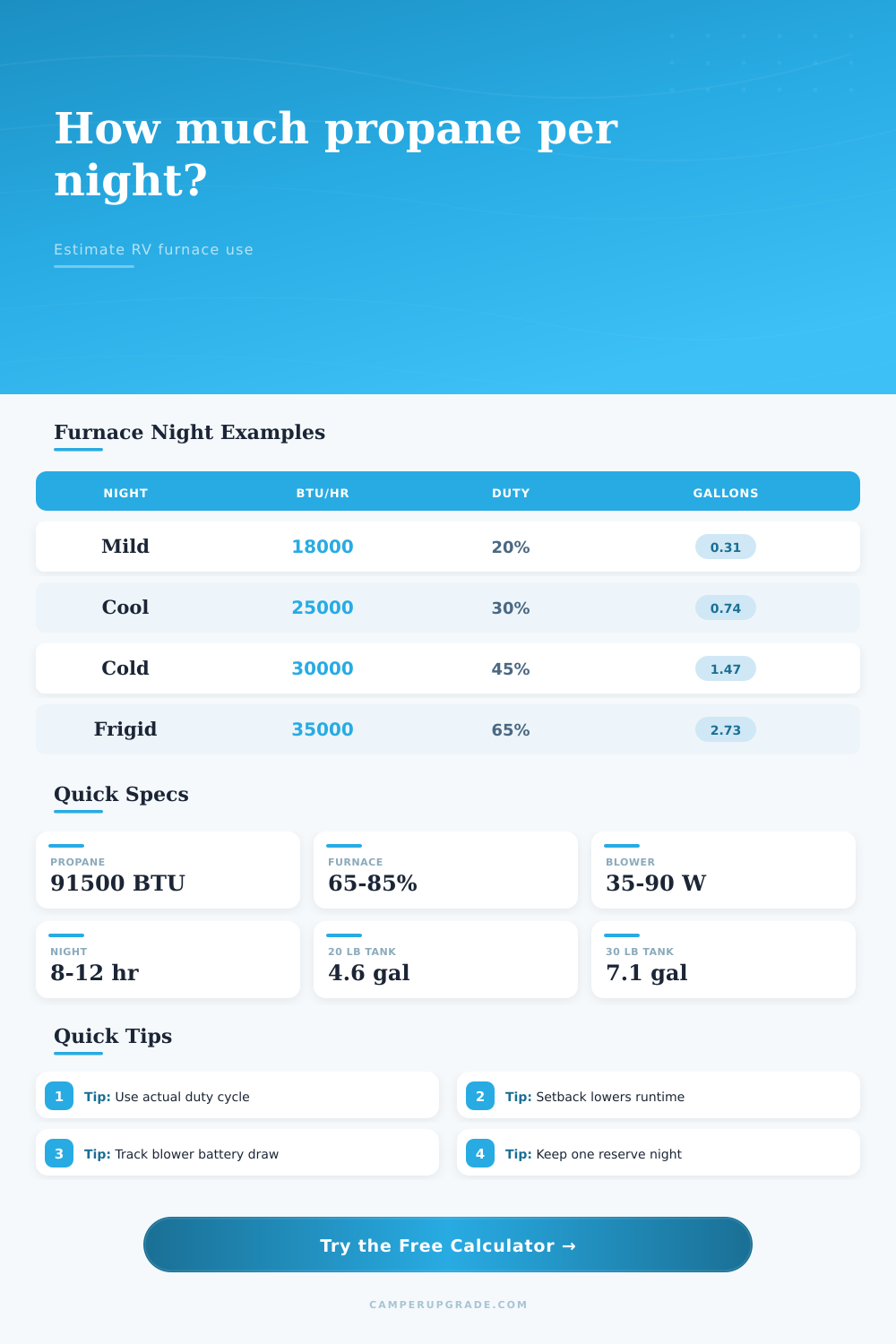
Furnace Propane Per Night Calculator
Estimate propane gallons, tank nights, delivered heat, and 12 volt blower draw from furnace BTU/hr, duty cycle, night length, efficiency, temperature delta, and thermostat setback.
Calculation Breakdown
Estimate only. Actual furnace runtime changes with wind, insulation, duct losses, floor temperature, thermostat placement, altitude, propane regulator condition, and how often doors open.
active hours = night hours × adjusted duty cycle
propane gallons = furnace BTU/hr × active hours ÷ propane BTU/gal
delivered heat = furnace BTU/hr × active hours × efficiency
blower Ah = blower watts × active hours ÷ battery volts
| Furnace rating | Duty cycle | 10 hr propane | Delivered at 80% |
|---|---|---|---|
| 18,000 BTU/hr | 20% | 0.39 gal | 28,800 BTU |
| 25,000 BTU/hr | 30% | 0.82 gal | 60,000 BTU |
| 30,000 BTU/hr | 45% | 1.48 gal | 108,000 BTU |
| 35,000 BTU/hr | 65% | 2.49 gal | 182,000 BTU |
| Inside setpoint | Outside low | Delta | With 5°F setback |
|---|---|---|---|
| 68°F | 45°F | 23°F | About 16% less duty |
| 68°F | 32°F | 36°F | About 10% less duty |
| 68°F | 20°F | 48°F | About 8% less duty |
| 68°F | 5°F | 63°F | About 6% less duty |
| Blower watts | Active runtime | Watt-hours | 12 V amp-hours |
|---|---|---|---|
| 40 W | 2 hr | 80 Wh | 6.7 Ah |
| 60 W | 4 hr | 240 Wh | 20.0 Ah |
| 75 W | 5 hr | 375 Wh | 31.3 Ah |
| 90 W | 7 hr | 630 Wh | 52.5 Ah |
| Scenario | Furnace | Night setup | Expected use |
|---|---|---|---|
| Mild insulated trailer | 20,000 BTU/hr | 8 hr, 20% duty | 0.35 gal |
| Typical shoulder season | 30,000 BTU/hr | 10 hr, 35% duty | 1.15 gal |
| Cold family trailer | 35,000 BTU/hr | 11 hr, 55% duty | 2.31 gal |
| Conservative boondock | 25,000 BTU/hr | 9 hr, 28% duty | 0.69 gal |
Your furnace warms up the RV, but it can run down your fuel. Who wants to wake up without a working heater? It’s a balancing act, and one made simpler with a measurement. We will provides an estimate for your custom setup. The following metrics is provided: delivered heat (BTU), blower amp-hours, tank runtime, and overnight gallons.
You won’t have to wonder if this tank gets you through the weekend. Or should I fill up? BTUs (British Thermal Units) are what most folks use when thinking about propane, but they often overlook duty cycle.
How to Calculate Your RV Heating Needs
Duty cycle refers to the % of the night the furnace burner is actualy firing. For example, a 30,000 BTU furnace sounds impressive but if it’s only running twenty percent of the night because your camper is well insulated then the furnace isn’t using as much fuel. Conversely, another person camping next door might have the exact same furnace but their camper is drafty so it burns more fuel by running eighty percent of the night. You can enter that % right into the tool.
Why does this matter? Estimating by outside temps alone is not reliable. It depends on wind, sun exposure, where the thermostat is located, etc., which change how many times the burner fires.
Another number that gets overlooked is efficiency. The furnace data plate shows input rating; i.e. This is amount of energy put into the fire. However, it doesn’t indicate the percentage of warmth retained by living space. Seventy to eighty-five percent of forced-air RV furnace energy ends up in the space. The remaining portion go out the exhaust and leaks around the seams of your ducts. Entering the efficiency rating changes output to reflect the true heat entering your cabin. It is a subtle difference, but it will tell you why two campers with the same heater feel differentaly comfortable.
There’s also electric side of the equation. This runs the blower, which is a 12-volt DC motor that pushes hot air into your livig area. While it’s tempting to just think about propane tank, don’t forget the house battery. A blower can pulls surprisingly large amounts of electricity on a cold night when you really need it. Having a full propane tank but a dead battery will leave you out in the cold (pun intended) if you’re boondocking without a generator or solar.
The tool tells you how many amps per hour your blower draws based off wattage and run time. This help you know if your power system can handles your heating requirements.
Using setback thermostats is one of the easiest ways to save money on your fuel bill. Drop the temp five degrees overnight. Five degrees lower will decrease the difference in temperature between inside and outside. Because there’s less of a gap, the furnace doesn’t have to work so hard to keep house at same temperature. By dropping your temperature at night, the calculator also reflect your savings in gallons, and it only takes a little bit to add up over time. A little goes a long way…
The reference tables gives you a way to benchmark what you’re doing. How much propane do you go through in a night? The average size tank is a 20 pound cylinder, which contains approximately 4.6 gallons. Now you know how many nights worth of heat you have when you fill up at a place. You have nine nights if you’re going through half a gallon a night, or just under two days if you’re burning through two gallons a night. That make a big difference in planning out your schedule and even where you set up camp. It’s not so much about how full your tank is, but rather how much propane you’re using.
To find out, you don’t have to be an engineer, simply plug in your numbers, pay attention to the results, and let the calculator take care of the math. You should of used this sooner.
No model knows when you open doors or feel wind chill, that part you’ll still want to keep tabs on. But once you know how much propane you’re actualy consuming, you’ll know exactly how long you can stay comfortable, and there goes the anxiety of running out. No more guessing, just knowing.