Fuel Trip Calculator
Estimate route fuel use, reserve margin, refill needs, and fuel mass for camper trips, tow runs, and long hauls.
⛽Trip Presets
⚙Fuel Trip Inputs
📊Fuel Spec Grid
📘Fuel Trip Reference Tables
| Route | Factor | Effect | Use Case |
|---|---|---|---|
| Flat highway | 1.00x | Baseline | Long cruise |
| Rolling mixed | 1.06x | Mild drag | Weekend run |
| Mountain grades | 1.18x | Hard pull | Pass climb |
| City stop-go | 1.24x | Idle loss | Urban loop |
| Economy Unit | To L/100 km | Back Convert | Best For |
|---|---|---|---|
| mpg US | 235.21 / mpg | 235.21 / rate | US trip data |
| mpg Imp | 282.48 / mpg | 282.48 / rate | UK trip data |
| L/100 km | Direct input | Direct input | Metric logs |
| km/L | 100 / kmL | 100 / rate | High-mileage |
| Fuel Type | Density | Energy | Notes |
|---|---|---|---|
| Gasoline | 0.745 kg/L | 32.0 MJ/L | Common RV fuel |
| Diesel | 0.832 kg/L | 35.8 MJ/L | Heavier, denser |
| LPG | 0.51 kg/L | 25.3 MJ/L | Stored as gas |
| E85 | 0.79 kg/L | 21.2 MJ/L | Lower energy |
| Trip Type | Distance | Base Rate | Fuel Use |
|---|---|---|---|
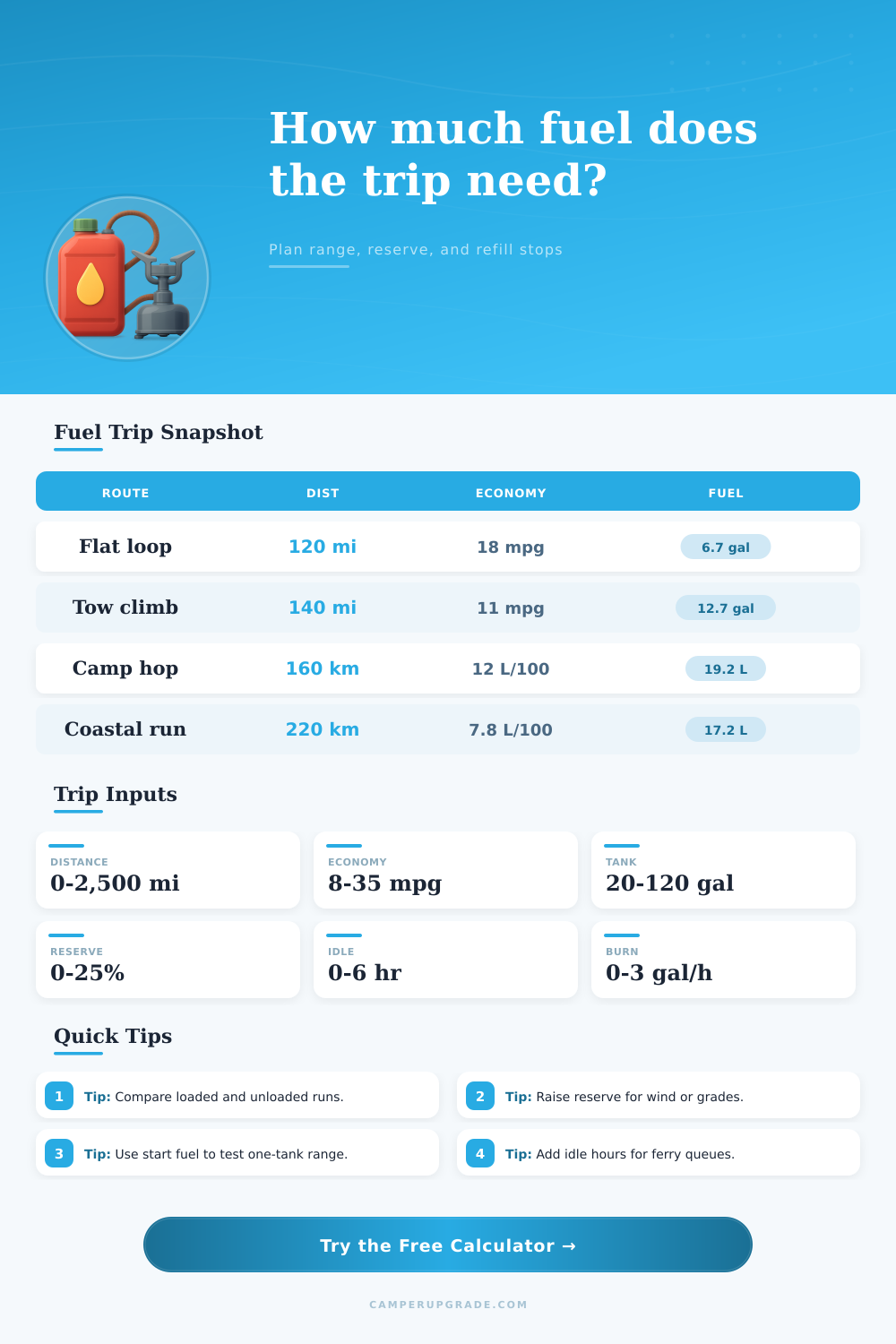
| Camp hop | 160 km | 12 L/100 | 19.2 L |
| Tow climb | 140 mi | 11 mpg | 12.7 gal |
| Coastal run | 220 km | 7.8 L/100 | 17.2 L |
| RV loop | 120 mi | 18 mpg | 6.7 gal |
Fuel planning for camper requires considering many factors because there is alot of factors that affect the fuel consumption of a camper. The fuel economy of a camper under ideal conditions can be accounted for, but you should also consider the effect of environmental and mechanical factor that can reduce the fuel economy of a camper. For instance, fuel economy can decrease if the camper ride over steep mountain grades.
The higher the grade, the more the engine must work to move the camper, thus burn more fuel. Fuel economy can also decrease if there is heavy winds. The extra effort the engine must perform to move the camper against the wind create more fuel consumption by the engine.
How to Plan Fuel for Your Camper
Thus, campers should not rely on the base fuel economy of there camper. The weight of the camper also impact the amount of fuel that the camper consumes. As campers add camping gear or a tow kit to the camper, the weight of the camper increase, which increases the amount of fuel that the camper consumes.
Fuel consumption increase by 5-17% with a heavy load. Thus, you should account for the weight of the load in the fuel calculations for the camper. Additionally, components like roof racks on a camper may increase the resistance of the camper against the wind.
The increased wind resistance cause the engine to burn more fuel. Thus, the fuel economy that is used to calculate the fuel consumption for a camper should be the actual economy that was experienced on past camping trips, not the fuel economy specified by an manufacturer of the camper. Another factor to consider is idling the camper engine.
Idling may be required to warm up the engine or to wait in lines at ferry terminal, for instance. Idling an engine burns fuel at a steady rate. Idling an engine can consume 0.5 gallons of fuel per hour if the air conditioning are on.
Because idling uses fuel yet does not allow the camper to gain any distance from its starting point, it is also important to include idle time in fuel planning. If you dont include idle time in fuel planning, it is possible that the fuel level in the camper will be less than expected. It is always important to include a fuel reserve in the planning of the camper to ensure that there is always enough fuel for the camper to operate.
A fuel reserve is used to cover unexpected event in the trip, and a common fuel reserve is 12 percent of the fuel needs of the camper. In situations where there could be heavy winds or when the camper will encounter steep grades, 15 to 18 percent of fuel needs can be reserved. Fuel reserves should be calculated based off the usable volume of the fuel tanks rather than the maximum volume that the fuel tanks can take.
If calculations reveal that the balance of the fuel for the camper will be a negative number, then the camper will not have enough fuel for the trip without refilling the fuel tanks. In addition to fuel calculations, there are other ways to maintain fuel economy for the camper. Maintaining the tire pressure for the camper can help to increase fuel economy; low tire pressure can result in a decrease of fuel economy of two mile per gallon.
In addition, it is also useful to track the actual consumption of fuel for each trip that the camper take. By tracking fuel consumption, you can create fuel plans for future trips. By creating accurate fuel plans, you can avoid the risk of running out of fuel for the camper.
By including the load of the camper, the idle time, the terrain that will be traveled, and the estimated wind during those trips, fuel plans can be created for the camper to follow during its trip.