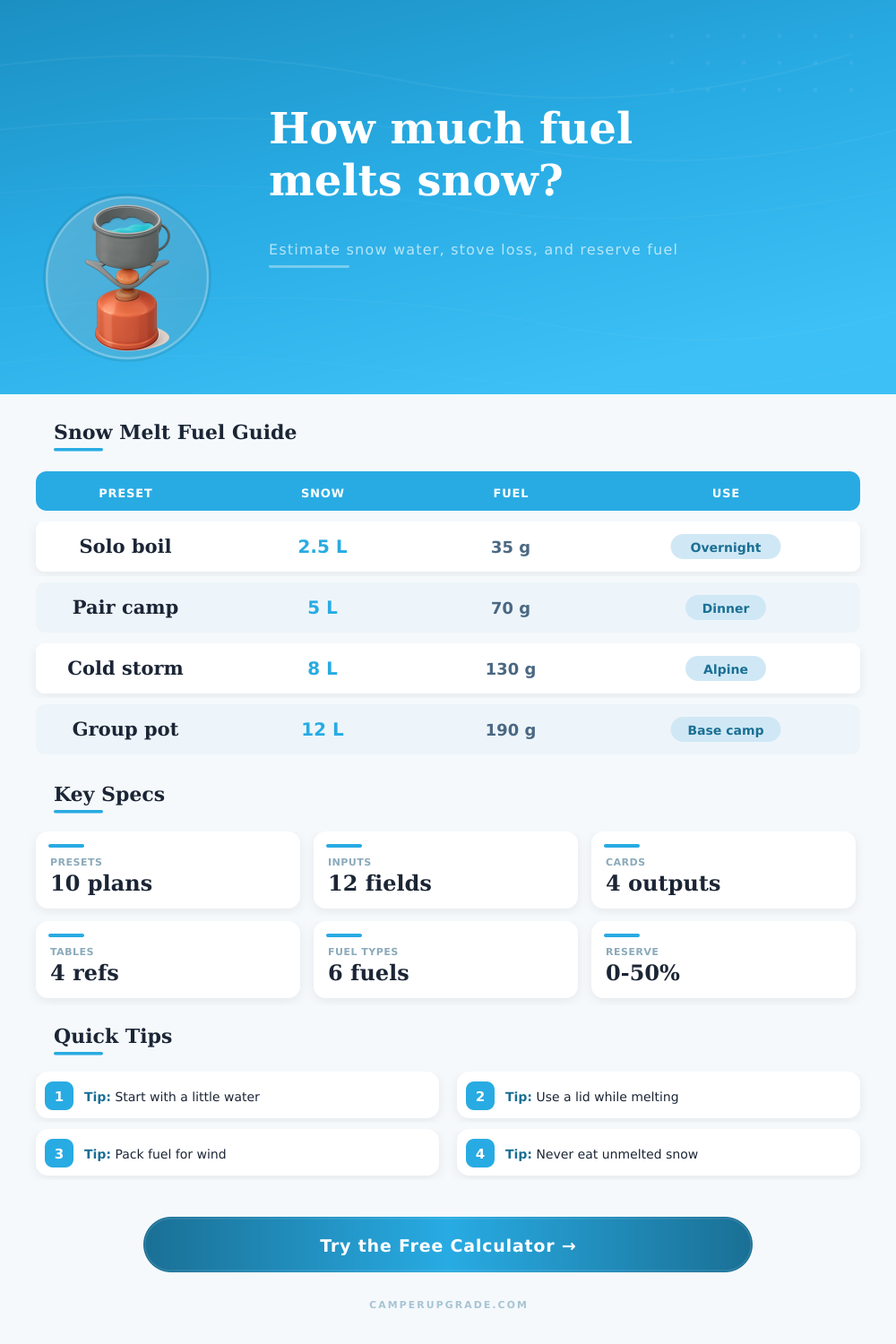
Fuel to Melt Snow Calculator
Estimate snow mass, melt-water yield, start-temperature penalty, stove efficiency, fuel grams, reserve fuel, pot batches, and water for winter camp snow melting.
⛺Snow Melt Presets
⚙Calculator Inputs
📊Detailed Breakdown
🧪Spec Grid
📘Reference Tables
| Snow Type | Density | 10 L Snow Yields | Camp Note |
|---|---|---|---|
| Very light powder | 50 kg/m3 | 0.5 L water | Huge volume, low yield |
| Cold powder | 80 kg/m3 | 0.8 L water | Common after fresh storms |
| Settled powder | 120 kg/m3 | 1.2 L water | Better for camp collection |
| Wind slab | 180 kg/m3 | 1.8 L water | Dense but slower to scoop |
| Packed camp snow | 250 kg/m3 | 2.5 L water | Good pot yield |
| Wet spring snow | 350 kg/m3 | 3.5 L water | Heavy and efficient |
| Fuel | Energy | Typical Efficiency | Winter Note |
|---|---|---|---|
| Isobutane canister | 46 MJ/kg | 35-60% | Warm canister helps pressure |
| White gas | 44 MJ/kg | 40-65% | Reliable in deep cold |
| Propane | 46 MJ/kg | 35-60% | Strong cold output |
| Alcohol stove | 27 MJ/kg | 25-45% | Slow for big snow melts |
| Kerosene | 43 MJ/kg | 35-60% | Good expedition fuel |
| Wood fire | 16 MJ/kg | 10-25% | Wet wood lowers output |
| Start Temp | Heat to 32 F | Melt Energy | Extra vs 32 F Snow |
|---|---|---|---|
| 32 F snow | 0 kJ/kg | 334 kJ/kg | 0% |
| 20 F snow | 25 kJ/kg | 334 kJ/kg | 7% |
| 10 F snow | 46 kJ/kg | 334 kJ/kg | 14% |
| 0 F snow | 67 kJ/kg | 334 kJ/kg | 20% |
| -20 F snow | 109 kJ/kg | 334 kJ/kg | 33% |
| Water Plan | Per Person | Snow at 120 kg/m3 | Use Case |
|---|---|---|---|
| Hot drinks only | 0.75 L | 6.3 L snow | Evening camp |
| Dinner and drink | 1.5 L | 12.5 L snow | Short overnight |
| Full evening | 2.5 L | 20.8 L snow | Cook and hydrate |
| Cold day fill | 3.5 L | 29.2 L snow | Next day bottles |
💡Snow Melting Tips
The calculator uses standard heat values for ice warming, latent heat of fusion, water warming, stove efficiency, and fuel energy density. Real trips still need judgment for wind, pot fit, priming, and weather.
Snow isnt liquid water that a persons can be drunk by. In order for snow to become liquid water that can be drunk by a person, it must be melted. The fuel require to melt the snow depends upon an amount of snow that is to be melted and the tempature of the snow that is to be melted.
Many traveler dont account for the fuel required to melt snow while on a trip. As a result, travelers often experience a shortage of fuel during there trips. Since snow contain air, the melted water from snow may contain a relatively small volume of liquid water compared to volume of snow that is melted.
Melting Snow for Drinking Water
The density of the snow is one of the factor that must be considered in the calculation of the amount of liquid water that will be obtained from melting snow. The density of snow can range from low density for powder snow to high densities for snow that the wind packs. If a person dont take into account the density of the snow that will be melted, a person may either have to carry too much snow, or may not have enough liquid water for drink.
The density setting on the calculator allows a person to adjust for the density of the snow that will be melted. The other factor that must be considered is the temperature