Fuel Reserve Margin Calculator
Estimate whether your current fuel covers a remote driving leg, detours, idle time, auxiliary use, and a deliberate reserve before the next reliable fuel stop.
🚘Remote Route Presets
⚙Fuel, Route, Reserve, and Condition Inputs
This calculator is a planning estimate for remote travel. Validate fuel economy on your own vehicle, know local fuel availability, and follow legal storage and ventilation rules for carried fuel.
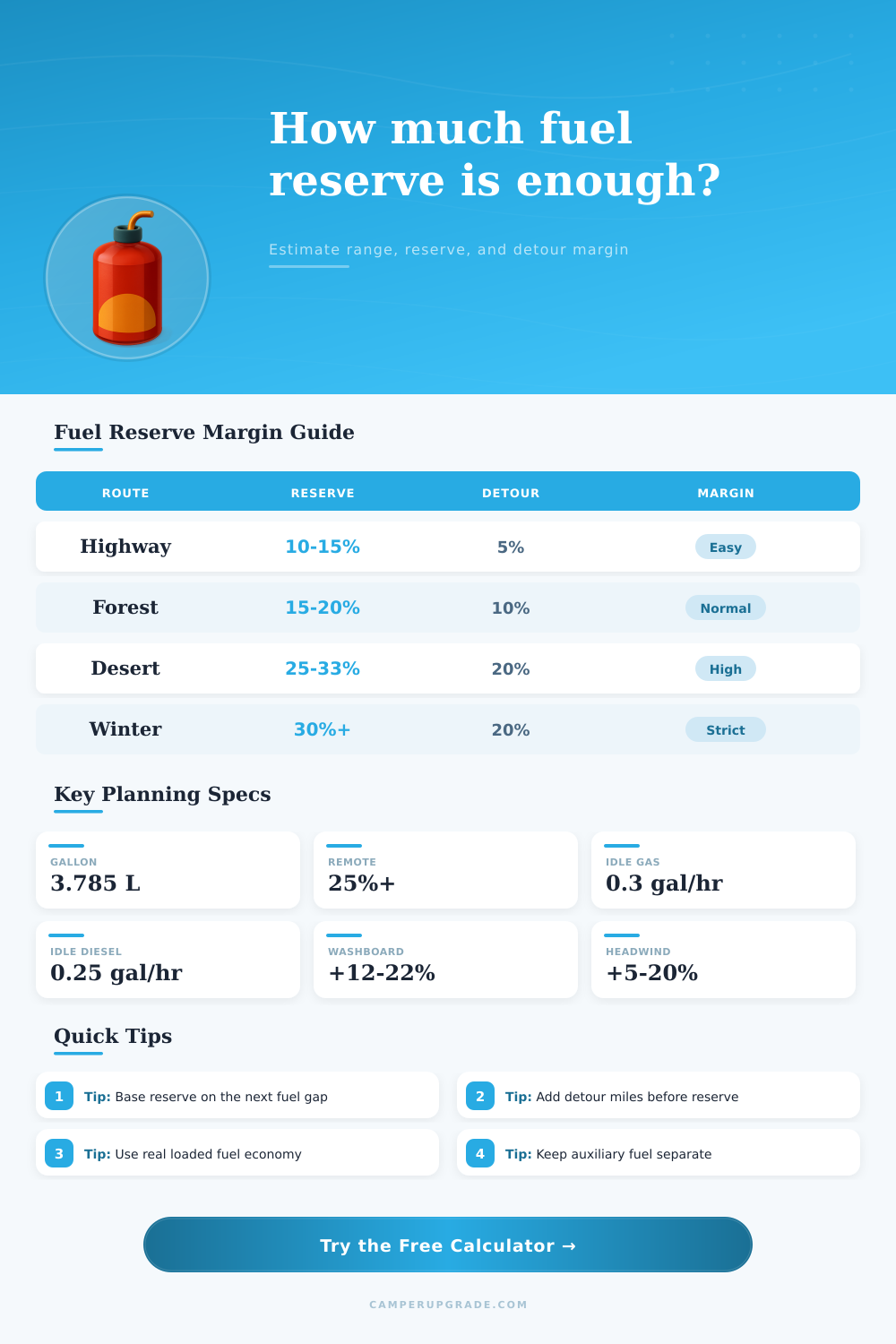
⛽Fuel Reserve Spec Grid
📋Fuel Reserve Reference Tables
| Route type | Reserve band | Detour band | Best use |
|---|---|---|---|
| Paved highway with frequent stations | 10 to 15% of tank | 5% or a short fixed distance | Interstate and developed camp corridors. |
| Forest road or mountain access | 15 to 20% of tank | 10% plus campsite scouting | Mixed gravel, climbs, and limited hours. |
| Desert track or long washboard | 25 to 33% of tank | 15 to 25% of route | Remote fuel, slow going, and turnarounds. |
| Winter, snow, or storm travel | 30% or more | 20% or more | Warm-up time, closures, and slow recovery. |
| Condition | Typical factor | Calculator field | Planning note |
|---|---|---|---|
| Rolling hills | 1.04 to 1.08 | Terrain | Small sustained penalty from grade changes. |
| Steep mountain pass | 1.12 to 1.20 | Terrain | Use higher setting when towing or heavily loaded. |
| Washboard gravel | 1.10 to 1.22 | Surface | Rolling resistance and speed changes add burn. |
| Soft sand or snow | 1.18 to 1.35 | Surface | Pressure, speed, and traction management matter. |
| Vehicle setup | Loaded economy cue | Reserve cue | Check before leaving |
|---|---|---|---|
| Campervan | 14 to 20 mpg is common | 15 to 25% | Roof box, tire pressure, and water load. |
| Truck camper | 9 to 15 mpg is common | 20 to 33% | Payload, wind, and mountain grade. |
| Towing small trailer | 8 to 14 mpg is common | 20 to 33% | Headwind and speed sensitivity. |
| Adventure motorcycle | 35 to 60 mpg is common | 15 to 30% | Soft luggage, sand, and throttle changes. |
| Unit or fuel item | Value | Calculator use | Why it matters |
|---|---|---|---|
| US gallon | 3.78541 liters | Fuel conversion | Lets imperial and metric inputs share one model. |
| Mile | 1.60934 kilometers | Distance conversion | Range and detour math stay consistent. |
| L per 100 km | 235.214 divided by mpg | Metric economy | Higher number means worse economy. |
| Auxiliary draw | Fuel per hour | Heater or generator use | Subtracts fuel before range is checked. |
💡Reserve Planning Tips
A fuel reserve margin is the difference between the amount of fuel that will be consumed on a route and the amount of fuel that a person keeps in reserve for unexpected situation. This fuel margin provide for situations like taking a wrong turn or going off the planned route to search for an animal, a friend, or even an unexpected closure of a road. If a person dont include a fuel reserve margin in their fuel planning, a problem that may seem minor can become a major one.
Fuel reserve margins has to be included in the planning of a trip because the fuel consumption on the road may not be as calculated as the fuel economy published on the vehicle window sticker. Factors like the terrain changes, the wind that push against the camper, the load on the camper’s roof, and the surface that the camper drives on can all play a role in the consumption of the fuel for the vehicle. Furthermore, the idling of the vehicle and other auxiliary equipment that uses some of the same fuel supply as the vehicle will also impact the fuel consumption of the camper on the road.
How to Plan Your Fuel Reserve for a Trip
Fuel consumption will be higher than expected if a person only uses the distance that must be covered by the camper and the fuel economy that is calculated for the camper when the camper is driving on even terrain and without any external factor affecting it’s movement. The calculator helps a person to account for these variable. The calculator takes into account the distance that the camper will travel and any detour that the camper may make along the road.
Furthermore, the calculator takes into account the fuel economy that the camper achieve while loading the camper and while traveling on terrain that is similar to the terrain that is to be traveled. The calculator considers each of the terrain, the road surface, the impact of the wind on the camper, and the load on the camper because each of these variables will have an impact upon the consumption of the fuel that is contained within the camper’s tank. The calculator also incorporates the reserve target that the camper desire to establish for the trip.
Either as a percentage of the fuel tank or as a distance that the camper desire to ensure is covered by the fuel that is contained in the tank. The calculator calculates the margin and takes into account the fuel that is use while idling the camper and using auxiliary equipment, as well as incorporates a buffer that accounts for the uncertainty of the fuel gauge. Finally, the calculator display for the user whether the fuel that is contained in the camper will cover the whole plan of the trip with a margin remaining within the fuel tank.
The output of the calculator is used to make a decision regarding the fuel consumption of the camper. If the margin that is displayed is large, this indicates that there will be enough fuel to complete the journey without having to acquire additional fuel along the journey. A smaller margin, however, indicate that the camper should either acquire additional fuel for the journey or shorten the leg of the journey that must be covered by the camper.
In instances in which the calculator indicates a negative margin, that margin indicates that the camper must either acquire fuel prior to beginning the journey or must utilize the fuel reserve that was established for the trip. In most instances, travelers will under-estimate the impact of certain factors on the fuel consumption of the camper. For instance, fuel consumption rate can increase in the face of a headwind that impacts the boxy camper that is traveling on a remote road.
Fuel consumption rates can also increase if the camper travels on washboard surface that force the camper to travel at slower rates. Furthermore, if the camper intends to tow a trailer that contains additional mass and alters the aerodynamics of the camper, fuel consumption will increase. These variable can all be tested in the calculator to determine which variable has the most impact upon fuel consumption.
The reference tables that are provided for different route type provide information regarding the fuel reserve that should be established for each type of journey. For instance, highways that have fuel station along their routes will require a smaller percentage of fuel to be established as a reserve for emergencies compared to the percentage of fuel that should be reserved for a journey into a remote desert area or a winter journey. The percentage of fuel that should be reserved for an emergency on a remote road will be higher than for a highway due to the possibility that the road will be closed, the road may have washboard surfaces that force the camper to travel at slower rates, and the weather on that road may force the camper to make stop along its route.
These tables are provided as a starting point for travelers, and may not be used as rules for fuel consumption on the road due to the fact that each road has different variables that will impact fuel consumption for each camper. A common mistake is to not account for the fuel that will be used by the camper for idling and auxiliary equipment. Fuel for these variables is drawn from the same tank as the fuel that is consumed for traveling on the road, so any fuel that is used for these variables will reduce the amount of fuel available for the road journey.
Another of the common mistake is to use an optimistic number for fuel economy that was established only on even terrain with no obstacles like hills, wind, or other road variables. The calculator is more accurate in that it accounts for the loaded fuel economy of the camper while it is load and traveling on its route. Furthermore, the fuel that is calculated by the calculator accounts for the fuel that is used by the camper when it is idling at various location along the route.
Twenty or thirty minutes of idling will consume some of the fuel that is available for the road journey because idling utilizes the fuel consumption rate for the hour. The same rule can be applied to the hours of fuel use for auxiliary equipment like a small generator that may run overnight. Fuel should be accounted for in layers so that the traveler ensure that there will be enough fuel for the trip.
The known distance to be driven and any detours should first be calculated. The fuel that will be used while idling and using auxiliary systems should be accounted for. Finally, the reserve target that was calculated for the trip should be protected.
Any fuel that is left over after accounting for these variables is the true margin for fuel consumption during the trip. If the true margin for fuel is low, the traveler may have to make a decision to either acquire additional fuel, shorten the distance that is to be driven by the camper, or both. Fuel planning is a process that should be used to determine how to protect the fuel reserve of the camper.
The calculator should be used prior to each leg of the journey that the camper take. Furthermore, the fuel economy can be updated after the camper empties each tank of fuel, and the reserve target for the trip can be updated to match the terrain that is to be driven on the upcoming trip. The margin for fuel that is protected is the difference between the camper arriving at the destination with fuel and options for emergencies versus the camper arriving at the destination without any options for fuel refills.