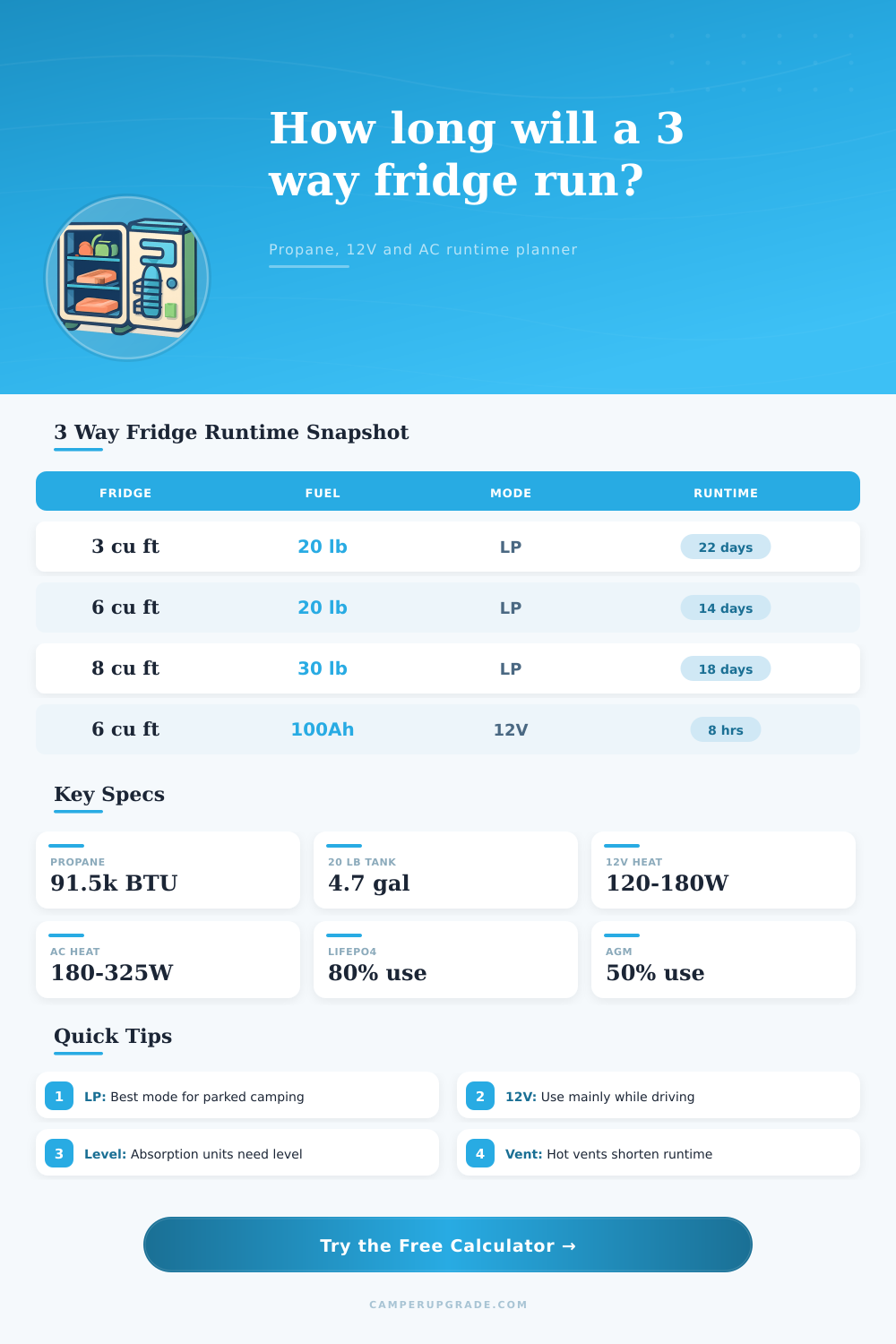
3 Way Fridge Runtime Calculator
Estimate absorption fridge runtime on propane, 12V battery, and 120V AC inverter power using tank size, burner BTU rate, heater watts, battery depth, and trip hours.
Runtime breakdown
| Fridge size | Typical burner input | 50% duty fuel use | 20 lb tank runtime |
|---|---|---|---|
| Compact 2.5-3 cu ft | 650-850 BTU/hr | 0.36-0.47 lb/day | 34-44 days if all fuel is available |
| Mid-size 5-6 cu ft | 1000-1300 BTU/hr | 0.56-0.72 lb/day | 28-36 days if all fuel is available |
| Large 7-8 cu ft | 1400-1600 BTU/hr | 0.78-0.89 lb/day | 22-26 days if all fuel is available |
| Large 9-10 cu ft | 1700-1900 BTU/hr | 0.94-1.06 lb/day | 19-21 days if all fuel is available |
| Hot compartment or poor venting | same burner | Duty often 70-90% | Runtime can drop by about one third |
| 12V element draw | Approx current at 12.8V | 100Ah LiFePO4 at 80% | 100Ah AGM at 50% |
|---|---|---|---|
| 100 W compact element | 7.8 A plus controls | About 10 hours | About 6 hours |
| 125 W small fridge element | 9.8 A plus controls | About 8 hours | About 5 hours |
| 150 W common mid-size element | 11.7 A plus controls | About 6.6 hours | About 4 hours |
| 180 W large fridge element | 14.1 A plus controls | About 5.5 hours | About 3.3 hours |
| 220 W large high draw element | 17.2 A plus controls | About 4.5 hours | About 2.7 hours |
| AC element draw | Battery load at 88% inverter | 200Ah LiFePO4 runtime | Best use |
|---|---|---|---|
| 180 W compact AC heater | 205 W plus controls | About 10 hours | Short pre-cool or brief shore-power gap |
| 225 W mid-size AC heater | 256 W plus controls | About 8 hours | Temporary inverter use only |
| 275 W common 6-8 cu ft heater | 313 W plus controls | About 6.4 hours | Shore power preferred |
| 325 W large AC heater | 369 W plus controls | About 5.4 hours | Generator or campground pedestal |
| Continuous overnight AC on inverter | 4.9-8.9 kWh/day | Needs a very large bank | Usually less practical than propane |
| Mode | Energy source | Runtime strength | Calculator note |
|---|---|---|---|
| Propane flame | LP gas burner and small 12V control draw | Longest parked runtime per pound carried | Use burner BTU, duty cycle, tank pounds, and fill share |
| 12V DC element | Battery or alternator-powered heating element | Short battery runtime; useful while driving | Assumes heating element runs continuously |
| 120V AC element | Shore power, generator, or inverter | Unlimited on shore power, short on battery inverter | Inverter efficiency converts AC watts to battery watts |
| Controls and fans | Small DC load on the house battery | Matters over long LP stays | Added to battery use in every mode |
| Hot-weather operation | More burner time or longer electric heating | Reduces all estimates | Raise duty cycle when vents are hot or sun-exposed |
An absorption fridge can run on three different power sources: propane, 12V DC electricity, and 120V AC electricity. The absorption fridge dont use a compressor to create cold temperatures within the fridge. Instead, an absorption fridge use a heat source to move a chemical solution through a series of coil.
Because the absorption fridge requires a heat source to function, the type of power source you use will determine how long your food will stay cold and how long your energy resource will last. Propane is one of the most common power source for an absorption fridge. This is mainly because the propane burner use propane fuel to create the heat necessary to run the absorption fridge.
Power Options for an Absorption Fridge
Propane is often the best power source for those who are camping off the grid. This is because propane will allow individuals to remain away from electrical hookups for long periods of time without emptying the house battery. However, another downside to use propane is that propane is also used to operate other appliance in the house, such as the furnace and the water heater.
Therefore, using propane for the absorption fridge will also require propane to power the furnace and the water heater. The 12V DC mode for an absorption fridge require the use of a heating element in place of the propane flame needed to start the absorption fridge. This mode is best used while driving a vehicle.
When driving a vehicle, the vehicle alternator can provide DC power to the fridge battery, which will power the 12V DC heating element in the absorption fridge. However, when parked, the 12V DC heating element will continuous draw electricity from the house battery bank. For this reason, it is important to not use 12V DC power while parked.
Using the 12V DC mode will rapidly deplete the battery in the battery bank. The 120V AC mode for an absorption fridge require the use of an inverter to change DC to AC electricity to power the absorption fridge. Using the 120V AC mode is less efficient than the other modes since using the absorption fridge will require taking electricity from the battery bank, using the inverter to change the DC to AC power, and then using the AC power to power the heating element in the absorption fridge.
Because the process of changing DC to AC power will lose some of that power, the 120V AC mode is not a good strategy for running the absorption fridge for long periods of time when off the grid from electricity resource. The absorption fridge has a duty cycle that measure how often the burner or heating element in the fridge will turn on and off. Since absorption fridges do not turn their burner or heating element on and off constantly, the fridge is set to cycle those component on and off to maintain the temperature in the refrigerator.
The duty cycle for the absorption fridge will increase if the fridge is expose to hot weather or if the sun shines on the refrigerator. The duty cycle is important to absorption fridge user because the cycle will determine the amount of propane or electricity that the absorption fridge will use throughout the day. By calculating the absorption fridges duty cycle, an individual can use a calculator to manage the energy resource for the fridge.
For instance, by calculating the absorption fridges duty cycle, an individual will be able to determine how much propane the fridge will consume during the day. Additionally, the individual will also be able to calculate the amount of electricity that the fridge will use. By calculating these value, an individual can assign a percentage of propane for the absorption fridge rather than using all of the propane for the fridge for the water heater and furnace.
Furthermore, by calculating both propane and electricity use for the absorption fridge, an individual will be able to determine if their energy resource are in balance with the length of their trip. By ensuring that an individual knows how much energy their absorption fridge will use, they will be able to ensure that they wont have warm food or a dead battery.