🍲 Freeze Dried Food Shelf Life Calculator
Estimate sealed shelf life from food type, moisture, packaging, and storage conditions
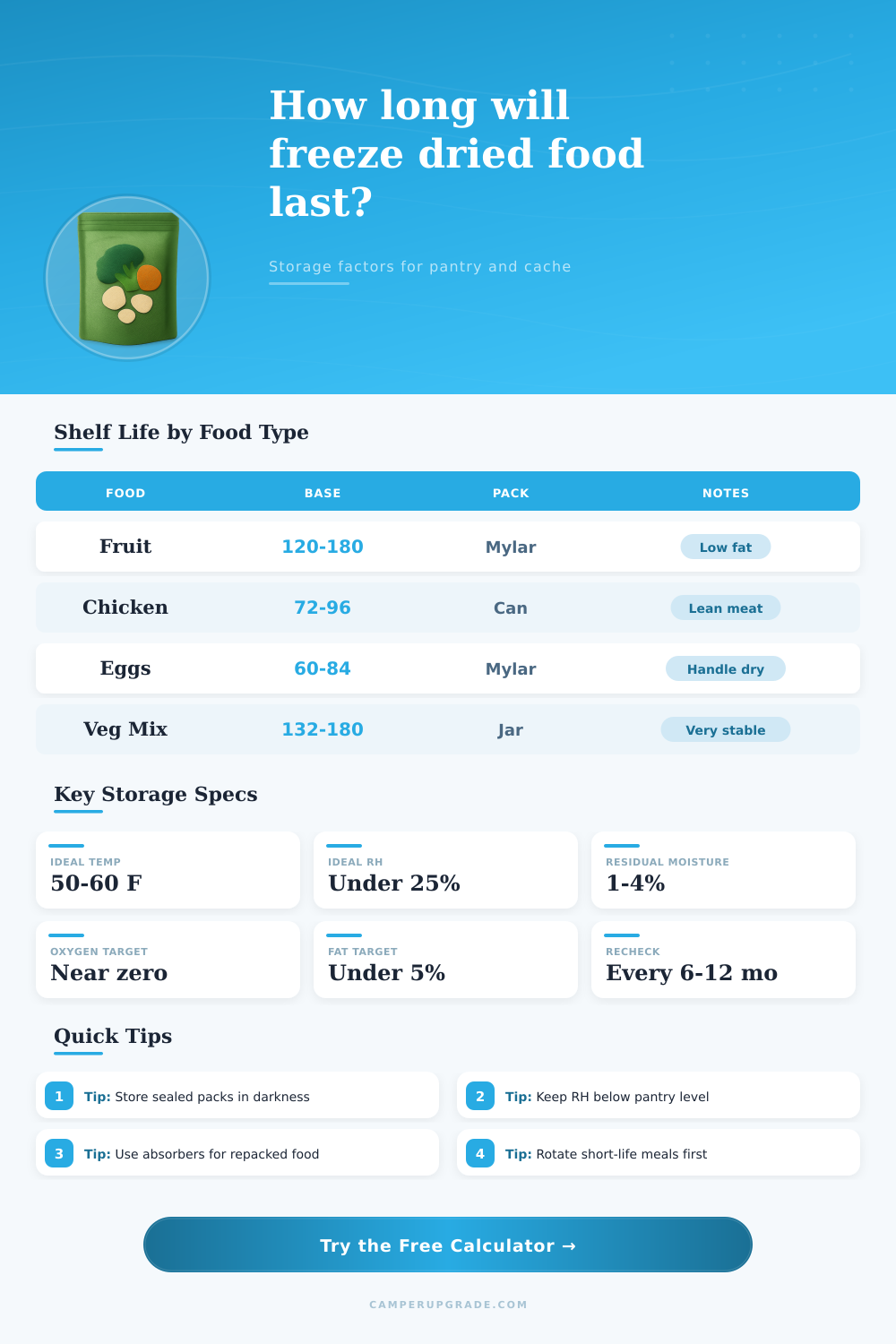
| Food Type | Base Months | Fat Level | Best Pack |
|---|---|---|---|
| Strawberry crisps | 156 | Very low | Mylar |
| Chicken dices | 84 | Low | #10 can |
| Powdered eggs | 72 | Medium | Mylar |
| Mixed vegetables | 168 | Very low | Jar |
| Beef stew bites | 120 | Medium | Vacuum |
| Whole milk powder | 96 | High | Mylar |
| Cheddar shreds | 60 | High | Can |
| Oat breakfast blend | 180 | Low | Foil |
| Package | Barrier | O2 Help | Factor |
|---|---|---|---|
| #10 can | Very high | Built in | 1.25 |
| Mylar + O2 | High | Strong | 1.18 |
| Mason jar | Good | Fair | 1.03 |
| Foil sachet | High | Good | 1.08 |
| Vacuum pouch | Good | Limited | 0.96 |
| Retail pouch | Fair | Poor | 0.74 |
| Rigid tub | Low | None | 0.70 |
| Zip bag | Low | None | 0.54 |
| Condition | Range | Factor | Effect |
|---|---|---|---|
| Cool cellar | 45-50F | 1.08 | Longer life |
| Ideal pantry | 50-60F | 1.00 | Baseline |
| Warm pantry | 60-70F | 0.82 | Faster aging |
| Hot garage | 70-80F | 0.62 | Short life |
| Dry air | Under 20% | 1.08 | Low risk |
| Normal room | 20-35% | 0.96 | Moderate |
| Damp room | 35-50% | 0.74 | Moisture risk |
| Humid garage | 50%+ | 0.52 | High risk |
| Metric | Low Risk | Watch | High Risk |
|---|---|---|---|
| Residual moisture | 1-3% | 4-6% | 7%+ |
| Fat content | Under 5% | 5-10% | 10%+ |
| Oxygen absorber | Match cc | Half match | Missing |
| Seal quality | Perfect | Good | Weak |
Freeze-drying is a method that remove the water from food. Freeze-drying is used to make the food more stability for long-term storage. The freeze-drying process removes almost all of water from the food.
The resulting food will contain only 2 to 4 percent moisture. Because there is no water in the food, bacteria and molds cant grow in the food. The enzymes in the food also move at a much slower rate when there is little water present.
How Long Freeze-Dried Food Lasts and How to Store It
However, the food will eventually degrade due to the presence of oxygen, light, and heat in the storage area for the freeze-dried food. The type of food that you freeze-dry will determine the length of time that your food will last. Low-fat foods, such as fruit and vegetables, tend to have longer shelf life than high-fat foods, such as meats and dairy products.
The fat in food will eventually become rancid standing in the food. Consuming food that contains rancid fats can cause bad taste in the food for the eaters. For instance, a vegetable mix may stay stable and retain its nutritional value for 15 year.
However, cheese, which contains more fat than vegetables, may only remain stable for five years. Therefore, the fat content in food is something that you must consider prior to freeze-drying your food product. The packaging of the freeze-dried food also impact the length of time that the food will remain good and edible.
Metal cans that nitrogen gas fills offers the highest level of protection for the food. Metal cans will protect the food from light and gas exposure. Additionally, foods that you vacuum-seal in Mylar bags with oxygen absorbers will remain stable in the same manner.
However, placing freeze-dried food in plastic zip bags or retail pouching will offer the least amount of protection for the food to remain in good quality. Therefore, the type of packaging that you use will also impact the shelf life of your freeze-dried food. One of the most important factor regarding freeze-dried foods is the storage temperature.
As the temperature of the food storage area increase by 10 degrees Fahrenheit, the rate of the chemical reaction in the food roughly doubles. This means that the shelf life of the food is halved as the storage temperature increases by this amount. The ideal storage temperature for freeze-dried foods is between 50 and 60 degrees Fahrenheit.
If you store your freeze-dried food in a garage where the temperatures regularly goes above 70 degrees, the freeze-dried food will degrade at a much more faster rate. Additionally, humidity impact the shelf life of freeze-dried foods. High humidity allow for the food to absorb moisture in the air.
Light exposure will also degrade freeze-dried foods. Ultraviolet light from the sun will cause colorful freeze-dried foods to oxidize. Oxidation will cause the freeze-dried flavors of the food to fade.
Additionally, the higher the fat content of the food, the more susceptibility its fats are to degradation from light exposure. Freeze-dried foods that contain high amounts of fat will degrade if expose to light. Therefore, you should store freeze-dried foods in a dark place to prevent the food from degrading.
To determine the length of time that your freeze-dried food will last, you can use a calculation. This calculation will take into account the type of food, packaging quality, storage temperature, and humidity level. The result of this calculation will show the number of month that the food will remain high quality.
The higher the stability score of the food, the closer the storage condition are to ideal conditions. Therefore, having a high stability score means that there is a greater margin of error in food storage. There are some mistakes that many people make when storing their freeze-dried food products.
For example, people often store their freeze-dried foods near heat source, such as water heaters. Additionally, people often fail to use the correct size of oxygen absorber for the food product that they are storing. For instance, people often move the food from the retail pouching into jars.
This can allow humidity to enter the food. To prevent the spoilage of freeze-dried foods, always rotate the stored foods. This means that you should eat the oldest food first.
Additionally, you should inspect foods every six to twelve months. Taking open samples of the freeze-dried food can allow you to determine if the food has gone bad. If the sample food has degraded, the entire batch of freeze-dried food is likely bad.