Food Plot Seed Calculator
Estimate plot acreage, adjusted seed pounds, pure live seed, bag count, and blend component weights for clover, brassica, cereal grain, pea, bean, and mixed wildlife plots.
Seed Blend Breakdown
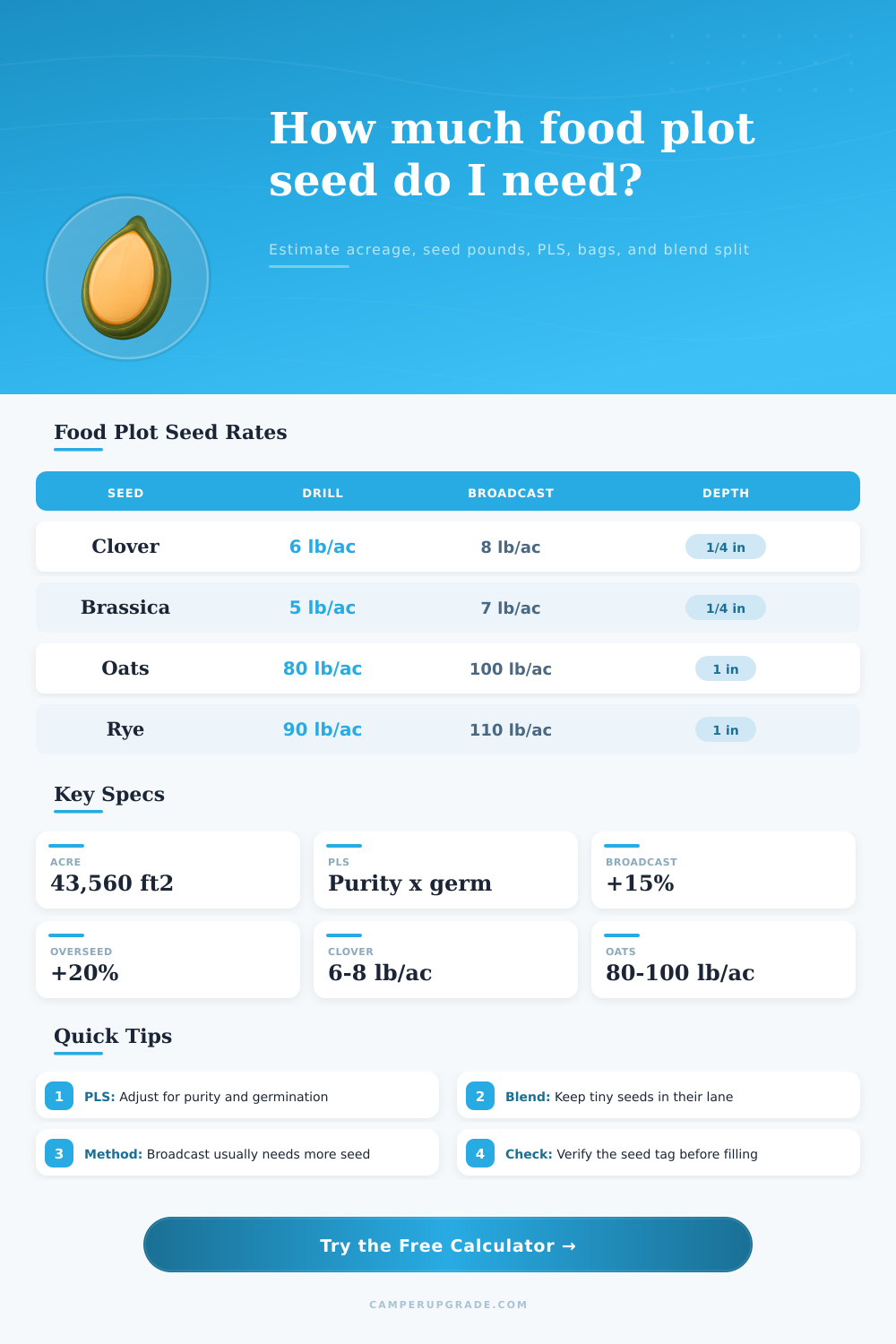
| Seed Type | Drill Rate | Broadcast Rate | Planting Depth |
|---|---|---|---|
| Clover mix | 6 lb/ac | 8 lb/ac | 1/8 to 1/4 in |
| Brassica mix | 5 lb/ac | 7 lb/ac | 1/8 to 1/4 in |
| Oats | 80 lb/ac | 100 lb/ac | 1/2 to 1 in |
| Cereal rye | 90 lb/ac | 110 lb/ac | 3/4 to 1 in |
| Winter wheat | 90 lb/ac | 120 lb/ac | 3/4 to 1 in |
| Austrian winter pea | 50 lb/ac | 70 lb/ac | 1 to 1.5 in |
| Blend | Typical Rate | Component Split | Best Use |
|---|---|---|---|
| Fall attraction blend | 80 lb/ac | 60% oats, 25% rye, 15% brassica | Fast fall draw |
| Perennial blend | 12 lb/ac | 60% clover, 25% chicory, 15% alfalfa | Multi year plot |
| Pea and bean mix | 90 lb/ac | 55% peas, 45% soybeans | Warm season forage |
| No till overseed | 65 lb/ac | 70% rye, 20% oats, 10% clover | Minimal soil work |
| Plot Size | Square Feet | Square Meters | Notes |
|---|---|---|---|
| 0.10 acre | 4,356 ft² | 405 m² | Micro plot |
| 0.25 acre | 10,890 ft² | 1,012 m² | Small strip |
| 0.50 acre | 21,780 ft² | 2,024 m² | Common kill plot |
| 1.00 acre | 43,560 ft² | 4,047 m² | Full acre |
| Plot | Clover 8 lb/ac | Brassica 7 lb/ac | Oats 100 lb/ac |
|---|---|---|---|
| 0.25 acre | 2.0 lb | 1.8 lb | 25 lb |
| 0.50 acre | 4.0 lb | 3.5 lb | 50 lb |
| 0.75 acre | 6.0 lb | 5.3 lb | 75 lb |
| 1.00 acre | 8.0 lb | 7.0 lb | 100 lb |
Calculating the correct seed rate for a food plot is a necessary step in the planning process because the correct seed rate will determine whether or not the food plot will be successful. The total amount of seed that will be needed for a food plot will depend upon several different factor, including the size of the food plot that is to be seeded, the planting method that will be used, the number that are listed on the seed tag, and a buffer percentage. In many instances, however, people does not account for each of these different variable.
The calculator will handle the mathematical element of the calculation for you. For instance, the calculator will save you the effort of having to convert your square footage unit into acres manualy. You must enter your plot size and your chosen seed mix into the calculator, as each of these factors is a primary element in calculating the total weight of seed that will be required for successful establishment of your food plot.
How to Calculate Seed Needed for a Food Plot
The planting method will also be a primary element in determining the rate at which you should plant your seeds. Methods like broadcasting seeds into the soil will require higher rates of seed than overseeding into existing cover in the ground, for example, because some of the seeds will land on existing thatch in the ground rather than on the dirt itself. One of the factor that must also be accounted for is the pure live seed percentage of the seed mixture that you plan to use in your food plot.
While many individual may not think of this as a variable to be accounted for, this percentage is essential to the growth of a thick stand of plants. The percentage of purity of the seeds and the germination rate of those seeds can be found on the seed tag, but you can calculate the percentage of the pure live seed by multiplying the purity percentage and germination percentage of the seed variety. For instance, a rate of 98% purity and an 85% germination rate would result in a 83% rate of pure live seed.
Because this percentage is relatively low, you will have to purchase additional quantity of seed than you might otherwise expect. Additionally, a buffer percentage can account for the loss of seeds due to factors like birds, rough ground, and the need to perform two passes with the seed broadcaster to cover all of the ground in the food plot. Another consideration with establishing food plots is the size of the seeds that will be planted into the ground.
Small seeds, like clover or brassica seeds, tend to move with the wind different than large seeds, like oats or rye seeds. As a result, it is important to use the blend breakdown element of the calculator to determine if two separate passes should be made with the broadcaster to ensure that each type of seed is planted at the proper depth into the ground. Food plots are rarely perfect in their dimension.
Therefore, it is important to measure the dimension of the plot that you intend to create into which you will be planting the seeds. Methods of measuring the land, such as pacing the area or using a mapping application to determine the dimension of the area to be seeded, can be accounted for in the calculator. Additionally, the acreage mode of the calculator will help you to avoid having to perform the mathematical conversion of square footage to acres.
Once you enter the area in acres into the calculator, the program will provide you with an adjusted rate of seed per acre that should be planted in your food plot. This adjusted rate is the more important percentage of the two rates (the other being the rate of seed that comes from the seed bag) because it accounts for all of the correction that have been made to the initial rate of seed per acre. In addition to determining the weight of the seed that is required to establish your food plot, the calculator will also provide you with the total number of bags of seed of which you will need to purchase.
This number will save you the effort of having to return to the store to purchase additional bags of seed for your plot. Through the use of the calculator, you can easily compare the number of bags of different size that you could purchase to determine which option will save you the most time in the seeding process. In addition to the variables described above, factor like weather and soil will impact the success of the food plot that you create.
For instance, heavy rain may make it impossible to properly plant the seeds into the ground before the rain washes them away before they can germinate. In contrast, dry weather may prevent the seeds from germinating due to a lack of moisture in which to germinate the seeds. The buffer percentage will account for these type of weather-related variables.
Additionally, the pH of the soil in which the seeds will be planted may impact the germination rate of the planted seeds, as low pH levels in the soil may prevent the seeds from germinating due to a lack of nutrients to the soil. Overall, then, the establishment of a successful food plot will require that you make a few small correction to the general rate at which you should be planting the seeds for that food plot. If you know the total bulk weight of the seed that will be required for the food plot, and if you are aware of the blend of the different component of that bulk weight that will be distributed across the acres that will be seeded, you can plan your planting process to maximize the efficiency and effectiveness of your planted food plot.
By using the proper amount of each type of seed for the food plot, and planting each component of that blend at the proper depth into the ground, you can ensure that your food plot has a higher probability of successfully growing its planted crops before the first frost of the season.