Food Plot Lime Calculator
Estimate agricultural lime for deer plots, clover patches, brassica strips, and mixed wildlife openings using acreage, current pH, target pH, soil texture, CCE, incorporation depth, and lime form.
🏕Food Plot Presets
⚙Acreage, pH, Texture, CCE, and Spreading Inputs
🧪Lime Estimate
🚜Lime Specification Grid
📊Lime Rate Tables
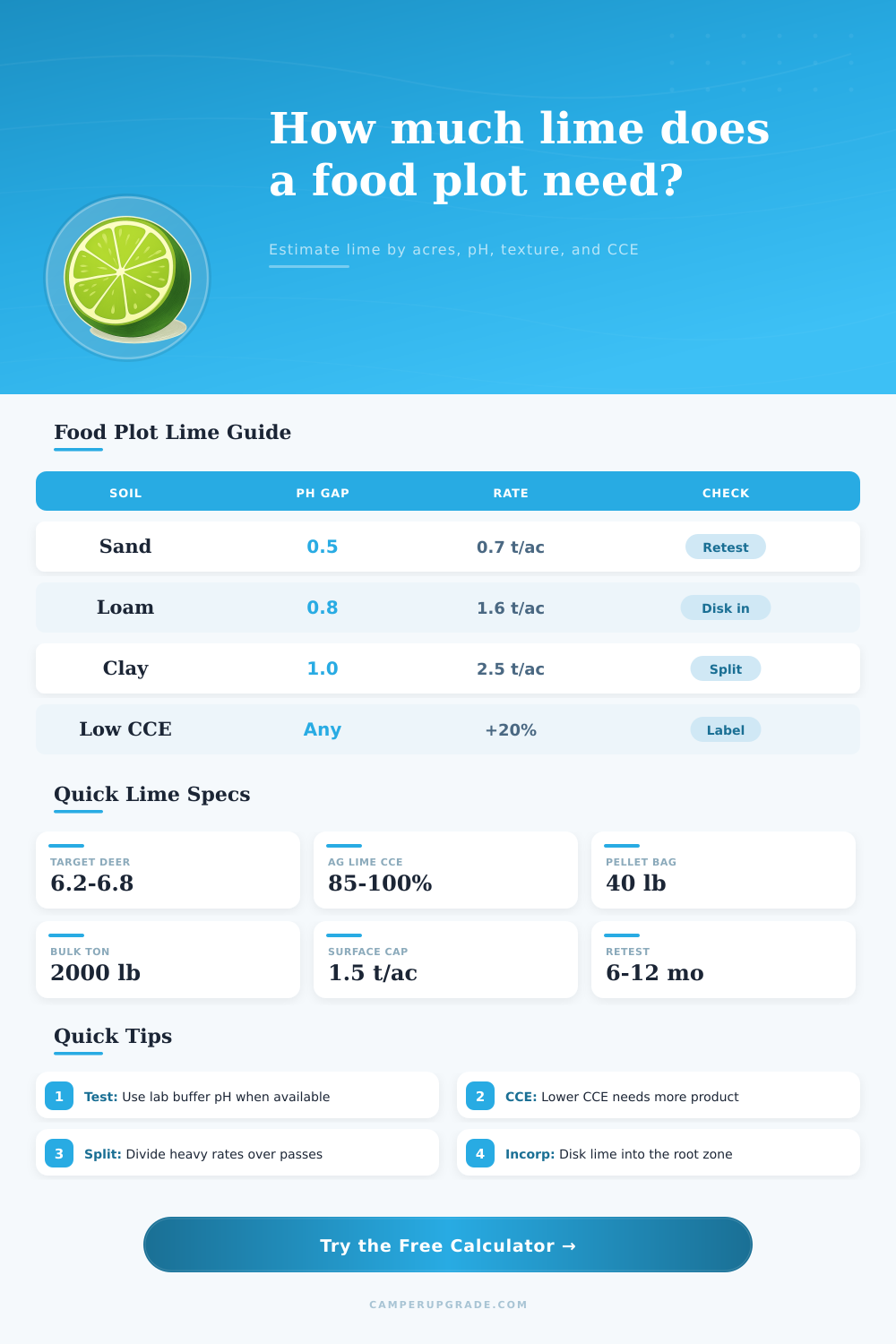
| Texture | 0.5 pH Rise | 1.0 pH Rise | Use Note |
|---|---|---|---|
| Sand or loamy sand | 0.6-0.8 t/ac | 1.2-1.6 t/ac | Moves faster, retest sooner |
| Sandy loam | 0.8-1.0 t/ac | 1.6-2.0 t/ac | Good for small ATV plots |
| Loam or silt loam | 1.0-1.2 t/ac | 2.0-2.4 t/ac | Common food plot baseline |
| Clay loam | 1.2-1.5 t/ac | 2.4-3.0 t/ac | Often worth splitting |
| Heavy clay or high organic | 1.5-1.8 t/ac | 3.0-3.6 t/ac | High buffering capacity |
| Food Plot Crop | Target pH | Priority | Field Note |
|---|---|---|---|
| Clover and alfalfa mixes | 6.5-7.0 | High | Respond strongly to lime |
| Brassicas and turnips | 6.0-6.8 | Medium | Avoid very acidic starts |
| Cereal rye and oats | 5.8-6.5 | Medium | Tolerates modest acidity |
| Chicory blends | 6.0-7.0 | High | Likes corrected soil |
| Buckwheat nurse crop | 5.5-6.5 | Lower | Useful on rough new plots |
| CCE Rating | Multiplier | Meaning | Example |
|---|---|---|---|
| 100% | 1.00x | Pure standard basis | 2.0 t stays 2.0 |
| 90% | 1.11x | Common ag lime label | 2.0 t becomes 2.2 |
| 80% | 1.25x | Lower neutralizing value | 2.0 t becomes 2.5 |
| 70% | 1.43x | Needs more product | 2.0 t becomes 2.9 |
| 60% | 1.67x | Check if worth hauling | 2.0 t becomes 3.3 |
| Application Rate | 40 lb Bags | Bulk Tons | Best Method |
|---|---|---|---|
| 0.25 acre at 1 t/ac | 13 bags | 0.25 ton | Hand or ATV spreader |
| 0.50 acre at 1.5 t/ac | 38 bags | 0.75 ton | ATV spreader or bulk |
| 1.00 acre at 2 t/ac | 100 bags | 2.00 tons | Bulk delivery preferred |
| 2.00 acres at 2 t/ac | 200 bags | 4.00 tons | Buggy or tractor spread |
| 3.00 acres at 2.5 t/ac | 375 bags | 7.50 tons | Bulk only for most crews |
💡Food Plot Lime Tips
Rates are planning estimates based on common agricultural lime equivalents. Local labs can refine the rate for soil buffer pH, calcium, magnesium, and regional lime quality.
Soil pH is a critical factor in determining what type of food plot to create for the deer in you’re hunting area. The soil pH will determine how well the plants grows in the soil. If the soil is too acidic for plants like clover, they will struggle to fix nitrogen, and plants like brassicas will remain stunted.
If the pH of the soil is not at a correct level for the food plot that you would like to create for the deer, the deer will not visit the food plot as often as you would like. To fix this pH of the soil, you can apply agricultural lime to the soil. The amount of agricultural lime that should be applied to the soil depends on many factor, such as the number of acres of the food plot, the current pH of the soil, the target pH of the soil, the texture of the soil, and the quality of agricultural lime that you will add to the soil.
How to Use Lime to Fix Soil pH in Deer Food Plots
By inputting these factors into a food plot agricultural lime calculator, the land manager creating a food plot for the deer in his or her hunting area will see a significant saving of time as well as money. The difference in the current soil pH and the target soil pH is referred to as the pH gap. If the pH gap is larger, then more agricultural lime will be required to even out the soil pH.
Soil with a current pH of 5.4 that should be amended to a target soil pH of 6.5 creates a larger gap than soil with a current soil pH of 6.0 that should be amended to a target soil pH of 6.5. The soil texture will also play a crucial role in how much agricultural lime will be required to even out the soil pH. Soils with sandy texture will require less agricultural lime than clay and organic soils because sandy soils will react fasterly to the agricultural lime.
The amount of agricultural lime that will be required will also factor into the agricultural lime calculator so that the calculation reflect the different soil textures. The Calcium Carbonate Equivalent, or the CCE, will represent the quality of the agricultural lime. This will reflect the amount of agricultural lime that will neutralize the acidity in the soil.
If the agricultural lime product contains a 70 percent CCE rating, more of this agricultural lime will be required than a product with a 100 percent CCE. If the land manager uses the agricultural lime with a 70 percent CCE rating instead of a 100 percent CCE agricultural lime, 40 percent more of the 70 percent CCE agricultural lime will be required. This factor will also be included in the agricultural lime calculator to make sure that the land manager does not have to calculate this percentage manual.
Another important factor is the depth to which the land manager will incorporate the agricultural lime into the soil. If the agricultural lime is not incorporated into the soil, it will take longer for the agricultural lime to incorporate into the soil. If the agricultural lime is spread into the soil at a depth of four or six inch, more of the agricultural lime can be incorporated into the soil, which will make it so the land manager requires less agricultural lime.
This factor is also accounted for in the agricultural lime calculator to determine how much agricultural lime should be worked into the soil. Additionally, the agricultural lime calculator will also tell the land manager if the application rate is so heavy for the food plot that it should be split into two passes to prevent the spreader from leaving streak in the food plot. A food plot agricultural lime calculator is helpful in determining the amount of agricultural lime that is required to even out the soil pH of a food plot.
However, the calculator is not a replacement for the soil test that can be run in a laboratory setting. The soil test will have a buffer pH that is specific to the land manager’s soil. This buffer pH will more accurately indicate what agricultural lime will be best for the food plot.
The agricultural lime calculator can help determine different option for the land manager. The calculator will size the agricultural lime bulk order. Furthermore, the calculator can also determine the amount of bags of agricultural lime that will be required for an ATV spreader.
In many cases, the food plots will not be uniform in there soil. For instance, it is likely that one part of the food plot has sandy soil, while another part of the food plot has clay soil. In these cases, the land manager will take several soil sample from the food plot to determine what the soil texture is and to ensure that the soil samples are accurate for the food plot.
Depending on the terrain of the food plot, the agricultural lime may have to be applied differently to account for these different soil type. The agricultural lime calculator may provide recommendations for the land manager. However, there may have to be further adjustments to the application plan for agricultural lime in the field.
It is also important to consider the time in which the agricultural lime is to be incorporated into the soil. Agricultural lime will work best if incorporated into the soil many month before the planting of the crops for the deer food plot. If agricultural lime is applied in the fall, it will work with the winter moisture in the soil.
However, if agricultural lime is applied in the early spring, it is also possible but not as effective as fall incorporation of the agricultural lime. Six to twelve months after applying the agricultural lime to the food plot, the soil pH should be tested again in the effort to determine whether the agricultural lime application was enough to even out the soil pH, or if more agricultural lime will be required to return the food plot to an even soil pH. When purchasing agricultural lime, there is a decision between bulk agricultural lime versus bagged pelletized agricultural lime.
Bulk agricultural lime will be cheaper per ton. However, bulk agricultural lime will require a large spreader and the land manager will have to have easy access to the bulk agricultural lime by a truck. Pelletized agricultural lime comes in bags so it is easier to spread with an ATV or a small tractor.
Additionally, pelletized agricultural lime is easier to use on small food plots or on the edge of food plots that may include woodlands in which a large truck cannot go. The agricultural lime calculator will provide recommendations for the total bag count or bulk tonnage of agricultural lime that will be required for the food plot. Another important factor to consider is the small plots that may be established.
In these small plots, extra agricultural lime will be required so that the agricultural lime does not fall short in accounting for all the acreage. Additionally, rough ground may require that some area of the food plot are missed when applying the agricultural lime. Accounting for this by using a buffer percentage in the agricultural lime calculator will account for these types of error so that when the land manager applies the agricultural lime, it will even out the soil pH.
The goal will be to even out the soil pH of the food plot to ensure that the plants will grow proper. This agricultural lime calculator will simplify the math involved in planning the application of agricultural lime to the food plot.