Food Dehydration Time Calculator
Estimate drying time, moisture removed, tray capacity, and a doneness window for backpacking meals, fruit snacks, jerky, vegetables, and herbs.
Dehydration estimate
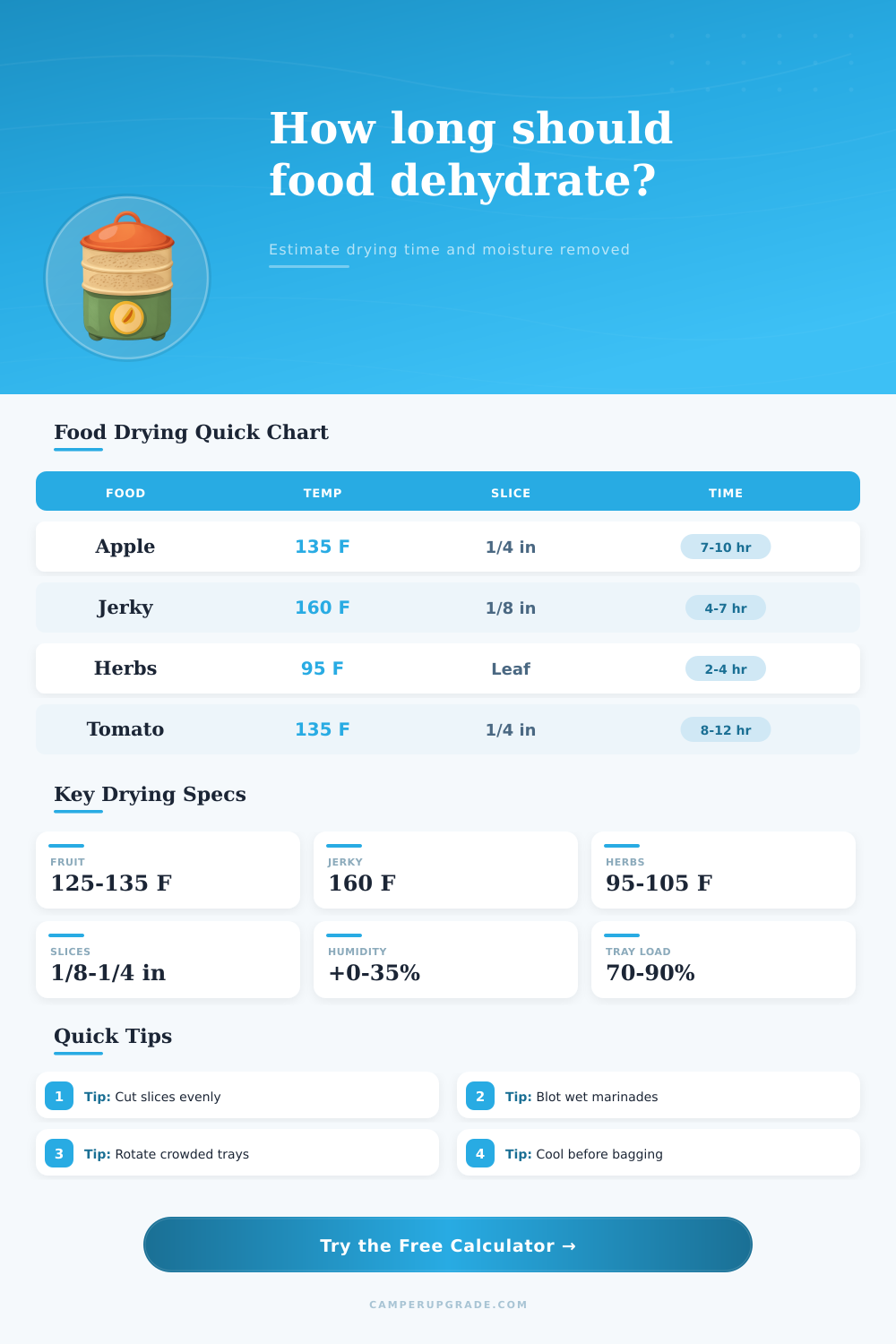
| Food type | Typical temp | Typical cut | Common time range |
|---|---|---|---|
| Apple, pear, peach | 125-135°F | 1/4 in slices | 6-12 hours |
| Banana, mango | 130-135°F | 1/4 in pieces | 8-14 hours |
| Lean meat jerky | 155-165°F | 1/8-1/4 in strips | 4-8 hours |
| Tomato, pepper | 130-140°F | 1/4 in slices | 8-14 hours |
| Mushrooms | 125-135°F | 1/4 in slices | 4-8 hours |
| Leafy herbs | 95-105°F | Single leaves | 2-5 hours |
| Condition | Time effect | Quality note | Calculator factor |
|---|---|---|---|
| 10°F below ideal | Slower | Gentler color, longer drying | About +18% |
| At ideal temp | Baseline | Best match for preset range | 0% |
| 10°F above ideal | Faster | Watch case hardening on fruit | About -13% |
| Jerky under 155°F | Not advised | Use food-safe meat process | Flagged |
| Herbs over 115°F | Faster | Aroma can fade | Flagged |
| Target texture | Approx final moisture | Common foods | Doneness cue |
|---|---|---|---|
| Pliable / leathery | 18-22% | Fruit slices, leather | Bends without wet beads |
| Chewy trail snack | 14-18% | Fruit, jerky, meals | Flexible but not sticky |
| Brittle / snaps | 8-12% | Veg, herbs, grains | Breaks or crumbles |
| Very crisp storage dry | 5-8% | Rice, vegetables, herbs | Hard, dry center |
| Tray load | Spacing | Time effect | Use note |
|---|---|---|---|
| 50-65% | Wide gaps | Faster, even | Good for wet fruit |
| 70-85% | Small gaps | Baseline | Best general target |
| 90-100% | Nearly full | Moderately slower | Rotate trays once |
| Over 100% | Touching or stacked | Much slower | Split the batch |
Food dehydration remove moisture from food using heat and airflow. To effectively remove moisture from food, you must manage many different variable during the dehydration process. These variables will ultimately determine the texture of the dehydrated food and how long the food will be in a dehydrator.
The variables that affect the food dehydration process include the thickness of the food, the temperature of the dehydrator, the airflow around the food, the humidity in the room, and the starting moisture of the food. If you dont manage these variables correct, the dehydration process could result in the food becoming too dry or not dry enough. One of the primary variable in food dehydration is the thickness of the food.
Things That Affect Food Drying
The thickness will ultimately determine how long the dehydration process take. Food that is cut into thick slice will take longer to dry than food that is cut into thin slices. The thicker the food, the longer it takes for the dehydration process to remove the moisture from the food.
If the thickness of the food is doubled, the dehydration time will not be doubled as well because the outer layer of the food will dry and create a barrier for the moisture to escape from the center of the food. The thickest slice of food will determine the length of time for all of the food in the dehydrator. If food is prepared for dehydration, you should measure the thickness of the thickest piece of food to accurately determine the time that it will take for the dehydration process to be complete.
The second variable of food dehydration is the temperature. High temperatures will help to remove the moisture from the food quickly. However, high temperature could result in case hardening of the food.
Case hardening is when the outer layer of the food becomes dry while the inside of the food is still damp. Low temperature will help preserve the color and aroma of herbs during the dehydration process. However, the food will take longer to dehydrate at low temperatures.
Using low temperatures could result in mold growth on the food if the humidity in the room is high. The temperature that you select during the dehydration process will ultimately depend on the type of food being dehydrated and the length of time that it should take to dry the food. The humidity in the room also play a significant role in the dehydration process.
Food dehydration machines remove the moisture from the food and expel the water in the room. If the humidity in the room is high, the machine will have to work harder to remove the moisture from the food. A batch of food that take eight hours to dry in a room with 35% humidity could take ten hours to dry in a room with 60% humidity.
The humidity in the room could ultimately determine whether the dehydration process take place in the summer or winter months. Another variable during the dehydration process is the pretreatment of the food. You can dip the food in lemon water to help preserve the color of the fruit.
However, submersing the food in lemon water will add some moisture to the food. Blanching the food will allow the cells of the food to soften and enable the moisture to escape from the food. Marinating the food in a wet mixture will allow the flavor of the liquid to be extracted from the food.
However, this will also introduce moisture to the food prior to the dehydration process. Another variable that could be programmed into the food dehydration process is the target texture of the food. Depending on the texture that is targeted, the food will dry to a specific moisture content.
If the texture is intended to be pliable and leathery, such as for fruit snacks, the food must contain some moisture so that the food does not crack when bent. However, if the texture of the food is meant to be brittle and crisp, more moisture must be removed from the food. The difference between the two textures is only a few percentage points of moisture content.
However, these percentage points do determine the length of time that the food will remain in the dehydrator. Another variable in the dehydration process is the tray capacity of the dehydrator and the food airflow. Airflow is used to remove the moisture from the food.
If the tray are overly crowded with food, the airflow will not be able to easily move between food pieces. You can rotate the food trays during the dehydration process to even out the airflow between food pieces. However, the airflow will never be as effective as if you allowed the food to be placed with gap in between each piece of food.
There must be enough tray capacity within the dehydrator so that the airflow can effectively move around each piece of food. There are many variable that can be controlled within the dehydration process. However, one variable that cannot be controlled is the humidity in the room.
However, you can ran the dehydrator at night when the humidity in the room may be lower. The thickness of the food cannot also be controlled once the food is sliced. However, when preparing the food for dehydration, the food can be sliced into even pieces so that the dehydration process takes the same amount of time for each piece.
When using an estimate to calculate the amount of time that the food will take to dehydrate, there is a window of time during which the food should be checked so that it isnt dehydrated for too long. If checked during the appropriate amount of time, the food can be prevented from drying out too much during the dehydration process. It is also a useful habit to keep records of the outcome of the dehydration process.
By keeping accurate records of the amount of time that the dehydration process took, the texture of the dehydration process, and any adjustment to the dehydration process, it is possible to create records that will help determine how your dehydration machine and the humidity in the area may affect the dehydration process of food. While the mathematics provide a starting point for food dehydration, the records that is created will provide the knowledge that can be applied to future dehydration processes.