Food Cache Duration Calculator
Estimate how many trail days a food cache can support after calories, people, spoilage, reserve margin, storage method, ration style, and access risk are counted.
🏕Food Cache Presets
⚙Calories, People, Days, Spoilage, and Reserve Inputs
This calculator estimates edible calorie duration. It does not replace local food-storage rules, bear-resistant container requirements, or food safety judgment for perishable items.
🥫Food and Storage Spec Grid
Dehydrated Meals
120-140Calories per ounce with low spoilage when sealed and kept dry.
Bars and Nut Mix
130-170Dense cache staples; protect chocolate coatings from high heat.
Cans and Wet Food
25-60Durable but heavy; useful for basecamp caches where weight matters less.
Sealed Dry Box
2-5%Typical handling-risk allowance for a dry, labeled, rigid container.
🔢Food Cache Planning Benchmarks
📋Food Cache Duration Tables
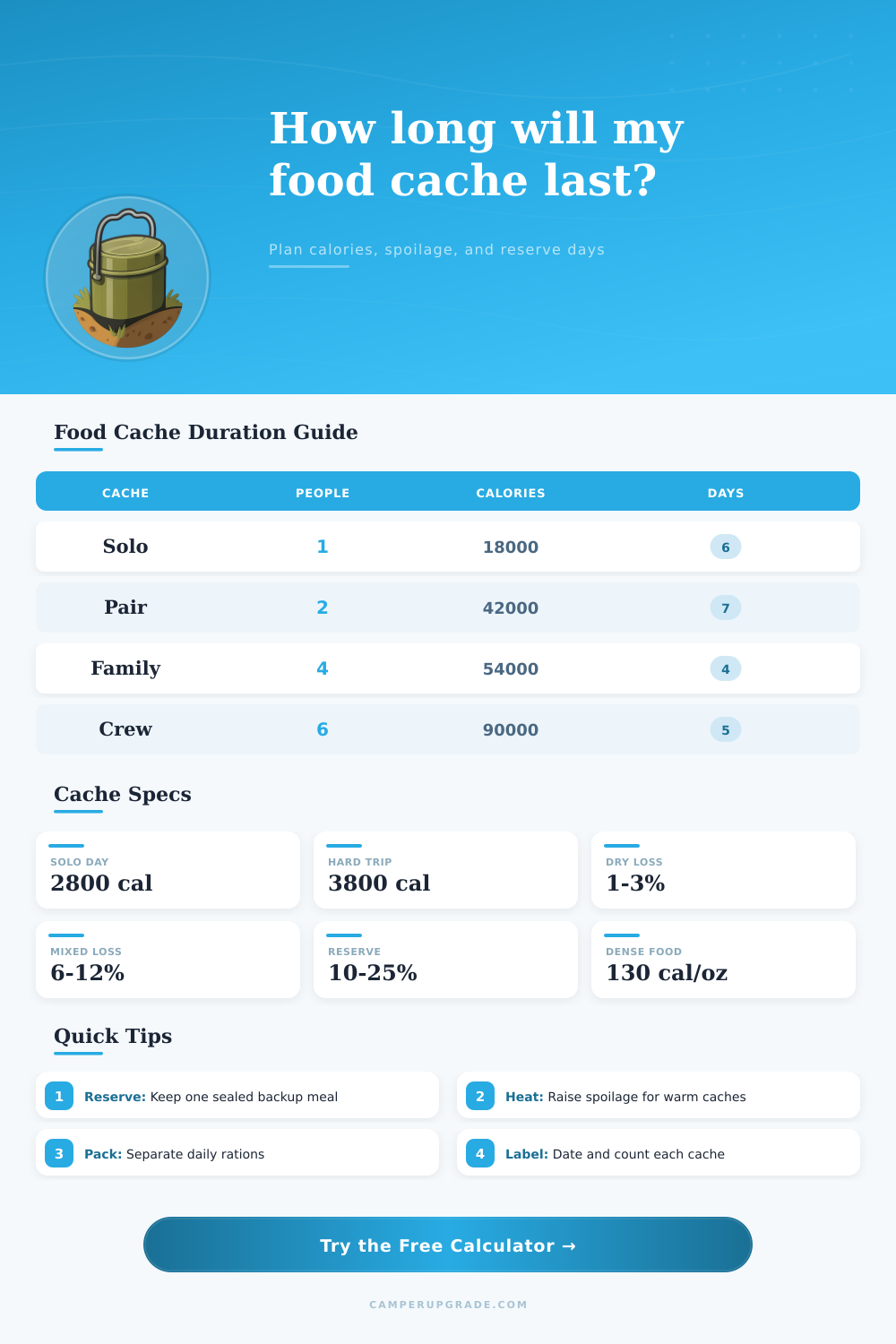
| Usable Calories | 1 Person | 2 People | 4 People |
|---|---|---|---|
| 12000 cal | 3.8 days | 1.9 days | 0.9 days |
| 24000 cal | 7.5 days | 3.8 days | 1.9 days |
| 48000 cal | 15 days | 7.5 days | 3.8 days |
| 72000 cal | 22.5 days | 11.3 days | 5.6 days |
| 96000 cal | 30 days | 15 days | 7.5 days |
| Storage Condition | Dry Loss | Mixed Loss | Use For |
|---|---|---|---|
| Cold sealed barrel | 1-3% | 3-6% | Winter or shade |
| Cool dry box | 2-5% | 6-10% | Most trips |
| Warm road box | 4-8% | 10-18% | Road drops |
| Hot vehicle tote | 8-15% | 18-30% | Desert heat |
| Hung soft cache | 5-12% | 12-25% | Short holds |
| Reserve Level | Extra Calories | Best Fit | Warning |
|---|---|---|---|
| 0-5% | Minimal | Easy exits | No delay room |
| 10% | Light backup | Short trips | Tight groups |
| 15-20% | Solid margin | Remote routes | More weight |
| 25% | One hard delay | Weather risk | Needs space |
| 30%+ | Expedition | Long gaps | Split caches |
| Food Type | Cal/Oz | Spoilage | Cache Note |
|---|---|---|---|
| Oils and nut butter | 160-240 | Low | Double bag |
| Bars and trail mix | 120-170 | Low | Heat watch |
| Dehydrated meals | 100-140 | Low | Keep dry |
| Bread and cheese | 70-120 | Medium | Short holds |
| Cans and pouches | 25-90 | Low | Heavy cache |
💡Food Cache Duration Tips
To adequately plan a food cache, one must account for food loss and the reserve margin that will be accounted for within the food cache to ensure the food cache will last the entirety of the individuals trip. A food cache can be defined as the collection of food that is stored in a specific location for later use. However, the food cache isnt always the same as the total amount of calories that will be consume.
The food within the food cache will be exposed to the elements, which can lead to the food losing its nutritional value or becoming altogether inedible. For these reasons, the raw amount of calories within the food cache will be higher then the calories that an individual will consume. Spoilage within the food cache is one of the primary variable that must be accounted for within the food cache calculation.
How to Plan a Food Cache
Food that is dried can retain the majority of its nutritional value if stored in a cool environment. However, the same foods can lose much of their nutritional value if they are store in a warm environment within the food cache. Spoilage is often difficult to visually identify.
The food cache can appear normal, but the food may have lost much of its nutritional value to moisture or other factor. The temperature settings within the food cache calculator will help determine how much the spoilage rate within the food cache can mathematically multiply the total amount of food loss. The weight of the food cache must mathematically equal the calorie count of the food cache.
The food cache may contain the appropriate amount of food to provide the necessary calories, but the food within the food cache can have a low density of the total number of calories. The calculator will compare the amount of calories that are entered with the weight of the food cache to determine whether or not the calorie density of the food is lower than the individual expects. If the weight is much higher than the calorie count, then bulky food items that contains fewer calories are being selected for the food cache.
The size of the group that will consume the food cache is a significant factor in the creation of the food cache. Each additional individual to the group increase the demand for calories daily. This increased daily demand for calories reduces the reserve margin for the food cache.
The headcount for the food cache should be adjusted within the food cache calculator to visually represent how the size of the group will shrink the food caches reserve margin. The larger the group, the more fast the group will consume the food cache. Therefore, a larger group requires a larger food cache to supply these individuals with the necessary calories.
The reserve margin within the food cache is set aside for unexpected events. The reserve margin is a buffer with extra food within the food cache that the individual will utilize during instances where the individual take longer than expected or exhibits greater appetite for the food. A reserve margin of at least fifteen percent of the total food cache should be included.
This reserve margin will account for ordinary challenges within the individuals trip. However, it should not be used for major emergencies that may significantly impact the trip and the individuals consumption of the food cache. The method in which the food is to be stored will impact the food cache.
For instance, if the food is to be stored within a hard sided container within a supervised area, there will be a low risk of the food being lost. However, if the food is to be stored within a bag in a remote area that is accessed by others, there will be a higher risk of the food within the food cache being lost. The storage method should be chosen within the food cache calculator so that the risk percentage of food loss within the food cache can be accounted for.
This percentage will depend on the number of individuals that will access the food cache and the number of animal that may access the food cache. One of the most common mistake in creating a food cache is to treat the food cache as one single group of food. The reserve margin and the daily ration of food should be separated.
If food is combined within the food cache, the reserve margin will be consume first. To avoid this mistake, separate the reserve portion of the food cache from the daily portions of food that will be consumed before packing the food cache. This will allow the individual to easily visually determine how many days of food remain within the food cache in the event that the individual encounters an unexpected situation or delay during there trip.
The longer that the food cache remains within a location, the more impact that the environmental temperature will have upon the food cache. The food cache that remains in the shade for three days will experience less food spoilage than the food cache that sits in an area that is exposed to the heat for ten days. The number of days that the food cache will be picked up from its storage location should be accounted for within the food cache plan.
If an individual finds themself short on food while on there trip, it is likely that either the spoilage rate or the reserve margin of the food cache was too low to account for the food that will be consumed during the trip. The goal of adequately planning a food cache is for the food cache to match the demands of the trip. The food cache should be matched with the size of the group that will utilize it, the condition in which the food will be stored, and the number of days that the food will be out of the individuals reach.
If the food cache is created in a way that matches the demand of the individuals that will consume the food cache, then the food cache will have enough calories to supply the group of individuals for their entire trip.