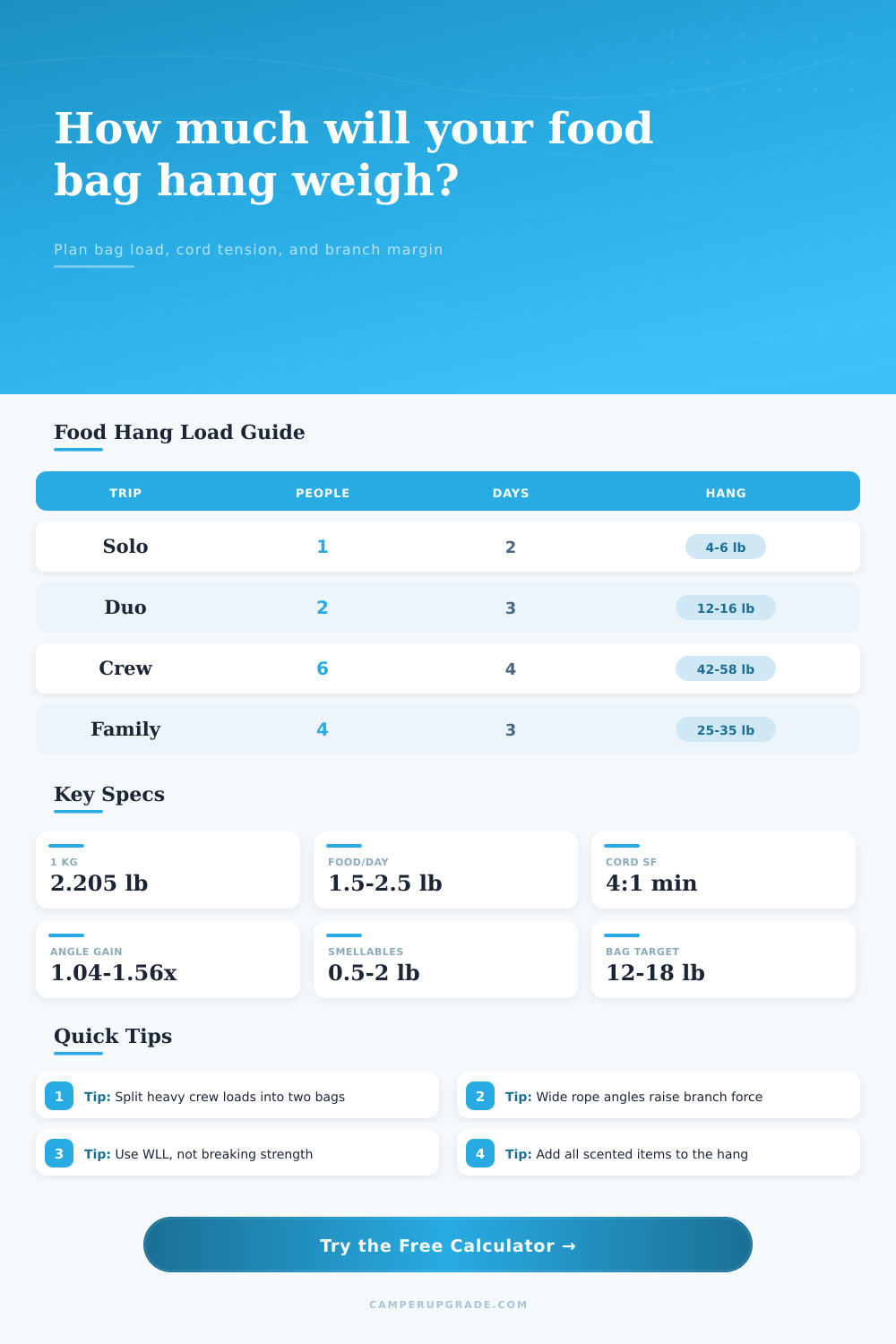
Food Bag Hang Weight Calculator
Estimate total food-hang weight, split it across bags, and check cord tension, branch load, and safety margin before you leave camp.
Food Hang Load Results
| Trip style | Food per person per day | Best use | Watch point |
|---|---|---|---|
| Ultralight dry menu | 1.25 to 1.6 lb | Short backpacking trips | High calorie density needed |
| Standard backpacking | 1.7 to 2.2 lb | Most three-season routes | Snacks and extras add up |
| Cold-weather menu | 2.2 to 2.8 lb | Winter or high exertion | Fuel and hot drinks often ride nearby |
| Family campground food | 2.0 to 3.0 lb | Cooler-free dry storage | Bulky packaging increases bag count |
| Group expedition ration | 1.8 to 2.5 lb | Crew planning and resupply | Split by meal kit or day bag |
| Hang method | Calculator factor | What it represents | Planning note |
|---|---|---|---|
| Vertical single limb | 1.05x | Near-vertical line with light friction allowance | Lowest force case when the limb is sound |
| PCT style over limb | 1.20x | Moderate angle plus limb friction and raising force | Good default for solo or small-team hangs |
| Counterbalance pair | 1.35x | Two bags with wider opposing line angle | Balance bags within a few pounds |
| Highline between anchors | 1.75x | Flatter span that raises anchor force | Use strong anchors and avoid shallow line angles |
| Scenario | People and days | Food plus smellables | Suggested split |
|---|---|---|---|
| Solo overnight | 1 person, 1.5 days | About 3 to 5 lb | One small dry bag |
| Weekend duo | 2 people, 3 days | About 12 to 16 lb | One or two 10 L bags |
| Family camp | 4 people, 3 days | About 25 to 35 lb | Two or three bags |
| Scout patrol | 8 people, 2 days | About 35 to 45 lb | Three balanced bags |
| Long resupply | 1 person, 6 days | About 11 to 16 lb | One larger food sack |
| Line material | Typical diameter | Working load used | Field tradeoff |
|---|---|---|---|
| 550 paracord | 4 mm | 110 lb | Easy to handle, stretches when loaded |
| Nylon accessory cord | 3 mm | 80 lb | Compact, better for lighter hangs |
| Nylon accessory cord | 5 mm | 250 lb | Stronger grip, heavier to pack |
| UHMWPE throw line | 1.8 mm | 130 lb | Slick and light, harder on hands |
| Polyester utility cord | 4 mm | 160 lb | Lower stretch and good abrasion behavior |
| Flat webbing sling | 12 mm | 300 lb | Best for anchor protection, bulky as a line |
After eating dinner, it’s dusk and you’re standing in a pine forest. The bears is stirring. Time to raise that food pack on a strong limb. The problem isn’t so much carrying it up as whether the branch will support it. And how do you assess a trees strength with nothing more than your eyeballs? How heavy will it be? Guesswork.
Two people on a three-day trip. Piece o’ cake. Except for all that rope, those carabiners, and oh yeah: the stinky trash. Engineering dilemma now. Enter your menu weight plus group size, and calculator will do the math. Use it to see if paracord or thin utility line are the right choice for your load.
How to Hang Your Food Safely
Prevent a guess: most hangers assume all of their gear’s weight pull down straight. Nope! If you’re like me, you’ll think two pack totaling 20 lbs means my rope bears 20 lbs. True enough…if I’m pulling vertically. Not true when I drape a rope across a limb and drop my packs on either side. Gravity creates an angle that multiplies tension exponentially. What looks like a small spread double and triples force at your anchor point. And it does so with zero extra food in the equation.
Think about a week long family camping trip vs an overnight solo trip. Four people x three days = pushing thirty pounds of organic stuff and hardware. A one person, one night trip equals four pounds total. It is trivial. The weight will shift things. One huge bag sway in the breeze. It torques the branch unpredictably. Two evenly balanced bags keep the center of gravity lower. There is less torque on wood fibers.
It is not simply about carrying capacity. It is about stability. The tool will help you see how to split the load into two bag. How much is each bag? Do you need to add another bag, which becomes unwieldy, or should you only take one?
Safety factors account for knots that weaken lines and the material we chooses. Five-fifty paracord, the standard stuff, can handles about one-hundred ten pounds before failing. Sounds like a lot. But if you use the angle factor of a wide highline setup, things change. All of a sudden your thirty-pound food weight is pulling at eighty pounds of tension on that taut, thin sheath.
Bear line is thin. Two millimeters looks sleek, packs small. But it offers no extra strength against shifting weights or heavy loads. Trips go smoothly or end with a cold dinner in the dirt if we choose a cord diameter based off an estimated branch limit. That’s where safety comes into play. Your cord was calculated at a four-to-one margin. In other words, it will hold four times what it was calculated to hold before failure occurs.
It adds in the potential of weakened lines from knots (up to half the strength of line). And it adds in the potential of unseen rot inside otherwise good-looking bark on trees and branches. Kicking the tree doesn’t reveal any internal decay, you have to go by the numbers for a cushion to compensate for things you can’t see.
Planning ahead has a psychological aspect as well. Knowing our limits in advance removes the need to improvise on the fly. This eliminates scrambling for more rope when the wind blows, or other situations where you should of sized things properly at home. It makes what used to be a stressful ritual part of the camp setup process.
By trip style, this is how much food you’ll carry on average. You can compare it to what you do. Ultralighters will be lighter. However, don’t forget condiment packets and fuel containers. Those stink like nobody’s business and get people’s attention. The rule of thumb: If it smells, put it in the bag. That includes trash. Don’t leave any soiled spoon; that just invites visitors. And they will ruin it for others.
There’s no such thing as brute strength when it comes to hanging your food safely. Rather, it’s about understanding material limits and force vectors. Rope and geometry are the tools for managing wood tension and gravity. Master that at the planning stage. Sleep well knowing you got the variables right. The bears won’t stay away because you got lucky. They’ll stay away because you stayed smart. That quiet confidence makes all the time spent crunching the numbers before you ever touch a branch worthwild.