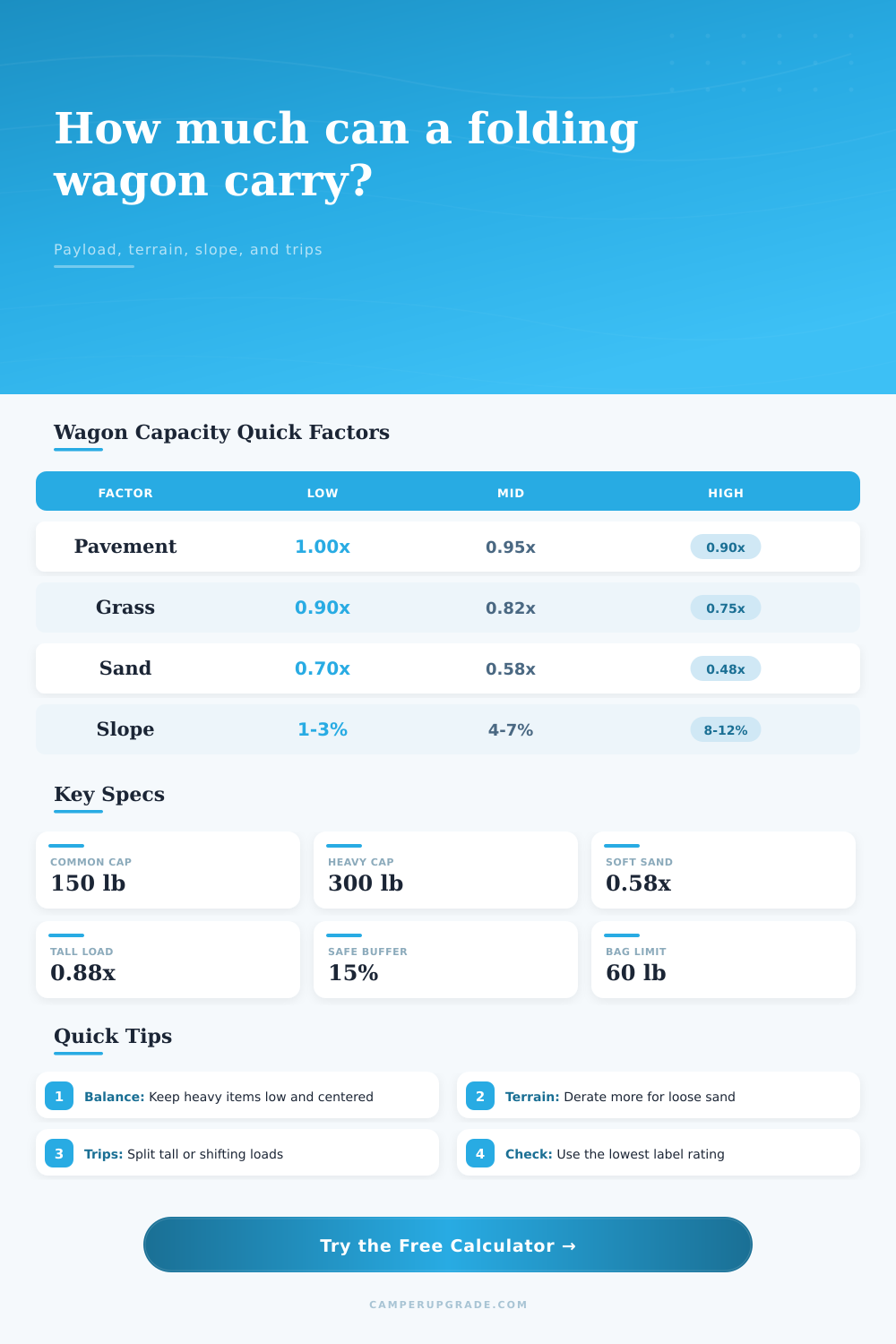
Folding Wagon Load Capacity Calculator
Estimate practical payload after terrain, slope, wheels, load height, distribution, distance, and safety buffer reduce the printed wagon rating.
🗺Load Presets
⚖Wagon And Load Inputs
Capacity Results
🧮Formula Cards
🔧Spec And Material Grid
📊Terrain Derating Table
| Surface | Capacity Factor | Pull Effort | Best Wheel Match |
|---|---|---|---|
| Smooth pavement or indoor floor | 1.00 | Low | Any wheel with intact tread |
| Packed dirt or firm campground gravel | 0.94 | Low to medium | Rubber tread or wide all-terrain |
| Short grass or uneven lawn | 0.86 | Medium | Wider rubber wheels, 7 in or larger |
| Loose gravel campsite road | 0.78 | Medium high | Wide all-terrain wheels, 8 in or larger |
| Firm wet sand | 0.70 | High | Wide all-terrain or balloon wheels |
| Soft dry beach sand | 0.58 | Very high | Balloon beach wheels, 10 in or larger |
| Roots, ruts, and rough trail | 0.64 | Very high | Wide all-terrain wheels and lower loads |
⛰Slope, Distance, And Height Factors
| Condition | Mild | Moderate | Severe |
|---|---|---|---|
| Slope grade | 0-3% = 1.00 | 4-7% = 0.92 | 8-12% = 0.82 |
| One-way distance | Under 300 ft = 1.00 | 300-900 ft = 0.96 | Over 900 ft = 0.91 |
| Load height above floor | 0-12 in = 1.00 | 13-24 in = 0.94 | 25 in+ = 0.86 |
| Distribution | Centered = 1.00 | End-heavy = 0.92 | Side-heavy = 0.86 |
🛞Wheel Diameter And Type Table
| Wheel Setup | Pavement | Grass or Gravel | Beach Sand |
|---|---|---|---|
| Narrow plastic, under 6 in | 0.96 | 0.82 | 0.60 |
| Rubber tread, 6-8 in | 1.00 | 0.92 | 0.72 |
| Wide all-terrain, 8-10 in | 1.00 | 1.00 | 0.84 |
| Balloon beach, 10 in or larger | 0.96 | 0.98 | 1.00 |
🎒Common Folding Wagon Loads
| Load Type | Typical Weight | Balance Risk | Capacity Note |
|---|---|---|---|
| Two filled medium coolers | 90-130 lb | Medium | Center both coolers over the bed floor |
| Five gallon water jugs | 42 lb each | High | Keep jugs upright and split if slope is steep |
| Bundled firewood | 35-55 lb per bundle | Medium | Stack below rim when crossing ruts |
| Bagged soil or gravel | 40-60 lb per bag | Low | Count bags against the adjusted safe capacity |
| Chairs, canopy, towels | 45-80 lb | High | Tall lightweight loads may tip before they overload |
| Laundry and bedding | 25-60 lb | Low | Often volume-limited before weight-limited |
💡Capacity Tips
A hundred and fifty-pound capacity is the maximum listed on the sticker from the manufacturer, which means it was calculated assuming best-case scenario: the one that never happens in real life. Maybe you’re packing the collapsible wagon full of gear (two big coolers), a canopy, enough chips to last all week. And then notice the material droops every time you reach a slight incline.
Loading it change how much it can carry. There is no way to include slope, vibration, and rolling resistance when calculating the static capacity. So what works fine stationary becomes half as strong once you get it moving.
Why Wagon Stickers Are Not Enough
This calculator will convert spec-sheet static capacity into something more realistic, based off your own journey. The printed limit is only a beginning. It’s a base for engineering calculations, not something most folks take as an absolute limit. And that limit assumes static conditions inside a lab. Throw in the variable of soft sand, and all bets are off, small plastic wheels starts to dig into surface instead of gliding over it, increasing resistance. To address this, the calculator decreases your safe payload (often by 40% or even more) on loose surfaces. So when the physics say no, don’t assume there’s space in the bin.
Choosing wheels is also important. To keep them from sinking into grass or gravel, wider tires with a larger diameter distribute weight more evenly. The system let you enter the kind and size of wheels so the system will adapt the results. A big wide balloon tire has good grip where a skinny plastic caster do not. And when you are towing heavy loads such as full water jugs or firewood, that extra buoyancy means staying within the wagon’s structure. The system would of tell you if your setup is up to the task or if you need to lighten the load.
Details matter, such as load placement. A slight variation in load distribution and load height are essential details. For example, loading heavier objects to the top will increase the center of gravity which lowers the tipping point, even if it’s still within safe limits. The calculator accounts for this; loading coolers into the bottom and chairs atop them will decrease your stability score. It is better to split the load and travel twice rather than wrecking your gear by overloading and tipping the wagon.
The slope grade also matters. A sharp incline adds stress to the rear axle and handle joints. By accounting for this gravitational force, the algorithm will prevent pushing the hardware to its limit. Having no safety buffer is not good. You can select a buffer in the form of a percentage, which acts as your safety cushion. For most people and typical mixed loads, 15% is default, so bump that up if you’re carrying delicate gear, such as electronics or kids. It means leaving some capacity on the table, but it protects you from shifting weights and abrupt bumps or jolts. It then calculates how many trips and provides you with an updated “safe” capacity. Listen when it says split the load because this math is designed to avoid breakdowns and fatigue.
Carrying stuff around is all about the laws of physics vs. It’s about expectations. The sticker on the wagon says one thing, but the terrain usually delivers something different than what you expect. Knowing your load balance, wheel geometry, and surface friction will help you plan better. Let the calculator deal with the variables, while you worry about the actual event. Keep the center of gravity low, load it right, and know what the ground you’re traversing can handle.