Foil Packet Cook Time Calculator
Estimate foil packet cooking time from ingredient thickness, filling weight, packet layers, heat source, starting temperature, altitude, turn interval, and rest time.
🏕Foil Packet Presets
⚙Cook Time Inputs
🧮Breakdown
⚙Spec Grid
📊Reference Tables
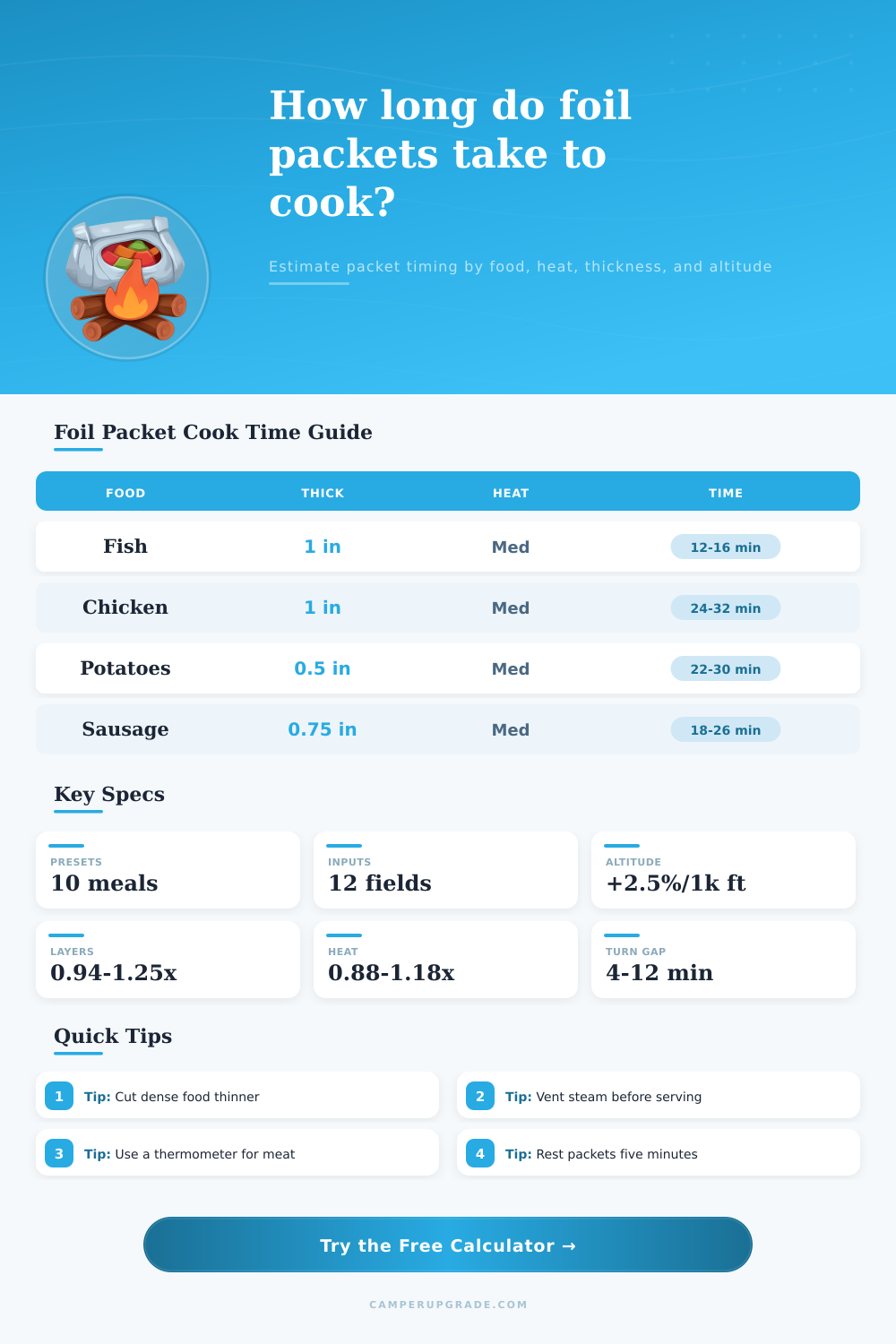
| Ingredient | Typical Thickness | Medium Heat Time | Check Point |
|---|---|---|---|
| Fish fillet | 0.75 to 1 in | 12 to 18 min | 145 F, flakes easily |
| Boneless chicken | 0.75 to 1.25 in | 24 to 35 min | 165 F center |
| Shrimp | Large shrimp | 8 to 14 min | Opaque and firm |
| Potato slices | 0.25 to 0.5 in | 22 to 32 min | Fork tender |
| Ground beef patty | 0.5 to 0.75 in | 18 to 28 min | 155 F or local target |
| Heat Source | Factor | Best Packet | Field Cue |
|---|---|---|---|
| Covered grill medium | 1.00x | Most mixed dinners | 350 to 400 F dome |
| Grill medium-high | 0.92x | Fish, sausage, peppers | 400 to 450 F dome |
| Campfire coal bed | 1.08x | Potatoes and hobo meals | Even gray coals |
| Bright coals on grate | 0.96x | Small flat packets | Hand 3 to 4 sec |
| Skillet with lid | 1.15x | Small stove packets | Steam trapped under lid |
| Packet Layer | Factor | Use Case | Watch For |
|---|---|---|---|
| Single heavy foil | 0.94x | Grill or oven fish | More browning, tears easier |
| Standard crimped foil | 1.00x | Everyday camp packet | Turn gently at seams |
| Double foil | 1.12x | Campfire coals | Longer heating lag |
| Parchment plus foil | 1.18x | Sticky fish or dessert | Less browning |
| Heavy double wrap | 1.25x | Buried or rough coals | Check tenderness late |
| Adjustment | Rule | Time Effect | Practical Move |
|---|---|---|---|
| Thickness | Each extra 0.25 in | Often +3 to 6 min | Slice potatoes thin |
| Altitude | Above 1000 ft | About +2.5% per 1000 ft | Add liquid and patience |
| Partly frozen food | Cold center | About +28% | Thaw before sealing |
| Overfilled packet | Little steam room | About +10% | Split into two packets |
| Watery vegetables | More steam mass | About +5% | Vent carefully at finish |
💡Foil Packet Tips
Foil packets are cooking vessels that use steam to cook food, and they work by sealing teh food. Food can be cooked in foil packets over coals or on a grill. However, the person must pay close attention to the timing of the foil packets when cooking with foil packets.
The timing of the foil packet depends on various variable when cooking in foil packets. These variables include the thickness of the food to be cooked, the type of food in the foil packet, the number of layer of foil in the packet, and the altitude at which people cook the foil packets. If you dont account for the variables when cooking in foil packets, the food may be undercooked or mushy when cooked in foil packets.
How to Cook with Foil Packets
The main process that occur in foil packets is heat transfer. Heat transfer occurs when steam enters the foil packet. The thicker the food is, the more longer it will take for heat to transfer from the exterior of the food to the cold center of the food.
For instance, one slice of potato is thinner than a chicken thigh, thus the potato will cook faster. Due to the various thickness of food, cooking times will vary for different type of food. A cooking time calculator will help to determine cooking times for food because it takes into account the weight and thickness of the food to be cooked.
Foil packets vary in the number of layers of foil. The number of foil layers impact the rate at which heat moves within the foil packet and the durability of the foil packet. A foil packet made from a single layer of foil will allow heat to easily transfer into the packet.
However, the foil is more likely to tear when cooked over a grate with rough coals. Using double layers of foil will allow the food in the foil packet to be protected from excessive cooking and direct heat. However, heat will take longer to transfer into the food because it has to pass through two layer of foil.
Cooking at altitude has an impact on foil packet cooking because the boiling point of water decreases at higher altitude. At higher altitudes, water will boil at a lower temperature. Thus, the steam in the foil packet has less energy.
Finally, the food within the foil packet will require more cooking time at higher altitudes. The starting temperature of the food is a variable that change the cooking time for foil packets. The starting temperature impacts cooking time because cooking takes place from the exterior of the food to the center of the food.
If the center of the food is cold, it will take more energy to cook the center of the food. For instance, if the food has a cold center because it came out of the cooler, extra minutes will be required to cook the food. If the food started at room temperature, there will be no cold center to cook.
Thus, the food will cook more quick. A cooking time calculator takes into account these starting temperatures because of the physics of heat transfer. The cooks should be turned the foil packets while cooking.
The foil packets should be turned because the side of the foil packet that is cooking will scorch while the other side of the foil packet might not be cooked yet. Many cooks will turn the foil packets every six to ten minutes during the cooking process. Additionally, the cooks can also feel the exterior of the foil packet.
If one side feels hotter than the other, the cook will flip the foil packet. Foil packets release steam when opened. Thus, it is important to take the necessary safety precautions.
When opening foil packets, tongs should be used to open the foil packet. The cook should also tilt the foil packet away from his face. Additionally, using a thermometer will allow cooks to know when the meat in the foil packet is cooked.
Using a thermometer is more accurate then using a timer to measure cooking time. The size of the vegetable cut has an impact on the cooking rate of the food in foil packets. Large pieces of dense vegetables like carrots and potatoes take longer to cook than vegetables like peppers and onions.
To ensure that vegetables cook evenly, they should be thinly slice. Finally, foil packets should not be overfilled with food. Steam will not be able to circulate properly in the foil packet if the foil packet is too full of food.
The center of the food will cook more slowly if the steam cannot reach it. To cook vegetables more efficient, the large amount of furnitures can be split into two foil packets.