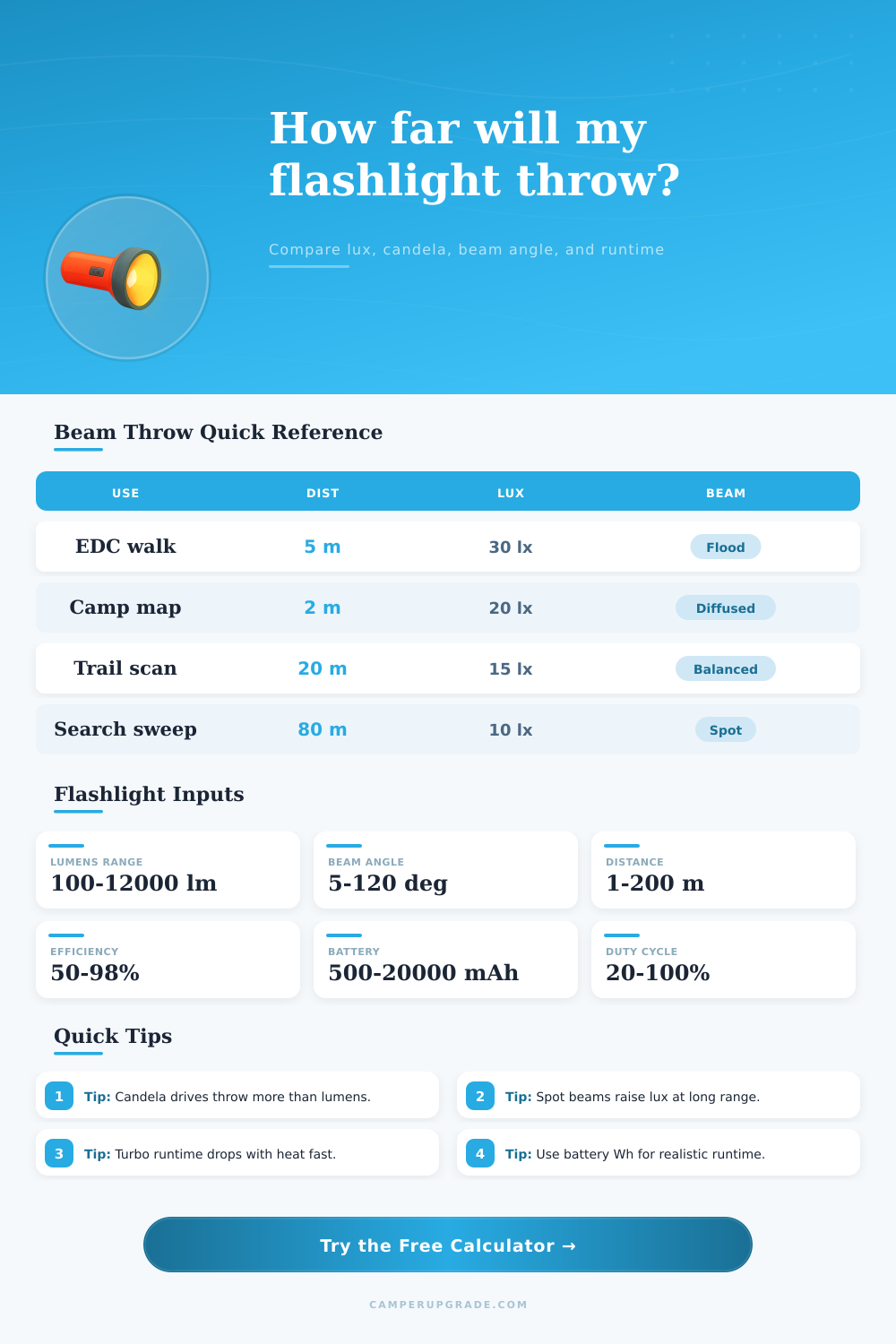
Flashlight Lumens Calculator
Estimate beam throw, center lux, and runtime from lumens, beam angle, distance, and battery details.
🔋Scenario Presets
⚙Flashlight Inputs
📊Optics Spec Grid
📘Reference Tables
| Beam Angle | Solid Angle | 1 Lux Reach | Typical Use |
|---|---|---|---|
| 8 degrees | 0.015 sr | 250 m | Long throw |
| 16 degrees | 0.061 sr | 125 m | Spot / search |
| 24 degrees | 0.138 sr | 75 m | Balanced beam |
| 40 degrees | 0.379 sr | 35 m | Flood / close |
| Task | Lux Target | Distance | Beam Note |
|---|---|---|---|
| Map reading | 15-30 lx | 1-3 m | Soft spill |
| Camp setup | 20-60 lx | 2-6 m | Wide flood |
| Trail walking | 10-25 lx | 5-20 m | Balanced |
| Search scan | 5-20 lx | 20-120 m | Tight spot |
| Battery Pack | Energy | 500 lm | 1000 lm |
|---|---|---|---|
| 14500 900 mAh | 3.3 Wh | 0.8 h | 0.4 h |
| 18650 3000 mAh | 11.1 Wh | 2.7 h | 1.3 h |
| 21700 5000 mAh | 18.5 Wh | 4.4 h | 2.2 h |
| 2x18650 pack | 22.2 Wh | 5.3 h | 2.6 h |
| Candela | 1 Lux | 0.25 Lux | Use Case |
|---|---|---|---|
| 2,500 cd | 50 m | 100 m | Indoor check |
| 10,000 cd | 100 m | 200 m | Walk / camp |
| 40,000 cd | 200 m | 400 m | Trail search |
| 160,000 cd | 400 m | 800 m | Rescue beam |
When you select a flashlight, you must understand the difference between lumens and candelas. Lumens will represent the total amount of light that a flashlight produces. The candela will represent the intensity of the light at the center of the flashlight beam.
It is possible for a flashlight to produce a high number of lumens. However, if the flashlight also produces a low candela, the light will spread out over a wide area. Because candela measure the intensity of the light, it is the most accurate value to use to determine how far the flashlight beam can travel.
How to Choose a Flashlight: Lumens, Beam, Lux and Battery
The distance that the flashlight beam can travel will depend off the beam angle of the flashlight and the intensity of it’s light. If a flashlight produce a narrow beam angle, it will emit most of its light in a narrow cone. By using a narrow beam angle, the flashlight will produce more candela.
The light will not spread out over a wide area and objects that are far away can be seen with the flashlight. A wide beam angle will spread the light out over a wide area. Using a wide beam angle will produce fewer candela value.
The farther that the flashlights beam of light travels, the less intense the light will become. Depending on what you want to see with your flashlight, you can select a beam angle. A narrow beam is good if you want to see objects that are far away.
A wide beam is good if you want to see the area around you. Lux is a measurement of the amount of light that falls on a specific surface. Lux determines how well you can see detail in the area where the flashlight beam lands.
If the lux value is high, it is easy to see details in the area. You can see the details of rocks on a walking path. With a low lux value, it is difficult to see details.
For map reading, a high lux value is needed close to the flashlight user. For walking on a trail, a medium lux value is needed over a distance of five to twenty meters. You can calculate lux values for specific tasks to determine the lux value needed for the flashlight.
A flashlight battery life and the amount of time that it will operate at set lumens and brightness levels will depend on the amount of energy stored in the flashlight battery. Brightness levels and lumens use alot of energy from the battery. The battery will drain quick when using high brightness settings.
Efficacy is a flashlight’s lumens divided by the wattage of the flashlight. Higher efficacy means the flashlight will run longer. Most flashlights has a turbo mode to allow high lumens output.
However, most flashlights will have a step-down mode in which the brightness of the flashlight decrease, and the flashlight will turn off the high brightness settings if it becomes too hot. This is to avoid overheating the flashlight. Instead of the milliamp-hours that are usually listed for flashlight batteries, the watt-hours will better describe the flashlights true battery capacity.
Because light can be lost as it passes through the lenses of a flashlight, the optical efficiency can affect the light output of the flashlight. The reflectors and lenses that direct the light from the flashlight diode can be inefficient. Most flashlights will lose some of the light to inefficiencies of the lenses.
The efficacy of the optics that the flashlight uses to direct its beam of light, as well as the thermal limits of that flashlight, determines the performance of a flashlight. If the flashlight is running at the maximum brightness level, it will begin to produce heat. The heat will make the light from the flashlight diode drop in strength.
Many flashlights use presets. If you are walking your dog, you can use the preset that gives the flashlight a moderate lumen output and beam angle to provide enough lux to show you the path that you are walking on. If you are exploring a cave, a narrow beam angle preset will give the flashlight a higher candela value to increase the distance that the flashlight beam travels.
Presets use reference tables to help humans determine what brightness, beam angle, and distance values are programmed into the flashlight to provide a specific lux level at a distance. Additionally, many flashlights have run-time grids that allow the flashlight user to match flashlight batteries to brightness levels. By using these different measurements of flashlight performance, humans wouldnt make any mistake when purchasing a flashlight.