First Aid Kit Weight by Group Size Calculator
Estimate carried medical kit weight from group size, trip length, terrain, remoteness, kit level, and specific add-on modules.
Real Trip Presets
Trip Inputs
Specific Modules
Results
Formula Breakdown
Material and Spec Grid
Reference Table: Core Kit Levels
| Kit level | Core weight | Per-person base | Best use |
|---|---|---|---|
| Minimal ultralight | 4.5 oz | 0.7 oz | Short low-risk hikes with fast exit |
| Standard backpacking | 7.5 oz | 1.15 oz | Weekend trail groups and camp trips |
| Expanded group kit | 11.5 oz | 1.75 oz | Families, youth groups, and RV base camps |
| Wilderness leader kit | 16.0 oz | 2.4 oz | Remote trips where evacuation takes longer |
Reference Table: Trip Risk Multipliers
| Factor | Low | Medium | High or remote |
|---|---|---|---|
| Terrain | 1.00 campground | 1.12 rocky trail | 1.30 off-trail or water |
| Help distance | 1.00 under 1 hr | 1.10 near backcountry | 1.35 expedition |
| Trip type | 0.92 day hike | 1.00 camp | 1.18 winter or paddling |
| Reserve | 0% | 10% | 20% |
Reference Table: Group Size Starting Points
| Group and trip | Person-days | Typical kit | Planning weight |
|---|---|---|---|
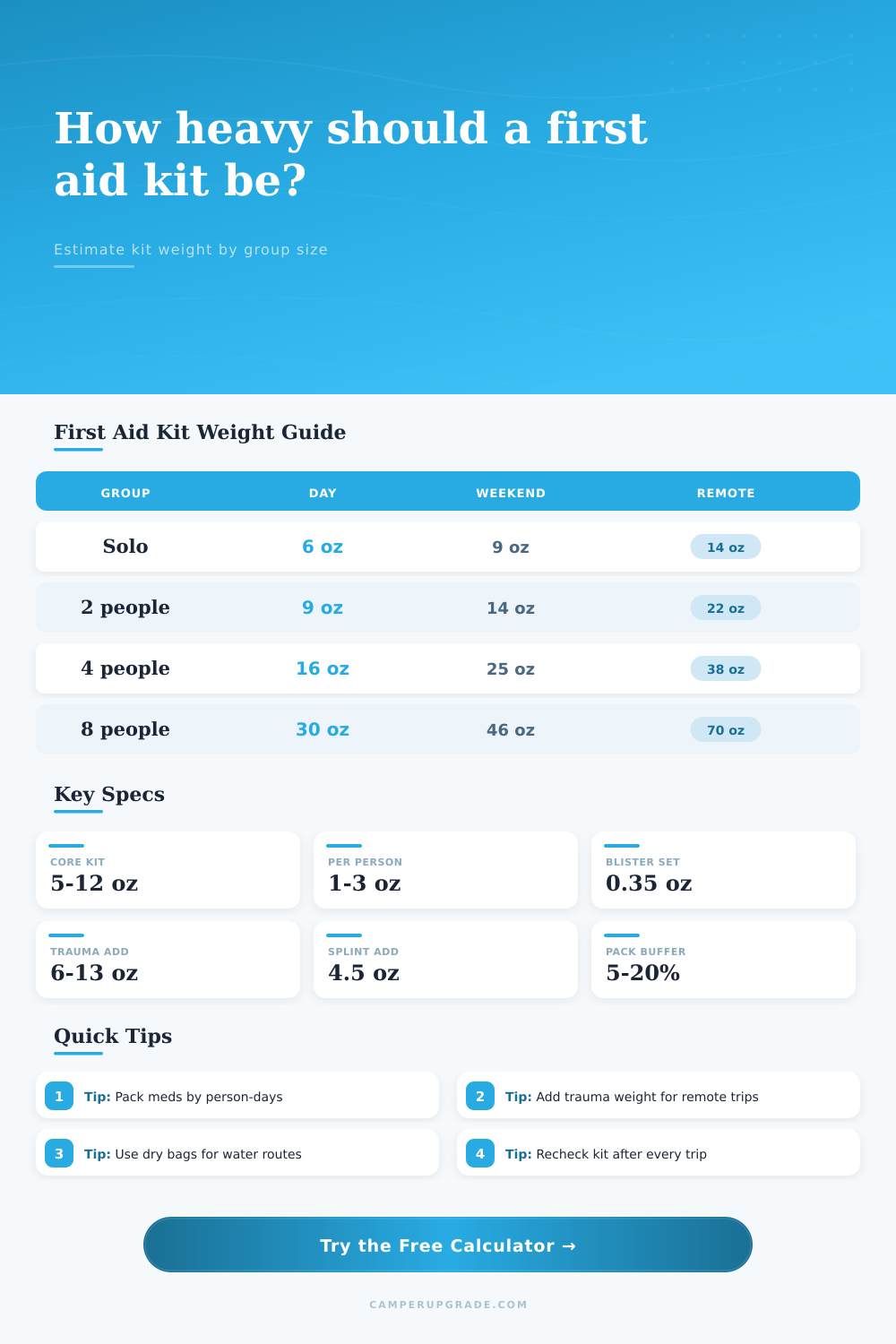
| Solo day hike | 1 | Minimal pouch | 6 to 10 oz |
| Two-person weekend | 4 | Standard pouch | 12 to 20 oz |
| Four-person camp | 12 | Standard or expanded | 22 to 36 oz |
| Eight-person remote | 24 | Wilderness leader kit | 55 to 80 oz |
Reference Table: Packaging Weight
| Packaging | Weight | Protection | Best fit |
|---|---|---|---|
| Zip pouch | 1.2 oz | Low water resistance | Day hikes and ultralight packs |
| Roll-top organizer | 2.4 oz | Good compartment access | Backpacking and car camping |
| Dry bag | 3.0 oz | Strong wet-route protection | Paddling, rain, river camps |
| Hard case | 7.5 oz | Crush protection | RV, boat, and base camp storage |
Field Tips
When you’ve sent your group off with no med supplies you know what happens; it’s a certain kind of panic. It is the kind where everyone argue over snacks while someone else go hunting for bandages. And there is more than leaving things behind to worry about. Weight control are pretending to be preparedness. Is your first aid kit so light that it won’t help if someone get hurt? Is it so heavy that it slow you down on the long haul? You need protection but without paying the price of hauling excess pounds up a mountain.
Enter the first aid kit calculator (above) to do the math for you based off the details of your trip and group size. No need to guess at coefficients. Antiseptic wipes, bandages… those thing come first in most minds. And sure, that stuff matters. But it’s light. It’s the other stuff, the “trip out” stuff that pack weight.
How to Pack the Right First Aid Kit
If you’re hiking for three days, you need enough supplies. Add another person? You don’t increase the size of the kit in direct proportion to how many people you add. Instead, you’re sharing resource. So if you have four hikers, then yeah, you want a better stocked kit than a single hiker but you don’t need four times the amount. That’s where the tool accounts for scaling effect so that you don’t wind up lugging around medical station that takes up all your pack space. It figures out how to balance what each individual need versus what we can share, which is why most folks get it wrong. Either they go too heavy assuming everyone needs their own complete set of trauma gear, or they go too light assuming that one kit will cover everything.
The terrain is also a factor (more so than anticipated). A flat gravel road in a campground will only require basic gear. In contrast, rocky ridges or loose scree will cut into your flesh if you slip which requires more heavy gear. That’s why the calculator factors in remoteness and terrain risk. You don’t want to be stranded for 12-hours without medical help after you’ve slipped and broken something. So, you’ll have to carry heavier gear such as pressure dressings or traction splints that can holds wounds open until emergency services arrive. And yes, those thing add ounces. But when somebody falls and breaks their arm, it’s all worth it: Gravity doesn’t wait and neither does blood.
The total weight includes packaging, too, which sneaks up on you as you try to calculate how much to carry. Ziplock bags are lightweight…until water gets in there and ruins your pain killers. Hard plastic cases keep things out of harm’s way (i.e., crushing and moisture) but weigh almost a pound themself. Typically, you want something in-between for backpacking: a dry bag or a roll-top organizer. With the calculator, you can specify what type of container you have and final number will take that into account. Small details matter; after all, you may be able to shave off an ounce with lighter gauze, but if you pick a heavier box then you’ll add two!
They figure meds and blisters by person-day. That’s wise since you can stretch out pain killers as needed (so long as you don’t run out). But they can runs out. There are 12 person-days of medicine rations in the example above because there are four hikers on a three-day hike. The tool will help you visualize how much you’re going through and how much to bring, so you have enough pills but don’t carry a pharmacy. It calculates it in terms of total weight vs. What is consumable vs. What is base equipment. So it can tell you what to swap out afterwards or what you’d need to leave behind next time. With wipes and tape, you swap those out. But with the gloves and shears, you should of saved those for next time.
There is no such thing as a perfect kit, since each day’s possibilities present their own hazards. A winter trip will demand warmer gear than say, a river paddle. A winter trip needs warmth-focused items like emergency blankets in the medical pouch, while a river paddle requires waterproof storage. A river paddle requires waterproof storage and specific wound care for boat cuts. The calculator provides a starting point; you fill in the blanks with judgement. It will help you determine how much weight you can realistically carry.
Is that weight too much? Then shave off the unnecessities. Is that weight too little? What do you think you’d need if someone were to break an ankle two hours off the trail head? A good kit is one you’re comfortabley leaving alone, but you are happy to open it. Let it sit quietly in your pack until you need it most.