Firewood Stack Volume Calculator
Estimate stacked cubic feet, full cords, selected cord units, usable solid wood, moisture-adjusted weight, and burn hours from stack size, log length, void factor, split size, species density, and burn rate.
Firewood stack estimate
| Species | Dry lb per cord | Air-dry lb at 20% | Relative burn note |
|---|---|---|---|
| Hickory | 4,100 lb | 4,920 lb | Very dense, long coal bed |
| White oak | 3,850 lb | 4,620 lb | Dense hardwood, long steady heat |
| Red oak | 3,650 lb | 4,380 lb | Good long-burn hardwood |
| Hard maple | 3,500 lb | 4,200 lb | Strong heat and predictable coals |
| Ash | 3,250 lb | 3,900 lb | Moderate hardwood, easy handling |
| Cherry | 2,900 lb | 3,480 lb | Medium heat, steady flame |
| Douglas fir | 2,650 lb | 3,180 lb | Softwood with good shoulder-season heat |
| Pine | 2,250 lb | 2,700 lb | Fast flame and shorter coal time |
| Unit name | Stack dimensions | Stack volume | Full cord equivalent |
|---|---|---|---|
| Full cord | 8 ft x 4 ft x 4 ft | 128 cu ft | 1.00 cord |
| Half cord | 8 ft x 4 ft x 2 ft | 64 cu ft | 0.50 cord |
| Quarter cord | 8 ft x 4 ft x 1 ft | 32 cu ft | 0.25 cord |
| Face cord, 16 in | 8 ft x 4 ft x 16 in | 42.7 cu ft | 0.33 cord |
| Face cord, 18 in | 8 ft x 4 ft x 18 in | 48.0 cu ft | 0.38 cord |
| Face cord, 24 in | 8 ft x 4 ft x 24 in | 64.0 cu ft | 0.50 cord |
| Split size | Typical void factor | Solid wood share | Use when |
|---|---|---|---|
| Kindling and small splits | 28-34% | 66-72% | Tight stove wood, short pieces, careful stacking |
| Small stove splits | 30-36% | 64-70% | Neat racks with regular pieces |
| Medium hand-stacked splits | 34-40% | 60-66% | Most camp and home firewood stacks |
| Large rough splits | 40-48% | 52-60% | Rough processing, mixed shapes, looser rows |
| Rounds and knotty pieces | 45-55% | 45-55% | Unsplittable rounds and irregular pile rows |
| Burn setting | Stack cu ft per hour | Best use | What to adjust |
|---|---|---|---|
| Low stove cruise | 0.20-0.40 | Small wood stove at low air setting | Use dense hardwood and dry splits |
| Cabin stove active | 0.40-0.70 | Regular heating with reloads | Set burn rate near 0.55 |
| Campfire moderate | 0.60-1.00 | Cooking, sitting, and shoulder-season fire | Raise for softwood and wind |
| Large campfire | 1.00-1.75 | Group fire or colder evening | Plan extra if wood is wet |
| Bonfire or warming fire | 1.75-3.00 | High flame and frequent feeding | Use as a short-event estimate |
| Stack example | Dimensions | Stack volume | Approx full cords |
|---|---|---|---|
| Camp bundle stack | 2 ft x 1.5 ft x 1.33 ft | 4.0 cu ft | 0.03 cord |
| Small porch rack | 4 ft x 4 ft x 1.33 ft | 21.3 cu ft | 0.17 cord |
| Half face cord | 4 ft x 4 ft x 1.33 ft | 21.3 cu ft | 0.17 cord |
| Face cord, 16 in | 8 ft x 4 ft x 1.33 ft | 42.7 cu ft | 0.33 cord |
| Face cord, 24 in | 8 ft x 4 ft x 2 ft | 64.0 cu ft | 0.50 cord |
| Full cord row | 8 ft x 4 ft x 4 ft | 128.0 cu ft | 1.00 cord |
A firewood stack volume calculator are a tool that can calculate the amounts of usable firewood that a firewood stack contains. Although the firewood stack might look large, the firewood contains gap in which air is stored. The calculator can take your three measurements of the firewood and show the total amount of firewood that will last for you.
First, you must enter the length, height, and depth of the firewood. These three measurement provide the volume of the firewood, but not the volume of the solid wood. You must enter a void factor for the firewood to adjust for the volume taken up by the air between the pieces of firewood.
How to Use a Firewood Stack Volume Calculator
A neat stack of firewood might have thirty-five percent air in it, but a less organized pile of firewood might have fifty percent air. This factor change the amount of firewood that can be burned, so it is important in determining whether the firewood is considered to be large or small in volume. Next, you must enter the length of the logs into the calculator.
This change the unit of measurement for the firewood. For example, if you bought face cords of firewood, the length of the firewood logs will change the volume of a face cord. Sixteen-inch long logs will have a different volume than twenty-four inch long logs.
By entering the length of the logs in the firewood stack volume calculator, it can show the volume of firewood in the same units that you purchased the firewood in. The user can select the species of the firewood in the firewood calculator. While this does change the weight of the firewood and the amount of energy it will produce when burned, it does not change the volume.
For example, hardwoods like hickory and white oak are much more denser than softwoods like pine or cedar. The firewood calculator can use these differences in density to calculate the moisture-adjusted weight of the firewood. Additionally, firewood calculators will also scale the energy of the firewood to reflect the moisture content of the firewood.
If the moisture content is above twenty percent, the calculator will scale the usable energy down. Wet firewood will weigh more due to the water content in the logs, but it will contain less energy due to the amount of energy required to boil the water away from the firewood. Another field in the firewood calculator is the burn rate field.
Although it might be overlooked when using the firewood calculator, the burn rate of the firewood is used to calculate how many hour the firewood will last when burned in the fire. For instance, a campfire will burn at a much faster rate than a stove set to a low setting. By entering the burn rate in the firewood calculator, it will provide an estimated number of hours that the firewood will last.
This is a crucial number in planning for how long the firewood will last. The void factor and split size work together in the firewood calculator. If the splits of the firewood are small, they can be stacked in such a way that there is little void in the firewood.
The same is true of large splits of firewood; they will create void in the firewood. The firewood calculator provides a percentage of void for each split size. You can adjust this percentage up or down to account for the void in your firewood stack.
A loose and large split firewood will have less solid firewood than a tight and small split firewood. The moisture content of the firewood can be entered into the calculator. This impacts both the weight and energy of the firewood.
Seasoned firewood will have a moisture content of fifteen to twenty percent. If the firewood has a moisture content above twenty percent, the firewood will register a higher weight on the calculator. However, the firewood calculator will scale down the energy content of the firewood.
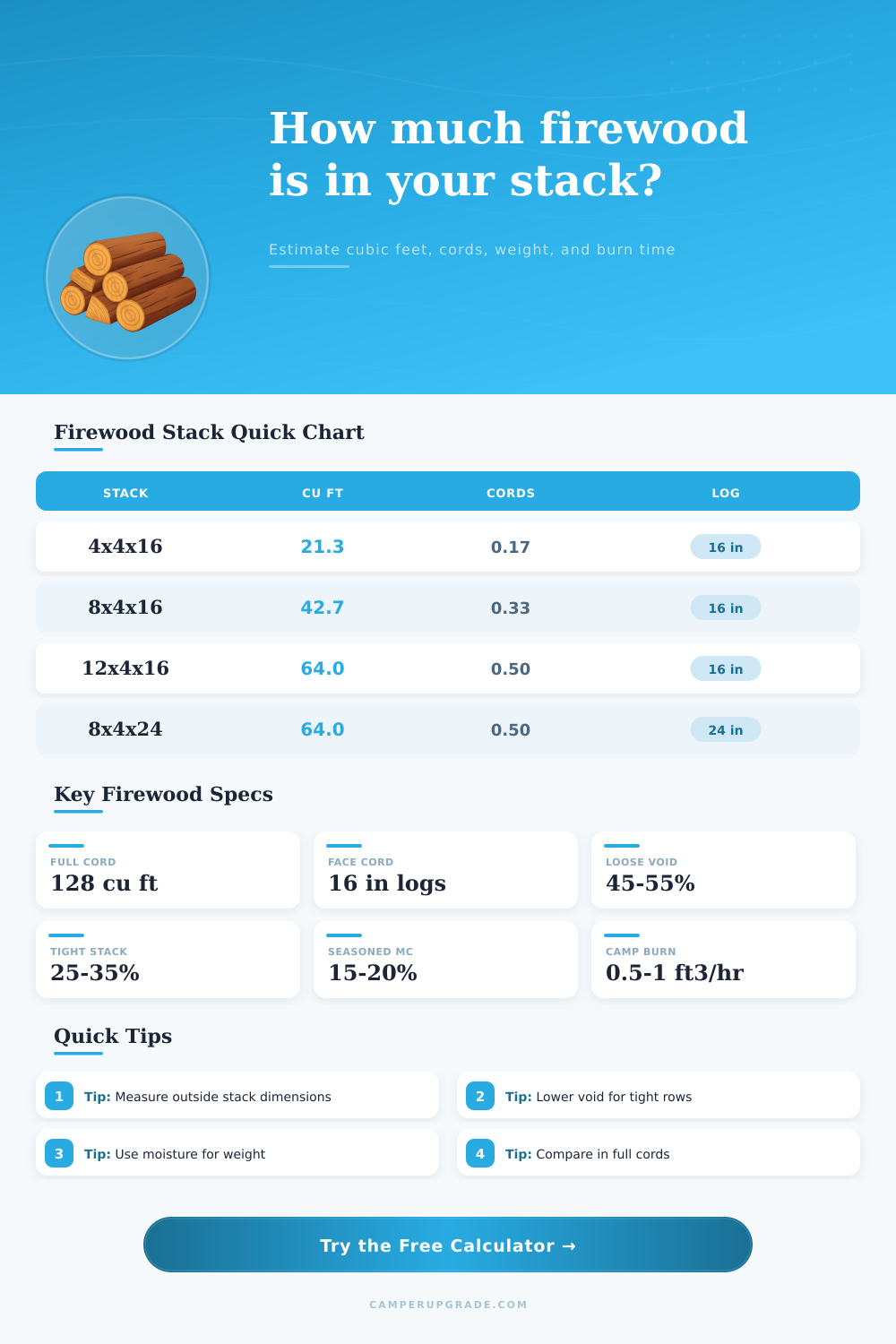
The extra moisture will require additional energy to boil away from the firewood as it burns. A reference table can be used to compare firewood units of measure. For example, the unit of a full cord is always one hundred twenty-eight cubic feet of firewood when measured when stacked.
A face cord will change based on the length of the logs. An eight-by-four-by-sixteen inch face cord is one-third of a full cord, but an eight-by-four-by-twenty-four inch face cord is half of a full cord. This table can help to avoid mistakes in treating all face cords of firewood as being the same size and volume.
A burn rate planning table is available to the user that intends to match the wood consumption rate to the heating situation. For example, if the firewood will be burned on a stove set to a low setting, it will use less wood per hour than burning it in a campfire. The burn rate planning table provides ranges of how much firewood will be consumed per hour in different fire settings.
This table can help to determine the burn rate that should be entered into the calculator. The burn rate will have a great effect on how much firewood will be needed to provide heat for a certain length of time, such as the number of evenings in the upcoming season. The firewood calculator may also contain preset measurements for common firewood stack units.
For example, a small porch rack or half face cord may be preselected with the dimensions already entered in the calculator. The calculator can use these measurements to determine the volume of firewood in a firewood stack that is common in a residential home. The accuracy of the firewood calculator depends on the information provided to it.
For instance, the outside measurements of a firewood stack will be higher if the firewood is not even in the firewood stack. To even out these measurements, average the height of the firewood in the firewood stack and measure the depth of the actual firewood. Additionally, ensure that the values provided for the void factor and the moisture content are honest and accurate.
The more accurate the provided measurements are, the more accurate the measurements that are provided by the firewood calculator. Therefore, by measuring your firewood, you are beginning to treat the firewood as a measurable resource in your home.